

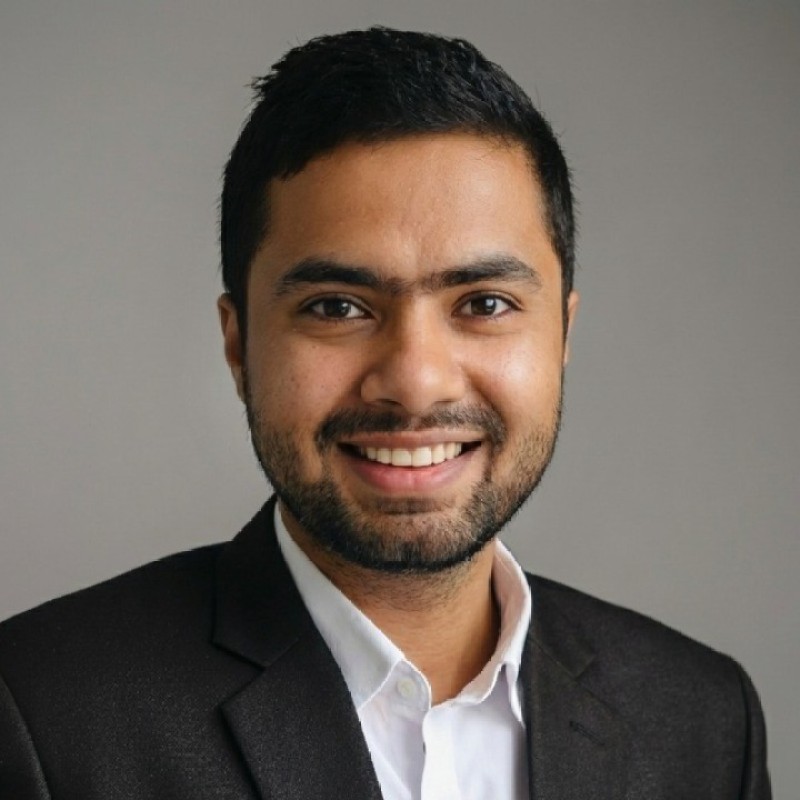
 Surendrabikram Thapa
· 6 previous affiliations
- Virginia TechSince 2021
- Principal Researcher · Since 2024
- Research Faculty Member · Since 2023
- Researcher · 2023–2024
- Master of Science - MS (Thesis), Computer Science · 2021–2023
- Graduate Certificate in Data Analytics, Data Processing and Data Processing Technology/Technician · 2021–2022
- ML Initiative2021–2026
- Co-Founder · 2021–2026
- Graduate Research Assistant · 2021–2023
- University of Technology Sydney2019–2021
- Research Assistant (Remote) · 2019–2021
- Visiting Scholar · 2019–2020
- Delhi Technological University2017–2021
- Undergrad student · 2017–2021
- Intern · 2019
Research Overview
Surendrabikram Thapa focuses on natural language processing for social media analysis, medical informatics, and remote physiological sensing. His early work addressed clinical diagnostics and multimodal hate speech detection, particularly in low-resource languages like Nepali. Recently, his research has expanded to evaluate the reasoning consistency of large language models and extract cardiovascular signals from unconstrained video.
Research Trajectory
Thapa’s early research applied machine learning and natural language processing to clinical diagnostics, with a specific focus on neurodegenerative disorders. In 2020, he explored early diagnosis methods for Alzheimer's disease, developing a Data-Driven Approach based on Feature Selection Technique for Early Diagnosis of Alzheimer's Disease. Concurrently, he investigated the use of linguistic features for clinical screening, introducing a framework for Detecting Alzheimer's Disease by Exploiting Linguistic Information from Nepali Transcript.
Following this clinical work, his focus shifted toward computational social science, particularly the moderation of online discourse and mental health surveillance. He led the creation of A Multi-Modal Dataset for Hate Speech Detection on Social Media: Case-study of Russia-Ukraine Conflict, which provided a foundation for analyzing text-embedded images used to spread propaganda. He expanded on this multimodal analysis in CrisisHateMM: Multimodal Analysis of Directed and Undirected Hate Speech in Text-Embedded Images from Russia-Ukraine Conflict, contributing to the fine-grained categorization of hate speech targets into individual, community, and organizational levels. This line of inquiry culminated in his organization of a shared task on Multimodal Hate Speech Event Detection, which challenged participants to identify both the presence and specific targets of toxic content in images. Recognizing the lack of resources for analyzing online discourse in his native linguistic context, he also introduced NEHATE: Large-Scale Annotated Data Shedding Light on Hate Speech in Nepali Local Election Discourse. Alongside his work on toxic speech, he contributed to automated mental health monitoring by Incorporating historical information by disentangling hidden representations for mental health surveillance on social media, proposing methods to capture the dynamic temporal patterns of users' historical posts rather than treating all past intervals equally.
In 2023, Thapa also engaged with biomedical natural language processing and data privacy. He collaborated on methods for Reducing Knowledge Noise for Improved Semantic Analysis in Biomedical Natural Language Processing Applications, integrating external knowledge graphs via nearest neighbor and graph neural network approaches to improve relation extraction. This graph-based methodology was similarly applied to MDKG: Graph-Based Medical Knowledge-Guided Dialogue Generation. In the domain of computer vision and transportation research, he addressed the challenge of sharing sensitive data by developing a framework for the GAN-based Deidentification of Drivers' Face Videos: An Assessment of Human Factors Implications in NDS Data. This system swaps faces to protect privacy while preserving essential behavioral cues like head and eye movements necessary for safety research.
This engagement with facial video analysis transitioned into a significant body of work within the research direction of Mitigating Motion and Lighting Artifacts in Remote Photoplethysmography. Rather than merely estimating average vital signs like heart rate, Thapa and his collaborators tackled the more complex problem of recovering the precise instantaneous shape morphology of blood volume pulse (BVP) signals. They proposed a Camera-based Recovery of Cardiovascular Signals from Unconstrained Face Videos using an Attention Network, a project that intersected with broader efforts in the area of Scaling Convolutional Receptive Fields for Sequence Modeling and the field of Isolating Skin Pixels for Robust Facial Analysis. Building on this, they introduced A Temporal Encoder-Decoder Approach to Extracting Blood Volume Pulse Signal Morphology from Face Videos, which adapted architectures originally designed for audio signal separation to process spatial averages of facial RGB values. This methodology, which was further detailed in a subsequent workshop presentation, advanced the broader field of Demographically Robust Remote Physiological Monitoring and utilized techniques related to the direction of Hybrid Time-Frequency Loss Optimization.
Most recently, in 2025, Thapa has returned to complex natural language processing challenges. He collaborated on BEAST: Leveraging Contrastive Learning and Unsupervised Sentence Embeddings for Improved Drug Abuse Detection, which addresses the difficulty of identifying drug abuse references hidden within figurative language and sarcasm on social media. He also co-developed a comprehensive evaluation framework for large language models, Measuring What Matters: Probing Transit Reasoning Consistency in Large Language Models, which assesses how models adapt and maintain narrative coherence under domain-specific constraints.
Current Directions
The most recent papers in the evidence indicate a dual focus on the robustness of large language models and the nuanced analysis of informal digital text. Recent work investigates the reasoning consistency of language models when subjected to domain-specific constraints, moving beyond standard accuracy metrics to probe in-context learning and multi-step reasoning through perturbation chains and cross-modal anchoring. In parallel, ongoing research addresses public health surveillance on social media, specifically developing contrastive learning techniques to decode figurative language, sarcasm, and informal speech for the detection of drug abuse trends.
Profile updated
| Paper | Venue | Year |
|---|---|---|
| A Temporal Encoder-Decoder Approach to Extracting Blood Volume Pulse Signal Morphology from Face VideosGitHubAdleof/ | 6th International Workshop on Computer Vision for Physiological Measurement (cvpm) | 2024 |
| A Multi-Modal Dataset for Hate Speech Detection on Social Media: Case-study of Russia-Ukraine ConflictGitHubtherealthapa/ | EMNLP | 2022 |
Loading new papers…
Other researchers whose papers cluster into the same research directions — a proxy for overlapping technical interests and shared intellectual neighborhoods.
See something wrong? Report a mistake