

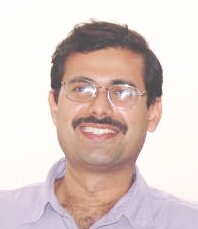
 Supratik Chakraborty
· 5 previous affiliations
- Indian Institute of Technology BombaySince 1999
- Bajaj Group Chair Professor · Since 2014
- Full Professor · Since 2012
- Associate Professor · 2005–2012
- Assistant Professor · 1999–2005
- Fujitsu Laboratories of America (FLA)1998–1999
- Member of Research Staff · 1998–1999
- Fujitsu Laboratories of America1998–1999
- Member of Research Staff · 1998–1999
- Stanford University1993–1998
- M.S. and Ph.D., Electrical Engineering (Computer Systems) · 1993–1998
- B. Tech. (Honours), Computer Science and Engineering · 1989–1993
Research Overview
Supratik Chakraborty focuses on formal verification, approximate model counting, and automated synthesis. His trajectory spans foundational algorithms for scalable Boolean satisfiability counting to inductive reasoning techniques for array-manipulating programs. Most recently, his work addresses auditable algorithms for model counting and approximate quantifier elimination in non-linear real arithmetic.
Research Trajectory
Chakraborty's early work in the corpus addresses the computational challenges of propositional model counting (#SAT) and uniform witness generation. In 2013, he introduced A Scalable and Nearly Uniform Generator of SAT Witnesses, providing a method for generating near-uniformly distributed test stimuli for large constraint sets. This addressed a critical bottleneck in directed random testing for simulation-based hardware verification. Concurrently, he developed A Scalable Approximate Model Counter, which advanced the practical implementation of approximate model counting for CNF formulas by providing solutions within given tolerance and confidence levels. This foundational work aligns with his long-term contributions to the research direction of Scaling Model Counting via Universal Hashing, an area where universal hashing is leveraged to provide rigorous approximation guarantees.
Around 2017, his focus expanded to include formal verification of programs and SMT solving heuristics. He presented Matching Multiplications in Bit-Vector Formulas, proposing a pre-processing heuristic to identify decomposed multipliers and encode the equivalence of sub-terms, thereby improving SMT solver efficiency when reasoning about word-level arithmetic operations. In the domain of software verification, he initiated a series of works on array-manipulating programs. This began with Verifying Array Manipulating Programs by Tiling (2017), which inferred array access patterns to compositionally prove quantified assertions by reducing the problem to an inductive argument over a slice of the assertion. He subsequently refined these verification techniques, introducing Verifying Array Manipulating Programs with Full-Program Induction in 2020 to induct over the entire program via a parametric size variable rather than relying on loop-specific invariants. This line of inquiry culminated in Diffy: Inductive Reasoning of Array Programs Using Difference Invariants (2021), which utilized difference relations between the control-flow graphs of two program versions to prove post-conditions.
Alongside program verification, Chakraborty continued to investigate the theoretical limits of counting and synthesis. In 2019, he published On the Hardness of Probabilistic Inference Relaxations, demonstrating that several relaxations used in probabilistic inference and model counting do not actually yield computational efficiency in a complexity-theoretic sense. His comprehensive perspective on counting was later formalized in a 2021 handbook chapter, Approximate Model Counting, detailing universal-hashing paradigms that piggyback on advances in SAT solving. Transitioning into automated synthesis, he guided research on A Normal Form Characterization for Efficient Boolean Skolem Function Synthesis (2021), addressing the dichotomy between theoretical hardness and practical efficacy in Boolean functional synthesis. This naturally extended to first-order logic in On Synthesizing Computable Skolem Functions for First Order Logic (2022), where he characterized the nuanced computability landscape of Skolem functions and provided algorithms for their synthesis. This work contributes directly to the broader area of Scaling Reactive Synthesis for Complex System Design.
In 2024, Chakraborty's research returned to advanced counting and quantifier elimination. He participated in developing Auditable Algorithms for Approximate Model Counting, addressing the need for deterministic counters that generate verifiable certificates for users with limited computational power. He also explored counting in new paradigms, co-authoring Exact ASP Counting with Compact Encodings to tackle model counting within Answer Set Programming. Furthermore, he contributed to Practical Approximate Quantifier Elimination for Non-linear Real Arithmetic, introducing an efficient approximation method that combines adaptive dynamic gridding with Handelman’s Theorem to solve non-linear constraints via a sequence of linear arithmetic constraints.
Current Directions
The most recent papers in the evidence indicate a focus on expanding the reliability and applicability of automated reasoning tools. Recent work investigates the generation of verifiable certificates for approximate model counters, ensuring that deterministic counting algorithms can be audited by users with limited computational resources. Additionally, Chakraborty is exploring exact model counting within Answer Set Programming (ASP) and developing practical, approximate quantifier elimination techniques for non-linear real arithmetic. These directions collectively emphasize bridging the gap between theoretically hard combinatorial problems and the need for efficient, trustworthy solvers in complex logical domains.
Profile updated
Loading new papers…
Other researchers whose papers cluster into the same research directions — a proxy for overlapping technical interests and shared intellectual neighborhoods.
See something wrong? Report a mistake