

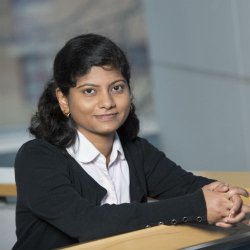
 Suparna De
· 6 previous affiliations
- University College LondonSince 2021
- Honorary Senior Research Fellow · Since 2021
- University of SurreySince 2021
- Senior Lecturer · Since 2025
- Assistant Professor · 2021–2025
- Postdoc · 2017–2019
- PhD student · 2005–2009
- Universidad de GranadaSince 2024
- Visiting Lecturer · Since 2024
- Economic and Social Research Council2021–2022
- Co-Principal Investigator: Automating capturing structured content from questionnaires · 2021–2022
- University of Winchester2019–2021
- Senior Lecturer · 2020–2021
- Assistant Professor · 2019–2020
- St. Stephen's College
- B.Sc(H) Physics
Research Overview
Suparna De focuses on the Internet of Things, urban computing, and natural language processing. Her early research established semantic modeling and search techniques for connected physical devices, which naturally evolved into mining spatio-temporal patterns from smart city data. Most recently, she investigates zero-shot learning and the integration of external knowledge resources to improve text classification and natural language inference.
Research Trajectory
De’s early work concentrated on the foundational architecture and semantic interoperability of the Internet of Things (IoT). Recognizing the need to integrate heterogeneous physical objects into the digital world, she presented a structured approach to provisioning real-world services in Service Modelling for Internet of Things (2011). Building on this need for machine-processable frameworks, she helped design an ontology to facilitate context-aware business services in A Comprehensive Ontology for Knowledge Representation in the Internet of Things (2012) and detailed a supporting architecture in An Internet of Things Platform for Real-World and Digital Objects (2012). As the scale of deployed sensors grew, she collaborated on techniques for prioritizing semantically equivalent devices in A ranking method for sensor services based on estimation of service access cost (2015). To address the broader challenge of discovering relevant data across distributed sources, she co-authored a taxonomy of discovery mechanisms in Search Techniques for the Web of Things: A Taxonomy and Survey (2016).
As IoT deployments matured into city-wide networks, De’s research shifted toward urban computing and the analysis of massive datasets generated by smart city environments. She contributed to a broad review of computational intelligence applications in A Survey on an Emerging Area: Deep Learning for Smart City Data (2019). Applying these data mining principles directly, she analyzed diverse sensor streams to derive spatio-temporal dynamics in London's environment in Inferring Latent Patterns in Air Quality from Urban Big Data (2021). She expanded this focus on urban dynamics to human behavior, applying matrix factorization and tensor decomposition to Foursquare check-ins in Mining Composite Spatio-Temporal Lifestyle Patterns from Geotagged Social Data (2022), and investigating mobility trends in Usage Mining of the London Santander Bike-Sharing System (2022). Concurrently, she explored the industrial applications of advanced machine learning, surveying the use of deep generative models to handle the stringent safety and low-latency requirements of manufacturing environments in Deep Generative Models in the Industrial Internet of Things: A Survey (2022).
In recent years, De’s research has increasingly focused on natural language understanding, specifically addressing the challenges of zero-shot learning and the integration of external knowledge into pre-trained language models. She oversaw the development of new methods for entailment-based text classification in Generalised Zero-shot Learning for Entailment-based Text Classification with External Knowledge (2022). To overcome the biases and limitations of traditional verbalizers in low-resource scenarios, her group introduced prompt-based approaches that leverage conceptual knowledge in Prompt-based Zero-shot Text Classification with Conceptual Knowledge (2023). She also participated in a comprehensive review of these methodologies in Fusing external knowledge resources for natural language understanding techniques: A survey (2023). Pushing the boundaries of data scarcity, she directed research into extreme classification scenarios where no labeled data is available, utilizing knowledge resources to handle entirely unseen topics in Zero-shot text classification with knowledge resources under label-fully-unseen setting (2024). Most recently, she led a team at SemEval-2024, presenting a novel data augmentation technique that combines generative models and biomedical knowledge to improve the robustness of natural language inference for clinical trials in DKE-Research at SemEval-2024 Task 2: Incorporating Data Augmentation with Generative Models and Biomedical Knowledge to Enhance Inference Robustness (2024).
Current Directions
The most recent papers in the evidence indicate a primary focus on natural language processing, particularly in low-resource and zero-shot settings. Recent work investigates how external knowledge resources—ranging from general conceptual knowledge to domain-specific biomedical vocabularies—can be integrated into pre-trained language models to improve text classification and inference. This includes developing prompt-based methods that bypass traditional verbalizer biases and addressing extreme classification scenarios where labels are entirely unseen during training. Additionally, her recent projects explore data augmentation techniques using generative models to reduce shortcut learning and enhance the robustness of natural language inference for specialized, high-stakes domains such as clinical trial reports.
Profile updated
Loading new papers…
Other researchers whose papers cluster into the same research directions — a proxy for overlapping technical interests and shared intellectual neighborhoods.
See something wrong? Report a mistake