

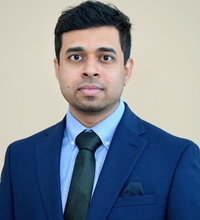
 Sumon Biswas
· 2 previous affiliations
- Case Western Reserve UniversitySince 2024
- Assistant Professor · Since 2024
- Carnegie Mellon University2022–2024
- Postdoc · 2022–2024
Research Overview
Sumon Biswas focuses on the development of reinforcement learning frameworks and architectural strategies designed to enhance the reasoning and code generation capabilities of large language models (LLMs). His research addresses the inherent limitations of autoregressive, token-level generation by integrating high-level planning and multi-agent coordination into the model training and inference processes. By shifting the focus from local token prediction to global strategic planning, his work seeks to improve model performance in complex domains such as mathematics, science, and software engineering.
Research Trajectory
The available evidence indicates a research program centered on the transition from local, heuristic-based reasoning to structured, global planning within LLMs. This trajectory is characterized by a move away from standard chain-of-thought (CoT) approaches, which often suffer from redundancy or logical drift, toward methods that enforce a "plan-then-execute" paradigm. Biswas’s work is primarily situated at the intersection of reinforcement learning (RL) and natural language processing, specifically investigating how specialized reward structures can incentivize models to maintain a "big picture" strategy during complex problem-solving tasks.
A significant component of this trajectory involves the optimization of computational efficiency. While external search algorithms (such as tree-based searches) can improve reasoning, they often incur prohibitive compute costs. Biswas’s research explores internalizing these strategic capabilities within the model’s policy through reinforcement learning, thereby achieving high-level reasoning performance without the need for heavy external search infrastructure.
Current Directions
Biswas’s current work emphasizes the specialization of LLM agents within collaborative frameworks. This direction addresses the limitations of monolithic model architectures by distributing complex tasks—such as algorithm design and code implementation—across multiple specialized agents. By utilizing collaborative reinforcement learning, this research seeks to improve the global coherence and correctness of generated code, ensuring that solutions meet both functional requirements and complexity constraints.
Furthermore, his research continues to refine the use of Group Relative Policy Optimization (GRPO) to guide LLM reasoning. This involves the design of frameworks that specifically reward the quality of intermediate planning steps, ensuring that the model’s reasoning trajectory remains aligned with a high-level strategy throughout the generation process.
Representative Work
In Plan Then Action: High-Level Planning Guidance Reinforcement Learning for LLM Reasoning, Biswas and his collaborators introduce the PTA-GRPO (Plan-Then-Action with Group Relative Policy Optimization) framework. This work identifies a critical weakness in current LLMs: their token-by-token generation often lacks a global strategy, leading to inaccurate or incoherent reasoning in complex tasks. The proposed method trains models to first generate a high-level plan and then execute it. By specifically rewarding the quality of these plans during the reinforcement learning process, the framework achieves significant performance gains across math and science benchmarks. This approach is notable for providing the benefits of strategic planning without the high computational overhead typically associated with external search algorithms.
Biswas further applies these principles of structured planning to the domain of automated software engineering in AlgoForge: Specializing Code Generation Agents through Collaborative Reinforcement Learning. This research addresses the tendency of LLMs to produce code that is locally coherent but fails to pass all test cases or meet optimal time and space complexity requirements. The AlgoForge framework integrates specialized LLM agents through a collaborative reinforcement learning paradigm. By defining distinct roles and improving coordination between agents, the system overcomes the limitations of standard autoregressive decoding and existing multi-agent systems that lack sufficient role specialization. This work demonstrates how collaborative RL can be used to produce globally optimal solutions for complex algorithmic tasks.
The focus on global planning is also central to the research presented in Plan Then Action: High-Level Planning Guidance Reinforcement Learning for LLM Reasoning, which further explores the limitations of local decision-making in autoregressive models. This work proposes that the degradation in performance observed in complex reasoning tasks is a direct result of the lack of global planning. By implementing a reinforcement learning approach that prioritizes the production of optimal reasoning trajectories, the research provides a scalable alternative to computationally expensive tree-based algorithms.
The provided corpus for Sumon Biswas is currently focused on work published in 2026, primarily highlighting his role as a senior researcher or principal investigator in the fields of reinforcement learning and LLM reasoning.
Profile updated
Loading new papers…
Other researchers whose papers cluster into the same research directions — a proxy for overlapping technical interests and shared intellectual neighborhoods.
See something wrong? Report a mistake