

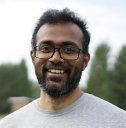
 Suhas Thejaswi
· 2 previous affiliations
- Aalto UniversitySince 2026
- Researcher · Since 2026
- PhD student · 2018–2022
- Postdoc · 2023–2025
Research Overview
Suhas Thejaswi focuses on combinatorial optimization, algorithmic fairness, and the design of responsible decision-support systems. His early work developed scalable approximation algorithms for diversity-aware clustering and data summarization under complex constraints. More recently, his research investigates human-AI complementarity, utilizing statistical risk control and prediction sets to mitigate counterfactual harm in automated decision-making.
Research Trajectory
Thejaswi's early research established foundational theoretical results for diversity-aware clustering, a variant of classical clustering designed to ensure fair representation of demographic groups. In 2021, he formalized this problem by requiring that a minimum number of cluster centers be selected from specified protected groups, introducing the framework in Diversity-Aware k-median: Clustering with Fair Center Representation. Concurrently, he investigated the fixed-parameter tractability of these formulations, demonstrating hardness results and developing approximation algorithms in Approximation algorithms for k-median with lower-bound constraints. This work contributed to the broader area of Bicriteria Constraint Relaxation and the research direction of Computational Complexity of Logical Constraints in Data Partitioning. Building on these theoretical foundations, he and his collaborators presented the first fixed-parameter tractable approximation algorithms and practical heuristics for fair-center representation in Clustering with Fair-Center Representation: Parameterized Approximation Algorithms and Heuristics (2022).
In 2024, Thejaswi extended his clustering research to accommodate intersecting demographic groups and multiple clustering objectives, such as $k$-means and $k$-supplier, providing tight parameterized approximation ratios in Diversity-aware clustering: Computational Complexity and Approximation Algorithms. He also applied fairness constraints to dimensionality reduction, developing a 1.5-approximation algorithm to ensure data representations remain accurate across different populations in Fair Column Subset Selection.
During this period, his focus expanded to the design of responsible decision-support systems, specifically addressing how algorithmic predictions interact with human judgment. A central theme of this work is mitigating "counterfactual harm"—instances where a human expert would have made a correct decision independently but fails due to misleading algorithmic advice. In Controlling Counterfactual Harm in Decision Support Systems Based on Prediction Sets, he introduced a causal framework to strictly limit the frequency of such harm. This research advanced the areas of Distribution-Free Statistical Guarantees via Conformal Risk Control, Distribution-Free Risk Control for Reliable Machine Learning, and Learning Individual Treatment Effects Under Counterfactual Unobservability. Alongside this, he investigated how providing humans with "prediction sets" rather than single answers can optimize joint performance, proposing a greedy algorithm to improve real-world outcomes in Towards Human-AI Complementarity with Prediction Sets.
Thejaswi also contributed to the statistical evaluation of large language models (LLMs). In Prediction-Powered Ranking of Large Language Models (2024), he participated in developing a framework that combines expensive human evaluations with LLM-generated assessments to produce mathematically guaranteed rank-sets. Returning to human-AI collaboration in 2025, he co-authored Towards Human-AI Complementarity in Matching Tasks, which modeled the optimal deferral of uncertain resource allocation decisions to human experts as a multi-armed bandit problem. He further explored the risks of algorithmic matching in high-stakes domains, proposing a post-processing framework to prevent counterfactual harm in refugee resettlement processes in Matchings, Predictions and Counterfactual Harm in Refugee Resettlement Processes.
Most recently, Thejaswi has continued to advance both fair combinatorial optimization and model evaluation. In 2025, he formalized the fair $k$-supplier problem for data summarization, providing improved approximation algorithms in Fair Clustering for Data Summarization: Improved Approximation Algorithms and Complexity Insights. The following year, he addressed the hardness of Capacitated Fair-Range Clustering: Hardness and Approximation Algorithms, contributing to the research direction of Parameterized Approximation Schemes for Constrained Clustering. Additionally, he participated in research addressing the stochastic instability of LLM evaluations, helping introduce a synchronized token generation method to improve benchmark reliability in Evaluation of Large Language Models via Coupled Token Generation (2026).
Current Directions
Recent work investigates the theoretical limits and practical applications of fair combinatorial optimization, alongside the reliable evaluation of generative models. In the domain of clustering and data summarization, Thejaswi is developing approximation algorithms for highly constrained environments, such as capacitated fair-range clustering and the fair $k$-supplier problem. Concurrently, his research addresses the stochastic instability of large language models, exploring methods like coupled token generation to synchronize randomness and improve the sample efficiency and reliability of model evaluations. He also continues to advance frameworks for human-AI complementarity, focusing on dynamic workload deferral and post-processing techniques to prevent counterfactual harm in high-stakes matching systems, such as refugee resettlement processes.
Profile updated
Loading new papers…
Other researchers whose papers cluster into the same research directions — a proxy for overlapping technical interests and shared intellectual neighborhoods.
See something wrong? Report a mistake