

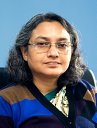
 Sudeshna Sarkar
· 1 previous affiliation
- Indian Institute of Technology KharagpurSince 1998
- Full Professor · Since 2007
- Associate Professor · 2002–2007
- Assistant Professor · 1998–2002
Research Overview
Sudeshna Sarkar focuses on natural language processing, specifically cross-language information retrieval and event extraction for low-resource languages. Her trajectory spans from foundational work in multilingual word embeddings to advanced document-level information extraction and domain adaptation. Recently, her research emphasizes cross-lingual transfer and meta-learning techniques to improve event detection in Indian languages.
Research Trajectory
In the mid-2010s, Sarkar’s research prominently addressed the challenges of Cross-Language Information Retrieval (CLIR), particularly for languages with limited parallel resources. Serving as the principal investigator and senior author, she explored how distributional semantics could bridge language barriers. This work is exemplified by Query Translation for Cross-Language Information Retrieval using Multilingual Word Clusters, where her team projected word embeddings from English, Hindi, and Bengali into a common vector space. By applying community-detection algorithms to this shared space, they successfully grouped conceptually identical words across different languages, facilitating more accurate query translation. Sarkar continued to lead this line of inquiry, subsequently publishing Using Communities of Words Derived from Multilingual Word Vectors for Cross-Language Information Retrieval in Indian Languages, which further refined the clustering of multilingual word vectors learned from comparable corpora to improve retrieval precision.
By 2019, Sarkar’s focus expanded into specialized information extraction and the mitigation of data scarcity through domain adaptation. As a second author, she contributed to Biomedical Relation Classification by single and multiple source domain adaptation. Recognizing that labeling data for highly specific domains like biomedicine is prohibitively expensive, this research investigated methods to transfer useful knowledge from one or more related source domains to an unlabeled target domain, improving relation classification performance on benchmark biomedical corpora.
Entering the 2020s, Sarkar’s work shifted toward complex event extraction, specifically addressing the limitations of sentence-level models. This transition aligns with the research direction of Global Context for Local Semantic Disambiguation. Traditional event extraction often struggles when arguments—such as the reasons or after-effects of an event—are scattered across multiple sentences in long documents like news articles. In Event Argument Extraction using Causal Knowledge Structures, Sarkar and her collaborators tackled this scattering issue by incorporating global context to capture causal event arguments that local, sentence-bound models typically miss.
Building on the need for broader context in information extraction, Sarkar’s subsequent research moved from extractive techniques to generative ones. In ArgGen: Prompting Text Generation Models for Document-Level Event-Argument Aggregation, she co-authored a novel approach to document-level event argument aggregation. Rather than merely extracting text spans, this work demonstrated the effectiveness of using prompt-based text generation models to consolidate scattered information into precise, document-level frames, particularly in multilingual settings.
Most recently, Sarkar has participated in research addressing the broader area of Cross-Lingual Transfer for Multilingual Event Extraction. As a collaborator on Meta-ED: Cross-lingual Event Detection Using Meta-learning for Indian Languages, she helped investigate model-agnostic meta-learning approaches for few-shot cross-lingual event detection. This work provides a mechanism for fast adaptation to new low-resource Indian languages, significantly outperforming base models by transferring structural knowledge from higher-resource languages.
Current Directions
The most recent papers in the evidence indicate a strong focus on overcoming data scarcity in complex natural language understanding tasks. Sarkar’s current work investigates the intersection of event detection, cross-lingual transfer, and generative modeling. A major theme is the shift away from sentence-level extraction toward document-level reasoning, utilizing prompt-based generation to aggregate scattered event arguments into cohesive informational frames.
Additionally, recent collaborations highlight an ongoing commitment to low-resource NLP, specifically for Indian languages. By employing meta-learning techniques, current research seeks to optimize parameter initialization so that models can rapidly adapt to new languages with only a few training instances. Together, these directions point toward a unified goal of building robust, context-aware information extraction systems that perform reliably across linguistic boundaries and document structures without requiring massive, domain-specific annotated datasets.
Profile updated
Loading new papers…
Other researchers whose papers cluster into the same research directions — a proxy for overlapping technical interests and shared intellectual neighborhoods.
See something wrong? Report a mistake