

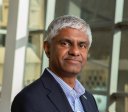
 Srirangaraj Setlur
· 3 previous affiliations
- Associate Director of Community Engagement, Institute for Artificial Intelligence and Data Science · Since 2024
- Co-Director, NSF Center for Identification Technology Research (CITeR) · Since 2013
- Co-Director and Principal Research Scientist, Center for Unified Biometrics and Sensors · Since 2009
- Senior Research Scientist · 2004–2009
- Senior Research Scientist · 1995–2009
- M.S. · 1991–1993
- Managing Director · Since 2023
- Bangalore University1986–1990
- B.E. · 1986–1990
Research Overview
Srirangaraj Setlur focuses on document image analysis, multimodal biometrics, and applied machine learning for healthcare and education. His early trajectory centered on large-scale optical character recognition and evaluation systems for complex scripts. Recently, his work has expanded to address cross-sensor fingerprint matching, multimedia synthesis, and the integration of large language models into clinical and pedagogical workflows.
Research Trajectory
Setlur’s early research established foundational methods in document image analysis and optical character recognition (OCR). In 1994, he explored techniques for Generating manifold samples from a handwritten word, addressing the inherent variability in handwriting. This focus on robust recognition systems naturally extended to large-scale, real-world deployments. By the early 2000s, he was leading efforts to design comprehensive evaluation frameworks for the United States Postal Service. This work, detailed in Truthing, Testing and Evaluation Issues in Complex Systems and the subsequent Large scale address recognition systems Truthing, testing, tools, and other evaluation issues, tackled the complex logistics of sampling live mail-streams, generating ground-truth reference data, and grading real-time address recognition performance.
Recognizing the paucity of resources for non-Latin scripts, Setlur expanded his focus to Indic and Asian character recognition. He addressed the lack of standardized evaluation tools and ground-truth data for Indian languages in Creation of data resources and design of an evaluation test bed for Devanagari script recognition. His expertise in this domain culminated in the comprehensive 2014 handbook chapter Asian Character Recognition, which synthesized the specific challenges of processing Chinese, Japanese, Korean, and Indic scripts, such as managing massive character classes. During this earlier period, he also briefly investigated healthcare applications, contributing to Emergency medicine, disease surveillance, and informatics.
In the 2020s, Setlur’s research incorporated deep learning to solve complex multimodal and biometric challenges. With collaborators, he developed systems for educational video analysis, introducing a multi-branch fully convolutional network in FCN-LectureNet: Extractive Summarization of Whiteboard and Chalkboard Lecture Videos. This work advanced the research direction of Robust Scene Text Recognition in Uncontrolled Environments and contributed to the broader area of Semantic Video Partitioning for Long Context Reasoning. His multimedia research also extended to audio-visual alignment, participating in the development of techniques for Audio Match Cutting: Finding and Creating Matching Audio Transitions in Movies and Videos, which aligns with the area of Automated Temporal and Semantic Alignment for Multimedia Synthesis.
A major theme in Setlur’s recent trajectory is advancing contactless biometrics. To bridge the gap between smartphone "finger-selfies" and traditional contact-based scans, he helped introduce RidgeBase: A Cross-Sensor Multi-Finger Contactless Fingerprint Dataset. This large-scale benchmark supports several research directions, including Bridging the Modality Gap in Cross-Spectral Matching, Unobtrusive Sensing for Continuous Physiological Monitoring, and Adaptive Contrast Enhancement for Robust Feature Extraction. It also provides critical data for the areas of Robust Identity Verification via Multimodal Biometric Fusion and Synthetic Pre-training for Biometric Recognition. He subsequently built upon this foundation with Ridgeformer: Mutli-Stage Contrastive Training for Fine-Grained Cross-Domain Fingerprint Recognition, a novel transformer architecture that combines global spatial features with fine-grained local alignment to achieve highly accurate cross-domain matching. This architecture advances the fields of Non-Rigid Elastic Deformation Modeling in Biometrics, Robust Biometric Recognition Beyond the Visible Spectrum, and Global Context and Long Range Dependencies in Vision Transformers.
Most recently, Setlur has explored the integration of large language models (LLMs) into specialized pedagogical and clinical systems. He contributed to Teaching Spell Checkers to Teach: Pedagogical Program Synthesis for Interactive Learning, which transforms corrective tools into interactive micro-lessons. This research intersects with multiple directions, such as Diagnostic Reasoning for Automated Pedagogical Feedback, Modular Architectures for Flexible and Scalable Curricula, and Schema Constrained Generation for Large Language Models, while also addressing Scaling High-Touch Interventions in Resource-Constrained Environments, Constrained Decoding for Syntactically Valid Code Generation, and The Durability Gap in Technology Enhanced Learning. In the medical domain, he participated in the development of LLM Augmented Intervenable Multimodal Adaptor for Post-operative Complication Prediction in Lung Cancer Surgery. This framework integrates clinical data and CT-derived radiomics with LLM-generated explanations, allowing surgeons to interact with the AI's reasoning. This work contributes to the areas of Faithfulness and Post-Hoc Rationalization in Chain-of-Thought Reasoning, Clinical-Radiomic Fusion for Precision Oncology, and Decoding Tumor Phenotypes with High-Dimensional Radiomics. Additionally, Setlur contributed to EvoMisty: Building, Optimizing, and Evolving Capabilities on a Social Robot, a framework that enables coding agents to synthesize, verify, and iteratively optimize reusable skills on physical social robots.
Current Directions
The most recent papers in the evidence indicate a strong focus on applied multimodal AI, specifically leveraging transformer architectures and large language models for high-stakes domains. Current work investigates cross-domain biometric matching, utilizing multi-stage contrastive training to resolve the domain gap in contactless fingerprint recognition. Simultaneously, Setlur is exploring intervenable AI systems in healthcare and education, where LLMs are used not just for static prediction or correction, but to generate interactive, explainable outputs—such as real-time rationales for surgical complication predictions and dynamically synthesized pedagogical feedback for learners.
Profile updated
Loading new papers…
Other researchers whose papers cluster into the same research directions — a proxy for overlapping technical interests and shared intellectual neighborhoods.
See something wrong? Report a mistake