

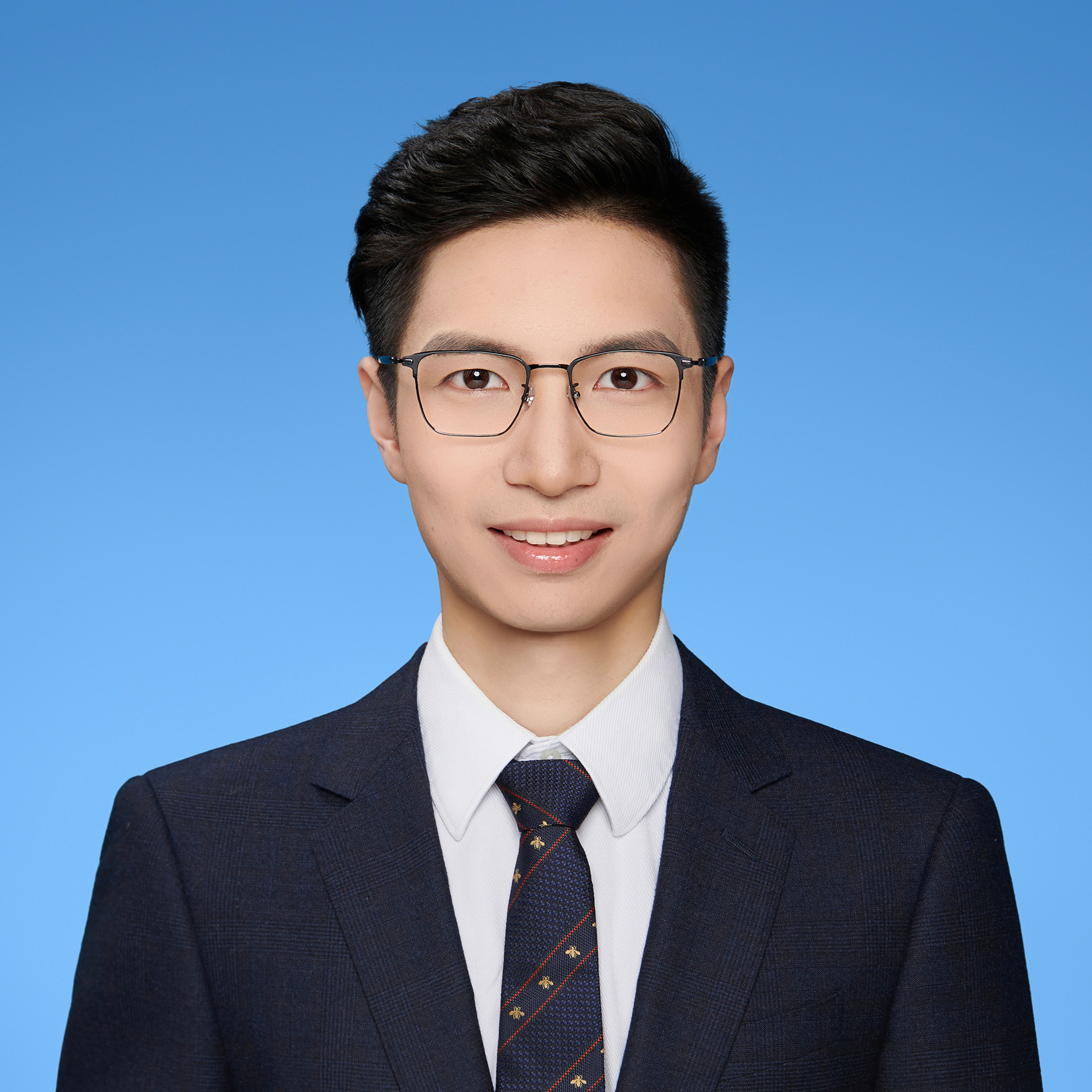
 Siyuan Feng
· 2 previous affiliations
- Shanghai Innovation InstituteSince 2025
- Assistant Professor · Since 2025
- Shanghai Jiao Tong University2016–2025
- PhD student · 2020–2025
- Undergrad student · 2016–2020
2 other authors named Siyuan Feng: Siyuan Feng (3 papers), Siyuan Feng (2 papers)
Research Overview
Siyuan Feng focuses on machine learning systems, large-scale reinforcement learning environments, and tensor program optimization. His trajectory spans from developing highly scalable multi-agent traffic simulators and generative modeling techniques to building efficient compilation frameworks for deep learning. Most recently, his work addresses fully distributed architectures for scaling large language model post-training.
Research Trajectory
Siyuan Feng's early research explored the intersection of reinforcement learning, multi-agent systems, and generative modeling. In 2019, he contributed to the development of scalable simulation environments for urban mobility, addressing the limitations of existing open-source traffic simulators. This effort yielded CityFlow: A Multi-Agent Reinforcement Learning Environment for Large Scale City Traffic Scenario. The project provided a robust platform for evaluating dynamic traffic environments, advancing the research direction of Parallel Architectures for Massive Scale Agent Simulations. By enabling the coordination of thousands of vehicles and pedestrians, this work also supported the broader area of Coordinating Interconnected Traffic Networks and the area of Empirical Trajectory Replay for High Fidelity Traffic Simulation.
During the same period, Feng participated in research on sequential discrete data generation. He collaborated on CoT: Cooperative Training for Generative Modeling of Discrete Data, which investigated methods to mitigate the exposure bias inherent in maximum likelihood estimation. This research contributed to the area of Mitigating Mode Collapse and Instability in Generative Training and intersected with the research direction of Optimizing Through Non Differentiable Token Selection.
In subsequent years, Feng's focus shifted toward machine learning systems and compiler optimization. He was part of the team that introduced MetaSchedule in Tensor Program Optimization with Probabilistic Programs (2022). This work proposed a domain-specific probabilistic programming language abstraction designed to construct rich search spaces for tensor programs, allowing domain experts to modularly compose program transformations for deep learning deployment. Continuing in the domain of compiler infrastructure, he later contributed to A Sample-Free Compilation Framework for Efficient Dynamic Tensor Computation (2025), which addressed the efficient execution of dynamic tensor operations without relying on traditional sampling overheads.
Most recently, Feng's systems research has expanded to address the massive computational requirements of modern foundation models. He collaborated on DistFlow: A Fully Distributed RL Framework for Scalable and Efficient LLM Post-Training (2026). By decoupling control logic from data transmission and introducing a decentralized coordination mechanism, this framework achieved near-linear scalability across hundreds of GPUs. This contribution aligns with the broader research direction of Decentralized Architectures for Scalable Distributed Learning.
Current Directions
The most recent papers in the evidence indicate a strong focus on high-performance systems for deep learning, specifically targeting the bottlenecks of large language model (LLM) training and dynamic tensor computation. Recent work investigates fully distributed reinforcement learning frameworks designed to scale LLM post-training across extensive GPU clusters. By decoupling control logic and utilizing decentralized data coordination, these systems aim to maximize throughput and scalability. Additionally, ongoing efforts address compiler-level optimizations, focusing on sample-free compilation frameworks to improve the efficiency of dynamic tensor computations in complex deep learning workloads.
Profile updated
Loading new papers…
Other researchers whose papers cluster into the same research directions — a proxy for overlapping technical interests and shared intellectual neighborhoods.
See something wrong? Report a mistake