

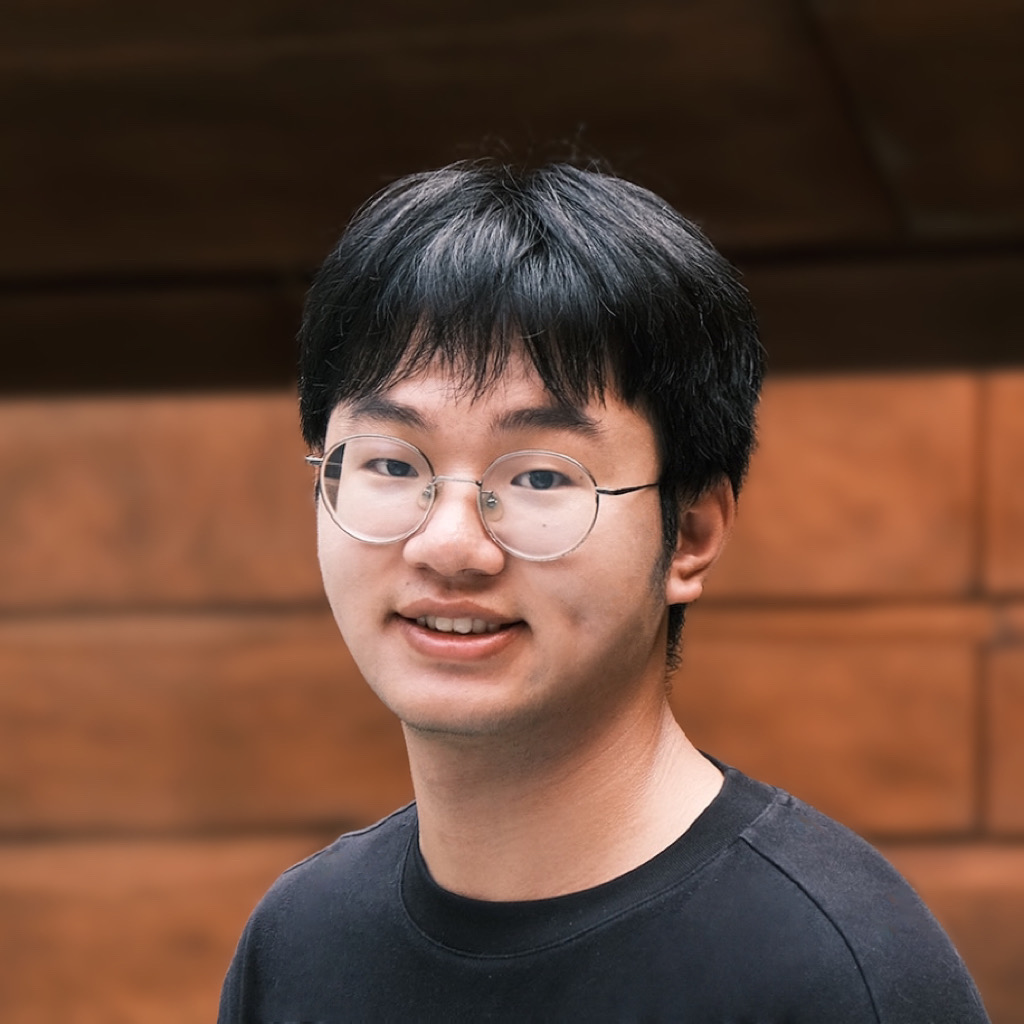
 Siyin Wang
· 1 previous affiliation
- Fudan UniversitySince 2020
- PhD student · Since 2024
- Undergrad student · 2020–2024
1 other author named Siyin Wang: Siyin Wang (Tsinghua University · 12 papers)
Research Overview
Siyin Wang focuses on language intelligence, large language model alignment, and embodied artificial intelligence. His trajectory spans early work in causal inference for sentiment analysis to recent advancements in multimodal reasoning and vision-language-action models for robotic control. Currently, he investigates proactive robot manipulation and hierarchical memory architectures for long-horizon embodied tasks.
Research Trajectory
Wang’s early research concentrated on natural language processing, with a specific emphasis on improving the robustness and generalization of sentiment analysis models through causal inference. In 2022, he introduced Causal Intervention Improves Implicit Sentiment Analysis, which applied causal methodologies to better extract underlying sentiment from text. This work contributed to the broader research direction of Implicit Sentiment Analysis in Factual Text and advanced techniques in the area of Knowledge Grounding for Implicit Stance and Sentiment. Building on these causal frameworks, he subsequently addressed the challenge of domain shift in Domain Generalization via Causal Adjustment for Cross-Domain Sentiment Analysis (2024). By proposing a backdoor adjustment-based causal model, this research disentangled domain-specific and domain-invariant representations, allowing models to perform reliably on unknown test data and contributing to the field of Learning Invariant Representations for Domain Generalization.
As large language models (LLMs) and large vision-language models (LVLMs) became central to artificial intelligence, Wang’s focus expanded to model alignment, generation control, and multimodal reasoning. In LLM can Achieve Self-Regulation via Hyperparameter Aware Generation (2024), he investigated whether language models could consciously regulate their own decoding strategies. To replace cumbersome manual adjustments, he proposed a text generation paradigm that allows models to dynamically adapt hyperparameters based on task demands. Concurrently, he addressed the fragile safety alignment of multimodal systems in Cross-Modality Safety Alignment (2024). This work introduced the "Safe Inputs but Unsafe Output" (SIUO) benchmark, revealing significant vulnerabilities in how LVLMs interpret complex, real-world scenarios when combining visual and textual information.
Moving into 2025, Wang collaborated on several projects enhancing the reasoning capabilities of foundation models. With co-authors, he developed ConvSearch-R1: Enhancing Query Reformulation for Conversational Search with Reasoning via Reinforcement Learning, a self-driven framework that eliminates the need for costly external rewrite supervision by aligning rewriting models directly with downstream retrievers. He also contributed to VisuoThink: Empowering LVLM Reasoning with Multimodal Tree Search, which integrated visuospatial and linguistic domains to facilitate deliberate, step-by-step "slow thinking" in vision-language models, overcoming the limitations of purely text-based reasoning approaches.
The most recent phase of Wang’s trajectory represents a deep commitment to embodied artificial intelligence and Vision-Language-Action (VLA) models, focusing on how agents plan, learn, and interact in physical environments. In World Modeling Makes a Better Planner: Dual Preference Optimization for Embodied Task Planning (2025), he proposed the Dual Preference Optimization (D²PO) framework, which jointly optimizes state prediction and action selection to help LVLMs better understand environment dynamics. He further improved the sample efficiency of robotic learning in SRPO: Self-Referential Policy Optimization for Vision-Language-Action Models (2025). By measuring progress in a latent world model space rather than raw pixels, SRPO uses a model's own successful attempts as grading rubrics for its failures. This approach turned sparse binary rewards into dense signals, advancing research in areas such as Group Relative Policy Optimization for Large Reasoning Models and The Capability Threshold for Autonomous Self-Improvement. During this period, he also participated in the development of World-aware Planning Narratives Enhance Large Vision-Language Model Planner, a framework that infuses LVLMs with visual, spatial, functional, and syntactic cognitive dimensions to improve long-horizon robotic planning.
In 2026, Wang’s work has increasingly focused on decoupling complex robotic tasks and processing omni-modal contexts. With collaborators, he introduced Learning to Move Before Learning to Do: Task-Agnostic pretraining for VLAs, a framework that separates a robot's physical understanding of movement from its ability to follow instructions. By pretraining on unlabeled random play data using an inverse dynamics objective, the method significantly reduces the need for expert demonstrations. He then led the development of RoboOmni: Proactive Robot Manipulation in Omni-modal Context, which shifts robotic manipulation from passive instruction-following to proactive collaboration. By unifying vision, speech, environmental sounds, and action into a single end-to-end framework, RoboOmni allows agents to infer implicit requests from ambient context, contributing to the broader research direction of Eliminating the Textual Bottleneck in Spoken Dialogue. Finally, he co-authored HiMe: Hierarchical Embodied Memory for Long-Horizon Vision-Language-Action Control, which addresses the "frequency-competence paradox" in robotics. HiMe employs a three-tier architecture—an Executor for movement, a Sentry for monitoring, and a Planner for long-term memory—enabling robots to navigate complex, multi-step tasks that require adapting to changing human preferences.
Current Directions
The most recent papers in the evidence indicate a strong focus on scaling and refining Vision-Language-Action models for complex, real-world robotic deployment. A primary theme in this current work is the architectural decoupling of cognitive and motor functions to improve both efficiency and capability. This is evident in efforts to separate task-agnostic physical pretraining ("learning to move") from instruction tuning ("learning to do"), as well as in the design of hierarchical memory systems that isolate fast, low-level motor control from slow, high-level strategic planning.
Additionally, recent work investigates the transition from reactive robotic agents to proactive collaborators. By integrating omni-modal inputs—spanning visual data, spoken language, and ambient environmental audio—current frameworks aim to enable robots to infer implicit human intent and proactively confirm actions before execution, reducing the reliance on explicit, step-by-step textual commands in embodied AI.
Profile updated
Loading new papers…
Other researchers whose papers cluster into the same research directions — a proxy for overlapping technical interests and shared intellectual neighborhoods.
See something wrong? Report a mistake