

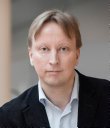
 Simo Särkkä
· 2 previous affiliations
- Aalto UniversitySince 2015
- Full Professor · Since 2015
- ELLIS Institute FinlandSince 2025
- Principal Investigator · Since 2025
Research Overview
Simo Särkkä focuses on Bayesian filtering and smoothing, spatio-temporal machine learning, and physics-informed models. His trajectory spans foundational work in continuous-time nonlinear state estimation to the development of highly scalable parallel algorithms for temporal state-space models. Currently, his research addresses probabilistic numerics, scalable Gaussian processes, and the integration of emerging computational paradigms with probabilistic inference.
Research Trajectory
His early research concentrated heavily on advancing nonlinear Kalman filtering and smoothing techniques, particularly for continuous-time and complex state-space models. He derived the continuous-time limit of the unscented Kalman filter for systems modeled by stochastic differential equations in On Unscented Kalman Filtering for State Estimation of Continuous-Time Nonlinear Systems. Building on this, he developed a novel fixed-interval smoothing formulation in Unscented Rauch-Tung-Striebel Smoother, which utilized a separate backward smoothing pass to recursively compute corrections to forward filtering results. He also addressed the challenge of unknown or time-varying measurement noise, applying variational Bayesian methods to jointly estimate dynamic states and noise parameters in Recursive Noise Adaptive Kalman Filtering by Variational Bayesian Approximations. This period of methodological development included a comprehensive comparison of Gaussian approximation techniques—such as Taylor series, unscented transformations, and Gauss-Hermite quadrature—in On Gaussian Optimal Smoothing of Non-Linear State Space Models. Much of this foundational work on optimal estimation was later synthesized in the text Bayesian Filtering and Smoothing.
Moving into the late 2010s, his focus expanded toward the intersection of numerical methods and probabilistic inference. With collaborators, he contributed to the research direction of Solving Differential Equations via Bayesian State Estimation, reframing ordinary differential equation solvers as nonlinear filtering problems in Probabilistic solutions to ordinary differential equations as nonlinear Bayesian filtering: a new perspective. This perspective provided a rigorous framework for quantifying the uncertainty inherent in numerical discretization. Concurrently, he advanced the area of Hilbert Space Approximations for Scalable Gaussian Processes. The paper Hilbert space methods for reduced-rank Gaussian process regression. proposed an efficient scheme using Laplace operator eigenfunctions to drastically reduce the computational complexity of Gaussian process inference, allowing it to scale to much larger datasets.
A major theme in his subsequent work has been the temporal parallelization of sequential algorithms, contributing significantly to the broader area of Parallel Associative Scans for Temporal State Space Models. This began with Temporal Parallelization of Bayesian Smoothers, which reformulated Bayesian filtering and smoothing as all-prefix-sums operations to achieve logarithmic time complexity. This parallel framework was later extended in Parallel Square-Root Statistical Linear Regression for Inference in Nonlinear State Space Models, which integrated these techniques with the research direction of Square-Root Filtering for Stable Covariance Propagation to improve numerical stability during complex nonlinear inference. The practical deployment of these parallel architectures was rigorously evaluated in On The Performance of Prefix-Sum Parallel Kalman Filters and Smoothers on GPUs, demonstrating substantial speedups across different hardware accelerators.
In parallel with computational scaling, his research continued to deepen in probabilistic numerics. The publication Modelling Pathwise Uncertainty of Stochastic Differential Equations Samplers via Probabilistic Numerics bridged stochastic differential equations with numerical uncertainty, advancing work in Probabilistic Numerics for Quantifying Discretization Uncertainty and the related area of Transforming Stochastic Differential Equations into Randomized ODEs. His research also applied constrained Gaussian process regression to physical inverse problems, such as estimating particle-size distributions from light-scattering data while enforcing physical normalization constraints in Determination of Particle-Size Distributions from Light-Scattering Measurement Using Constrained Gaussian Process Regression. Additionally, he explored sequential decision-making under uncertainty, introducing a particle-based policy optimization framework for continuous partially observable Markov decision processes in Sequential Monte Carlo for Policy Optimization in Continuous POMDPs.
Most recently, his work has expanded into emerging computational paradigms and distributed systems. He investigated quantum algorithmic advantages for machine learning in Provable Quantum Algorithm Advantage for Gaussian Process Quadrature. Looking toward network-level estimation, Communication-efficient distributed Kalman filtering using ADMM formulated distributed Kalman filtering as an unconstrained optimization problem to minimize communication overhead between local estimators. Furthermore, Bayesian Fourier Features for Reduced Rank Gaussian Processes unified various low-rank kernel approximation methods through a novel Bayesian quadrature framework, continuing his long-standing effort to make powerful probabilistic models computationally tractable.
Current Directions
Based on his most recent publications, current research directions center on maximizing the computational efficiency and scalability of probabilistic inference. A primary focus is the continued development of parallel-in-time algorithms for state-space models, leveraging GPU architectures and prefix-sum formulations to break the sequential bottleneck of traditional Kalman filters and smoothers.
Another active area is the advancement of probabilistic numerics, specifically in quantifying the pathwise uncertainty of stochastic differential equation samplers. This work treats numerical integration itself as an estimation problem, providing mathematically grounded confidence bounds on simulated trajectories. Additionally, recent papers indicate an expanding interest in applying Bayesian quadrature and reduced-rank approximations to scale Gaussian processes, as well as exploring how quantum computing and distributed optimization frameworks (like ADMM) can be harnessed to solve complex filtering and quadrature problems more efficiently.
Profile updated
Loading new papers…
Other researchers whose papers cluster into the same research directions — a proxy for overlapping technical interests and shared intellectual neighborhoods.
See something wrong? Report a mistake