

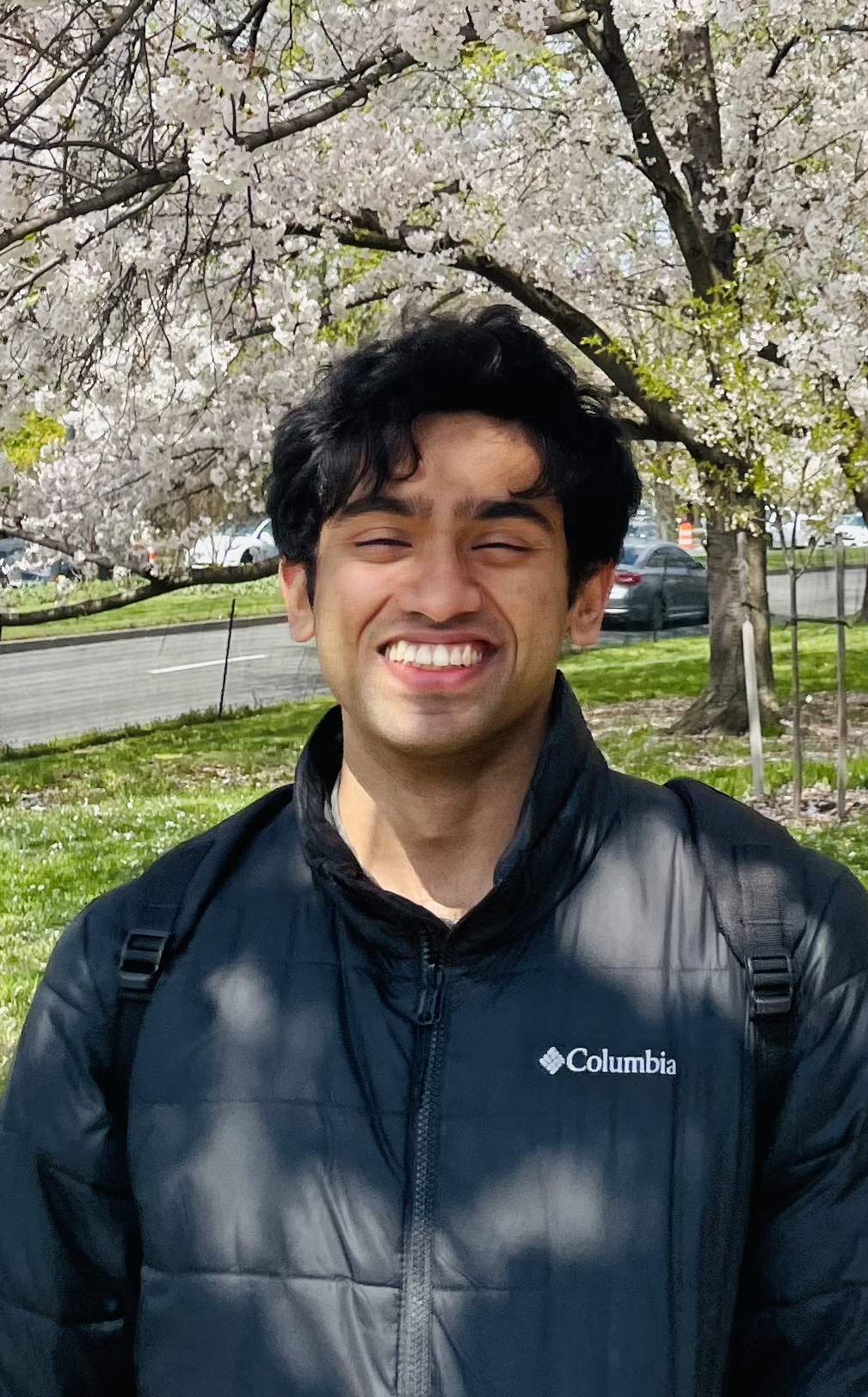
 Siddharth Nayak
· 5 previous affiliations
- waymoSince 2025
- LLM/VLM Software Engineer · Since 2025
- Graduate Research Assistant · 2020–2025
- PhD student · 2022–2025
- MS student · 2020–2022
- Master of Science - MS, AeroAstro (Autonomy)
- Research Scientist Intern · 2023
- Undergrad student · 2016–2020
- Summer Research Intern · 2019
Research Overview
Siddharth Nayak focuses on multi-agent reinforcement learning (MARL), graph neural networks, and the integration of foundation models for autonomous robotic systems. His work addresses the challenges of Decentralized Coordination Under Partial Observability, specifically focusing on limited communication bandwidth, long-horizon planning, and the interpretability of learning-based navigation methods. By combining tools from combinatorial optimization and deep learning, he develops frameworks that allow robotic swarms to operate efficiently in decentralized settings where global information is unavailable.
Research Trajectory
Nayak’s research began with a focus on enhancing computer vision through reinforcement learning. During his undergraduate studies, he developed methods to optimize image pre-processing for object detection, moving away from human-centric image quality metrics toward those that maximize the performance of pre-trained neural networks. This early work established a theme of using RL to tune complex systems where traditional analytical gradients are unavailable.
Upon joining MIT, Nayak transitioned toward the intersection of reinforcement learning and operations research. His Master’s research focused on learning-based scheduling, specifically developing hybrid architectures that combine the strengths of RL with integer programming (IP). This work addressed the computational challenges of large-scale scheduling by using neural networks to extract coefficients that guide IP solvers toward robust solutions. This period marked a shift toward solving high-dimensional optimization problems in dynamic environments, laying the groundwork for his subsequent focus on multi-agent systems.
His doctoral work has primarily centered on the scalability and coordination of multi-robot teams. A significant portion of this research involves Graph Reinforcement Learning for Dynamic Multi-Agent Systems. By utilizing graph neural networks (GNNs), Nayak developed methods for Zero-Shot Scaling of Graph Reinforcement Learning Policies, allowing policies trained on a small number of agents to be deployed in much larger swarms without retraining. This work also explored the application of these techniques to space traffic management, investigating how satellites can navigate and avoid collisions under strict communication and observation constraints.
Most recently, Nayak has integrated large language models (LLMs) into the multi-agent planning pipeline. This evolution addresses the "long-horizon" problem, where agents must execute complex sequences of tasks based on high-level human instructions. His current research explores how foundation models can serve as cognitive architectures for robots, facilitating task allocation and error correction in environments characterized by non-stationarity and partial observability.
Current Directions
Nayak’s current research is concentrated in three primary areas:
Scaling MARL in Partially Observable Systems He continues to refine architectures like InforMARL, which use Graph Attention Mechanisms for Adaptive Feature Aggregation to manage local information. The goal is to enable decentralized navigation that matches the performance of centralized systems while maintaining the computational efficiency required for real-time deployment. This includes exploring Scaling Multiagent Reinforcement Learning through Progressive Population Curricula to handle increasingly complex agent interactions.
Long-Horizon Planning and Foundation Models A major current focus is the LLaMAR framework, which utilizes the reasoning capabilities of language models to decompose complex goals into actionable sub-tasks for multi-robot teams. This work aims to bridge the gap between high-level semantic understanding and low-level physical control, particularly in Safety Critical Planning for Physically Extended Multi Agent Systems where agents must account for their physical volume and dynamics.
Interpretable Communication Protocols Nayak is investigating the use of LLMs to create human-interpretable communication protocols between agents. By moving away from "black-box" vector-based communication, this research seeks to make the collaborative decisions of robotic swarms transparent to human supervisors, which is critical for deployment in high-stakes environments like search-and-rescue or space operations.
Representative Work
Reinforcement Learning for Improving Object Detection In this first-author work, Nayak introduced ObjectRL, an algorithm designed to optimize image pre-processing parameters to improve the performance of pre-trained object detection networks. The research demonstrated that optimal image quality for machine perception often differs from human visual preferences, and that RL can effectively navigate the non-differentiable space of pre-processing techniques to enhance detection accuracy.
NICE: Robust Scheduling through Reinforcement Learning-Guided Integer Programming As a primary contributor, Nayak developed the Neural network IP Coefficient Extraction (NICE) framework. This work addresses the difficulty of solving large-scale integer programs for robust scheduling. By using RL to approximate complex objectives and extract coefficients for the IP formulation, the method achieves significant reductions in schedule disruptions compared to traditional baseline formulations, demonstrating a successful hybrid of deep learning and combinatorial optimization.
Scalable Multi-Agent Reinforcement Learning through Intelligent Information Aggregation This paper introduces InforMARL, a novel architecture for decentralized multi-agent navigation. Nayak developed a GNN-based approach to aggregate local neighborhood information for both the actor and the critic in a MARL framework. The results showed that InforMARL achieves superior sample efficiency and performance while remaining scalable; a policy trained on a small group of agents can be successfully deployed in much larger systems without additional training.
Long-Horizon Planning for Multi-Agent Robots in Partially Observable Environments In this first-author paper presented at NeurIPS 2024, Nayak proposed LLaMAR (Long-Horizon Planner for Multi-Agent Robotics). The framework employs a "plan-act-correct-verify" cognitive architecture that uses language models to parse human instructions into multi-step plans. The system is specifically designed for partially observable environments, allowing teams of robots to coordinate and re-plan dynamically as new information is discovered.
Satellite Navigation and Coordination with Limited Information Sharing Nayak explored the application of MARL to space traffic management, focusing on collision-free navigation for satellites. The research investigated transfer learning techniques, demonstrating that models trained in simulated ground environments can be effectively adapted to space environments, even when accounting for complex orbital perturbations and limited communication ranges between vehicles.
Data-driven Spatial Classification using Multi-Arm Bandits for Monitoring with Energy-Constrained Mobile Robots In this recent first-author work, Nayak presented a bi-level framework for environmental monitoring. The system coordinates a heterogeneous team of drones and ground charging stations to classify spatial regions. By combining multi-armed bandits for data collection with integer programming for energy-aware path planning, the framework provides theoretical guarantees on classification accuracy and task completion time under noisy sensing conditions.
Profile updated
Loading new papers…
Other researchers whose papers cluster into the same research directions — a proxy for overlapping technical interests and shared intellectual neighborhoods.
See something wrong? Report a mistake