

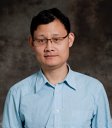
 Shuqiang Jiang
· 2 previous affiliations
- Full Professor · Since 2025
- Chinese Academy of Sciences2008–2025
- Professor · 2013–2025
- Associate Professor · 2008–2013
1 other author named Shuqiang Jiang: Shuqiang Jiang (7 papers)
Research Overview
Shuqiang Jiang focuses on multimedia content analysis, food computing, and embodied artificial intelligence. His trajectory spans from early work in video understanding and image retrieval to large-scale visual food recognition and zero-shot learning. Most recently, his research emphasizes vision-and-language navigation and robotic manipulation, developing agents capable of complex spatial reasoning and interactive planning in 3D environments.
Research Trajectory
Jiang's early research addressed foundational challenges in video and image understanding. In 2004, he contributed to semantic summarization in sports media with A new method to segment playfield and its applications in match analysis in sports video, which utilized Gaussian mixture models to detect playfield pixels. His focus later expanded to complex scene recognition. In Scene Recognition with CNNs: Objects, Scales and Dataset Bias (2016), he investigated scale-induced dataset bias, introducing a spliced architecture that combined object-centric and scene-centric networks to process both local patches and global views.
A significant portion of his subsequent work established and expanded the domain of food computing. Following a comprehensive overview in A Survey on Food Computing (2019), his group released major datasets to benchmark visual recognition tasks. ISIA Food-500: A Dataset for Large-Scale Food Recognition via Stacked Global-Local Attention Network (2020) provided an extensive ontology of nearly 400,000 images, while FoodLogoDet-1500: A Dataset for Large-Scale Food Logo Detection via Multi-Scale Feature Decoupling Network (2021) introduced a large-scale resource for identifying food brands. Alongside domain-specific applications, he continued to refine core computer vision optimization techniques. In Rethinking the Optimization of Average Precision: Only Penalizing Negative Instances before Positive Ones Is Enough (2022), he proposed the PNP loss for image retrieval, demonstrating that directly minimizing the number of negative instances ranked before positive ones yields more effective gradient assignment.
By 2023, Jiang's research increasingly intersected with embodied AI and generalization across unseen environments. He applied causal inference to robotics in Layout-based Causal Inference for Object Navigation, developing methods to prevent autonomous agents from overfitting to their training environments, contributing to the research direction of Generalizing Navigation to Unseen Spatial Layouts. Concurrently, he addressed generalization in visual recognition with Bi-Level Meta-Learning for Few-Shot Domain Generalization, advancing the broader area of Bridging the Domain Shift in Few Shot Learning by training models to recognize novel classes in entirely unfamiliar domains.
In 2024, his work in embodied intelligence expanded significantly, focusing on how agents interact with and navigate complex 3D spaces. He introduced the concept of affordance navigation—where agents locate areas to perform specific functions rather than just finding objects—in Object-to-Manipulation Graph for Affordance Navigation. This was complemented by An Interactive Navigation Method with Effect-oriented Affordance, which detailed the ADIN system for planning efficient paths through cluttered environments by predicting the time cost of moving obstacles. To improve Vision-Language Navigation (VLN), he developed predictive spatial representations in Lookahead Exploration with Neural Radiance Representation for Continuous Vision-Language Navigation, allowing agents to evaluate occluded paths. He also addressed the deployment of these models on physical robots in Sim-to-Real Transfer via 3D Feature Fields for Vision-and-Language Navigation, enabling monocular systems to achieve panoramic semantic understanding. Further refining navigation planning, Trajectory Diffusion for ObjectGoal Navigation utilized a Transformer-based diffusion model to generate temporally consistent future trajectories.
Jiang has continued to bridge his expertise in food computing and advanced machine learning. In Synthesizing Knowledge-Enhanced Features for Real-World Zero-Shot Food Detection (2024), he utilized multi-source knowledge graphs and a 1D diffusion model to detect unseen food items. This multimodal approach extended to nutritional analysis in Spatial-Aware Multi-Modal Information Fusion for Food Nutrition Estimation (2025). His recent robotics work includes GridMM: Grid Memory Map for Vision-and-Language Navigation (2025), which introduced a dynamically growing egocentric map to capture fine-grained visual cues. Looking toward sustainable applications and long-horizon planning, his 2026 publications include Eating for a Sustainable Planet: Personalized Sustainable Diet Recommendation via Constraint-Aware Decision-Making Modeling, which frames dietary sustainability as a learnable constraint rather than a simple preference, and Joint Navigation and Manipulation Planning with 3D Interaction Chains, a unified framework that uses Vision-Language Models to jointly plan multi-stage robotic navigation and manipulation tasks.
Current Directions
The most recent papers in the evidence address complex, long-horizon reasoning in both embodied artificial intelligence and personalized recommendation systems. In robotics, current work investigates joint planning frameworks that unify navigation and manipulation, ensuring that mobile agents not only reach a target but arrive at a pose optimized for subsequent physical interaction. This is supported by ongoing research into dynamic, egocentric memory maps that improve spatial understanding in vision-and-language navigation. Concurrently, in the domain of food computing, recent efforts focus on integrating multi-modal information for nutrition estimation and developing constraint-aware decision models that balance personalized dietary preferences with ecological sustainability.
Profile updated
Loading new papers…
Other researchers whose papers cluster into the same research directions — a proxy for overlapping technical interests and shared intellectual neighborhoods.
See something wrong? Report a mistake