

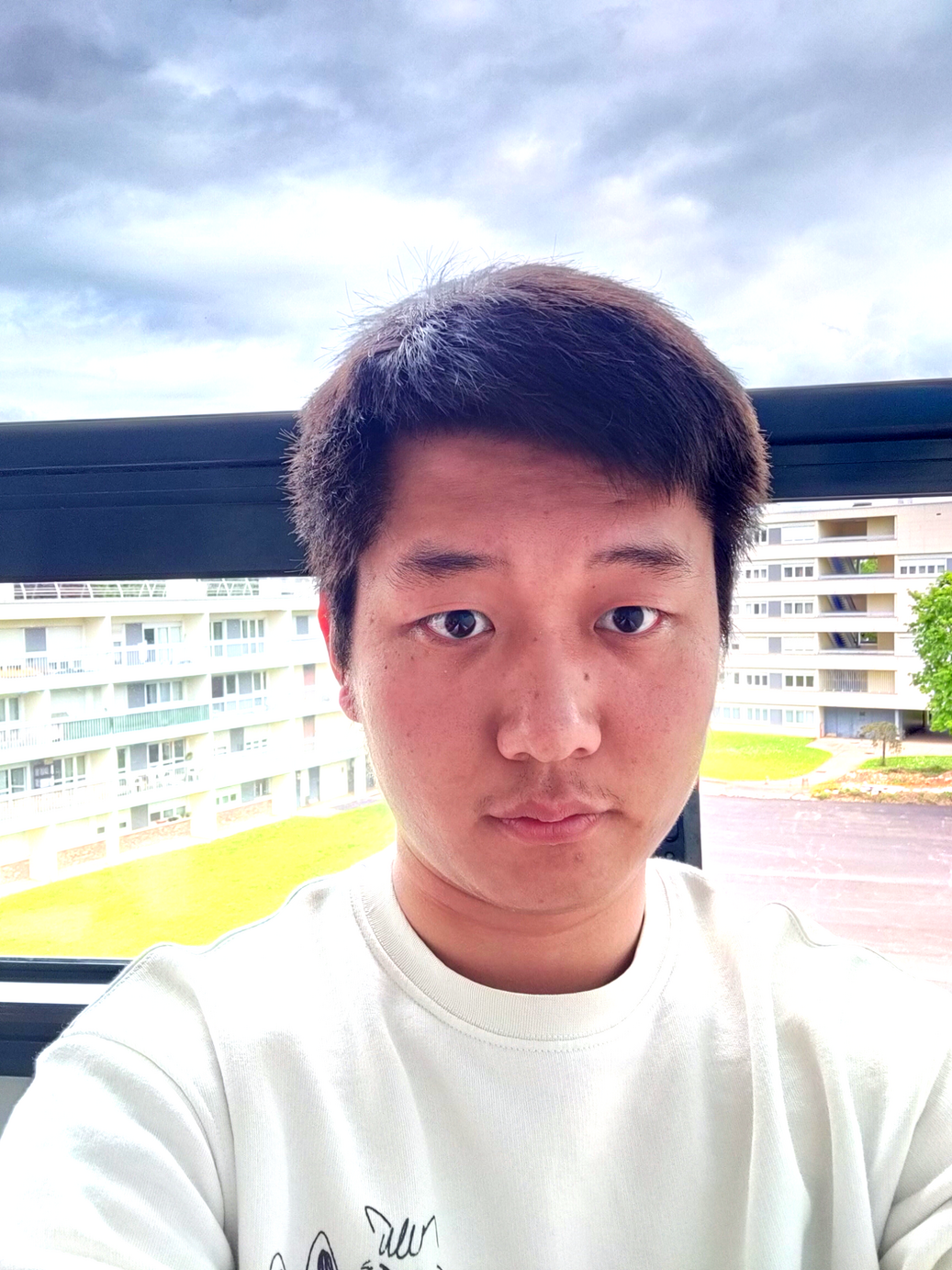
 Shuo Yang
· 6 previous affiliations
- CY Cergy Paris UniversitéSince 2023
- PhD student · 2023–2027
- Vrije Universiteit BrusselSince 2023
- PhD student · 2023–2027
- Luokung Technology2021–2022
- Computer Vision Engineer · 2021–2022
- Polytech Tours2021
- Intern · 2021
- École Centrale de Nantes2018–2021
- MS student · 2019–2021
- Master's degree, Advanced Robotics · 2018–2021
- Jilin University2015–2019
- Bachelor's degree, Electrical, Electronic and Communications Engineering Technology/Technician · 2015–2019
17 other authors named Shuo Yang: Shuo Yang (University of Hong Kong · 49 papers), Shuo Yang (Harbin Institute of Technology · 49 papers), Shuo Yang (25 papers), Shuo Yang (International Computer Science Institute · 20 papers), Shuo Yang (Peking University · 9 papers), and 12 more
Research Overview
Shuo Yang focuses on geometric deep learning, specifically designing neural network architectures for non-Euclidean spaces and matrix manifolds. His trajectory spans the development of foundational operations for symmetric positive definite and Grassmann manifolds using gyrovector spaces. His current work investigates unified mathematical frameworks for building attention mechanisms and fully-connected layers on symmetric spaces of noncompact type.
Research Trajectory
Shuo Yang’s research trajectory is defined by a sustained effort to adapt deep learning methodologies to non-Euclidean geometries. Beginning in 2023, he contributed to the area of The Computational Overhead of Non-Euclidean Deep Learning by extending the mathematical framework of gyrovector spaces to matrix manifolds. In Building Neural Networks on Matrix Manifolds: A Gyrovector Space Approach, Yang and his collaborators generalized missing geometric concepts—such as inner products, gyroangles, and hyperplanes—to Symmetric Positive Definite (SPD) and Grassmann manifolds. This work unlocked new building blocks like Multiclass Logistic Regression for these spaces, advancing the research direction of Manifold Valued Neural Architectures while maintaining high parameter efficiency in tasks involving human action recognition and knowledge graph completion.
Building on these foundational operations, the trajectory progressed toward more comprehensive architectural frameworks. In 2024, he co-authored Matrix Manifold Neural Networks++, which generalized core deep learning components, including fully-connected and convolutional layers, directly to SPD and Grassmann manifolds. By leveraging the algebraic structure of gyrovector spaces, this research provided a principled method for constructing deep architectures for non-Euclidean data. This contribution sits within the broader area of Machine Learning on Curved Riemannian Manifolds and intersects with specialized work in Deep Learning on Symmetric Positive Definite Manifolds and the area of Log-Euclidean Embeddings for Geometric Deep Learning.
Most recently, in 2025, Yang's work has expanded to encompass even broader geometric families. In Neural networks on Symmetric Spaces of Noncompact Type, he and his co-authors introduced a unified mathematical framework for building neural networks on symmetric spaces of noncompact type, a category that includes both hyperbolic spaces and SPD manifolds. By deriving a novel "point-to-hyperplane" distance based on Busemann functions, the research enabled the design of general-purpose fully-connected layers and attention mechanisms. This advancement significantly contributes to the research direction of Generalizing Machine Learning to Arbitrary Riemannian Manifolds, demonstrating strong performance across diverse domains such as image classification, EEG analysis, and natural language processing.
Current Directions
Recent work investigates unified mathematical frameworks that can seamlessly operate across diverse non-Euclidean geometries. The most recent papers in the evidence address the challenge of designing general-purpose neural network components—such as attention mechanisms and fully-connected layers—for symmetric spaces of noncompact type. By utilizing advanced geometric concepts like Busemann functions to define point-to-hyperplane distances, this research aims to create versatile models capable of handling complex data structures across varied domains, including computer vision, physiological signal analysis, and natural language tasks.
Profile updated
Loading new papers…
Other researchers whose papers cluster into the same research directions — a proxy for overlapping technical interests and shared intellectual neighborhoods.
See something wrong? Report a mistake