

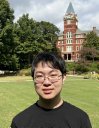
 Shuo Cheng
· 2 previous affiliations
- Georgia Institute of TechnologySince 2022
- PhD student · Since 2022
- University of California San Diego2018–2020
- MS student · 2018–2020
Research Overview
Shuo Cheng focuses on robotics, computer vision, and machine learning, with an emphasis on enabling robots to reason and perform complex, long-horizon tasks. His trajectory spans early work in computer vision and 3D reconstruction to recent developments in task and motion planning and robot learning. His current research investigates skill acquisition, domain adaptation, and generalizable manipulation in highly variable environments.
Research Trajectory
His early research explored foundational problems in computer vision and machine learning. In 2018, he collaborated on Fine-Grained Video Captioning for Sports Narrative, developing a pipeline that incorporated human pose and optical flow to automatically narrate sports games. The following year, he investigated sequential patterns in recommender systems, contributing to CosRec: 2D Convolutional Neural Networks for Sequential Recommendation, which encoded item sequences into three-way tensors to capture complex item correlations.
By 2020, his focus shifted toward 3D computer vision and scene reconstruction. He participated in developing methods to enforce consistency between surface normals and depth in multi-view stereo, detailed in Normal Assisted Stereo Depth Estimation. Building on this domain, he introduced a multi-stage framework for high-resolution depth estimation in Deep Stereo Using Adaptive Thin Volume Representation With Uncertainty Awareness. This work proposed spatially varying depth hypotheses to manage memory constraints, advancing the research direction of Uncertainty Guided Adaptive Search and Sampling.
Transitioning into robotics and physical interaction, he began addressing the challenges of robotic manipulation. In Learning to Regrasp by Learning to Place (2021), he proposed a point-cloud-based system that uses stable intermediate placements to transform initial grasp poses into desired configurations. This contribution aligns with the broader area of Robotic Vision Beyond the Pre-Segmented Object Assumption.
In 2023, his work expanded into imitation learning, dynamics modeling, and long-horizon planning. To address the suboptimal nature of human demonstrations, he collaborated on Learning to Discern: Imitating Heterogeneous Human Demonstrations with Preference and Representation Learning, an offline imitation learning framework that filters diverse data quality, contributing to the research area of Salvaging Success from Failed Agent Trajectories. Concurrently, he explored the manipulation of granular materials in Neural Field Dynamics Model for Granular Object Piles Manipulation. This project utilized a density field-based representation to exploit spatial locality, intersecting with research directions such as Local Spatial Inductive Biases for Physical Dynamics and the area of Continuous Spline Parameterization for Kinematic Trajectory Smoothing.
A major theme of his recent trajectory is the integration of Task and Motion Planning (TAMP) with learning-based methods to achieve complex, long-horizon tasks. He developed LEAGUE: Guided Skill Learning and Abstraction for Long-Horizon Manipulation, a framework that uses TAMP's symbolic plans to guide deep reinforcement learning for composable sensorimotor skills. He extended this paradigm in NOD-TAMP: Generalizable Long-Horizon Planning with Neural Object Descriptors (2024), which combined neural object descriptors with TAMP to learn adaptable skills from minimal human demonstrations, improving generalization across diverse object shapes and poses.
Most recently, in 2025, his research has addressed domain adaptation and continual learning. He introduced a unified framework for sim-to-real transfer in Generalizable Domain Adaptation for Sim-and-Real Policy Co-Training, leveraging Unbalanced Optimal Transport to align observations and actions between simulated and real-world environments. Additionally, he proposed LG-SAIL in Continual Robot Learning via Language-Guided Skill Acquisition, a framework that utilizes Large Language Models to guide sequential and incremental skill learning, overcoming the limitations of domain-specific skills in traditional TAMP.
Current Directions
The most recent papers in the evidence address the challenges of deploying robotic systems in complex, real-world environments through advanced domain adaptation and continual learning. Recent work investigates "sim-and-real" policy co-training, utilizing optimal transport techniques to align simulated data with real-world demonstrations for robust generalization. Additionally, current research explores the intersection of large language models and robot learning, focusing on language-guided frameworks that enable robots to incrementally acquire and adapt skills for long-horizon tasks without relying exclusively on rigid, domain-specific programming.
Profile updated
Loading new papers…
Other researchers whose papers cluster into the same research directions — a proxy for overlapping technical interests and shared intellectual neighborhoods.
See something wrong? Report a mistake