

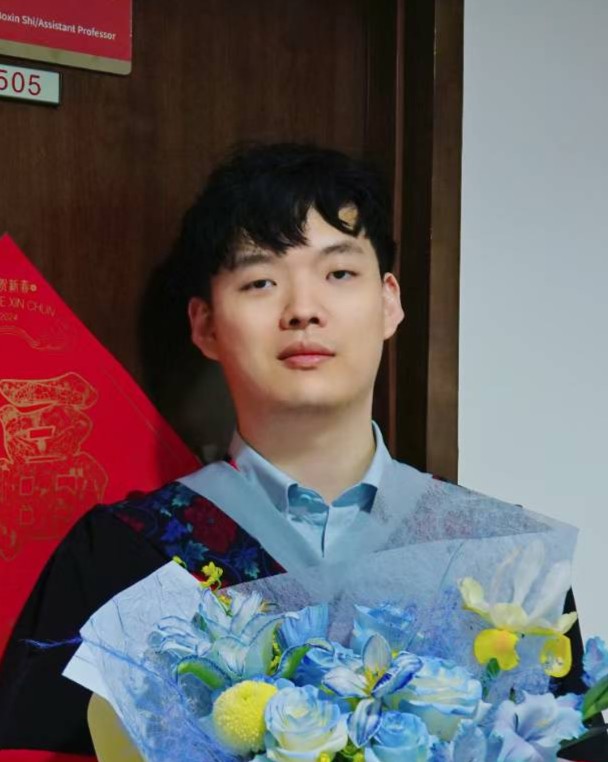
 Shuchen Weng
· 3 previous affiliations
- Researcher · Since 2024
- Peking UniversityCurrent
- Current
- PhD student · 2019–2024
- Tianjin University2015–2019
- Undergrad student · 2015–2019
Research Overview
Shuchen Weng focuses on generative computer vision, specifically image and video editing, language-guided colorization, and conditional image repainting. His trajectory spans from early work on spatial compositing and semantic image manipulation to advanced multimodal generation frameworks. Recently, his research emphasizes physics-aware semantic editing, affective image manipulation, and audio-synchronized video generation.
Research Trajectory
Shuchen Weng's research trajectory began with a focus on conditional image generation and compositing, addressing the semantic gaps between user inputs and generated visual content. In Conditional Image Repainting via Semantic Bridge and Piecewise Value Function, he introduced a mechanism to seamlessly composite generated content onto user-provided images while preserving the semantics of language inputs. This focus on spatial adaptability continued in MISC: Multi-Condition Injection and Spatially-Adaptive Compositing for Conditional Person Image Synthesis, which improved condition injection mechanisms by removing spatially-invariance constraints for more robust person image synthesis. Concurrently, he explored attention mechanisms in other domains, such as Context-Aware Cross-Attention for Skeleton-Based Human Action Recognition, which utilized lightweight RGB video features to inform network context and dynamically focus on relevant skeleton joints.
By 2022, Weng's work shifted toward Transformer-based architectures, specifically addressing challenges in image colorization and unified repainting. He developed frameworks to bridge the semantic gap between vision and language, notably in L-CoDer: Language-Based Colorization with Color-Object Decoupling Transformer. This work explicitly decoupled color and object terms within a Transformer to achieve global consistency, contributing to the broader research area of Spatial Attention Masking in Generative Diffusion Models. He also collaborated on CT2: Colorization Transformer via Color Tokens, an end-to-end framework that treated colorization as a classification task using discrete color tokens to resolve issues of color bleeding and under-saturation. In parallel, he advanced image editing with UniCoRN: A Unified Conditional Image Repainting Network, which integrated background information and multi-modal constraints into a single framework. This approach moved away from traditional two-step processes, aligning with the research direction of Photometric Consistency in Generative Object Insertion.
Building on these foundations, Weng's research expanded to incorporate physical realism and formalize the repainting task. He participated in the development of LuminAIRe: Illumination-Aware Conditional Image Repainting for Lighting-Realistic Generation, a framework that ensures newly generated objects possess physically realistic lighting and shadows by estimating environment lighting from the background. This contribution advanced the field of Physics-Constrained Generative Modeling for Image Restoration. He subsequently formalized these concepts in Conditional Image Repainting, defining condition inputs and formulating two-phased models to synthesize realistic visual content based on multiple cross-modality conditions.
In 2025, Weng's trajectory broadened significantly into affective computing and physics-aware semantic editing. He introduced frameworks to translate abstract emotions from text captions into concrete visual adjustments, as detailed in Toward Deeper Emotional Reflection: Crafting Affective Image Filters With Generative Priors. This work, which evolved from Transformer-based architectures to Diffusion-based models equipped with Large Language Model reasoning, contributed to the area of Bridging the Affective Gap in Computer Vision. He further explored photographic style transfer in Personalized Image Filter: Mastering Your Photographic Style, leveraging diffusion models to decompose style into distinct photographic concepts while preserving image structure. Simultaneously, he addressed disentangled control over high-level semantics and low-level physical properties in PhyS-EdiT: Physics-aware Semantic Image Editing with Text Description, combining a dual-network architecture with synthetic datasets to achieve precision in physics-aware editing.
Most recently, Weng has focused on the temporal dimension, developing advanced frameworks for video generation and editing. In VIRES: Video Instance Repainting via Sketch and Text Guided Generation, he integrated Sequential ControlNet and sketch-specific attention into a Diffusion Transformer backbone to perform precise instance-level repainting, advancing the research direction of 3D Convolutions for Spatiotemporal Feature Learning. He also tackled audio-visual synchronization in Audio-Sync Video Generation with Multi-Stream Temporal Control, proposing a framework that demixes audio into separate tracks for speech, sound effects, and music to achieve precise event timing and lip-syncing. This was followed by collaborative work on Audio-sync Video Instance Editing with Granularity-Aware Mask Refiner, a unified framework combining a diffusion-based video backbone with an iterative mask refiner and an LLM-driven audio agent. His recent affective computing research culminated in Affective Image Editing: Shaping Emotional Factors via Text Descriptions, which leverages a continuous emotional spectrum and Multimodal Large Language Models to manipulate factors like color tone and facial expressions, contributing to the area of Continuous Dimensional Spaces for Affective Computing. Finally, he extended language-guided colorization to the temporal domain with L-C4: Language-based video colorization for creative and consistent color, ensuring semantic accuracy and temporal consistency in video colorization.
Current Directions
Recent work investigates the intersection of multimodal generation and temporal consistency, with a strong emphasis on audio-synchronized video editing and affective computing. The most recent papers in the evidence address the challenge of maintaining strict temporal synchronization and spatial control in video generation, utilizing techniques such as multi-stream temporal demixing and LLM-driven audio agents to coordinate speech, sound effects, and visual instances. Concurrently, ongoing research explores affective image manipulation, leveraging continuous emotional spectra and Multimodal Large Language Models to translate nuanced text descriptions into complex, emotion-evoking visual adjustments. These directions highlight a broader focus on fine-grained, multimodal control in generative computer vision.
Profile updated
Loading new papers…
Other researchers whose papers cluster into the same research directions — a proxy for overlapping technical interests and shared intellectual neighborhoods.
See something wrong? Report a mistake