

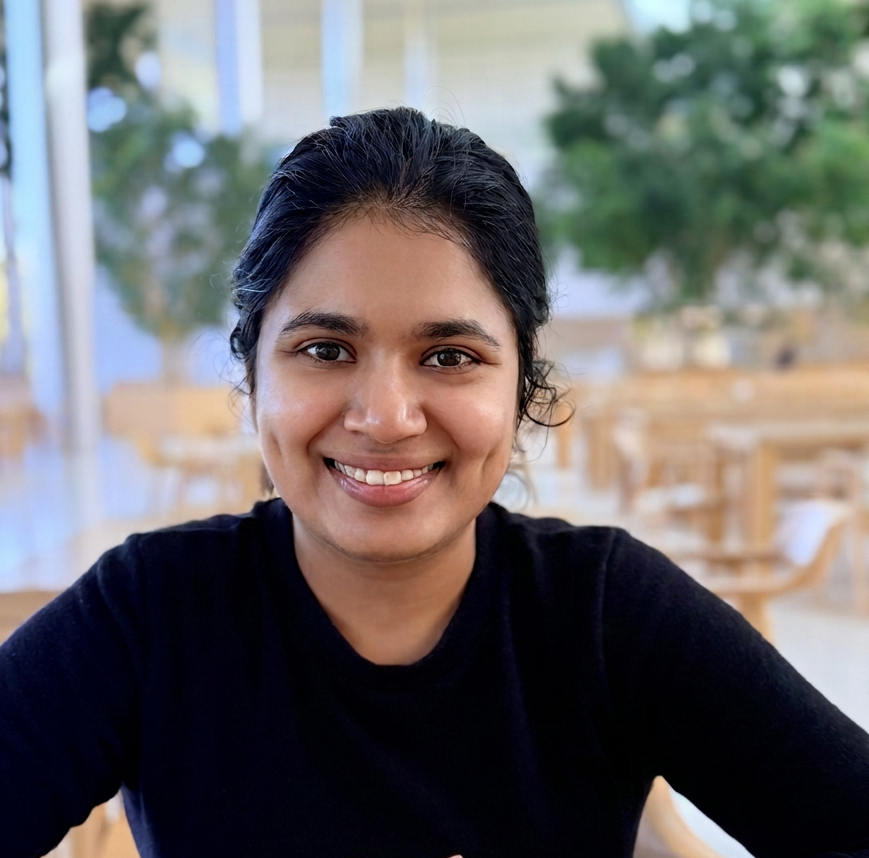
 Shruti Palaskar
· 6 previous affiliations
- Apple (United States)Since 2022
- Researcher · Since 2022
- Carnegie Mellon University2016–2022
- PhD student · 2018–2022
- MS student · 2016–2018
- Research Intern · 2021
- Research Intern · 2020
- Abridge2019
- Research Intern · 2019
- Research Intern · 2018
Research Overview
Shruti Palaskar focuses on multimodal foundation models, vision-language reasoning, and artificial intelligence safety. Her early work explored multimodal learning from video and speech, developing architectures to fuse audio, visual, and textual data for low-resource languages and accessibility. Recently, her research addresses the alignment and safety of multimodal systems, specifically investigating how joint image-text reasoning introduces emergent vulnerabilities.
Research Trajectory
Shruti Palaskar's early research concentrated on building foundational datasets and architectures for multimodal language understanding, with a particular emphasis on video and speech processing. In 2018, she contributed to the creation of How2: A large-scale dataset for multimodal language understanding, which provided instructional videos paired with English subtitles and Portuguese translations. This resource established sequence-to-sequence baselines for tasks such as multimodal summarization, machine translation, and automatic speech recognition.
During this period, she also explored how multimodal data could aid languages lacking written forms. Her participation in the JSALT 2017 workshop led to Linguistic unit discovery from multimodal inputs in unwritten languages: Summary of the "Speaking Rosetta" JSALT 2017 Workshop. This work demonstrated how images and translations from high-resource languages could help discover linguistic units directly from raw speech, advancing the area of Strategies for Low Resource Speech Translation and the research direction Visual Grounding as a Universal Language Pivot. Continuing her work on accessibility and multimodal resources, she collaborated on How2Sign: A Large-Scale Multimodal Dataset for Continuous American Sign Language in 2021. This dataset provided over 80 hours of synchronized video, speech, and text, including a specialized 3D pose subset, to support sign language recognition and generation. Her investigations into the complexities of fusing audio, visual, and textual modalities culminated in her 2023 publication, Multimodal Learning from Videos: Exploring Models and Task Complexities, which synthesized her architectural approaches to video-based reasoning.
Following her transition to an industry research role as a Senior Research Scientist at Apple, her focus shifted toward the alignment and safety of multimodal foundation models. In 2025, she co-developed SafetyPairs: Isolating Safety Critical Image Features with Counterfactual Image Generation, an automated framework that generates counterfactual image pairs differing only by subtle, safety-critical features. This benchmark revealed perceptual blind spots in state-of-the-art vision-language models, contributing to the area of The Cross Modal Safety Gap in Multimodal Models and the broader field of Closed Loop Semantic Verification for Multimodal Generation.
Expanding on the challenges of joint modality evaluation, she introduced JOINTMMSAFE: A Combinatorial Safety Benchmark for Multimodal Foundation Models. This framework addressed the limitations of evaluating vision and language inputs in isolation by introducing a borderline severity level to better distinguish unsafe content from benign combinations that become harmful only when joined. Most recently, she presented VLSU: Mapping the Limits of Joint Multimodal Understanding for AI Safety. This comprehensive benchmark demonstrated that while models achieve high accuracy on individual modalities, their performance degrades significantly when joint image-text reasoning is required. This research highlights critical vulnerabilities in the research area of Emergent Safety Risks from Benign Multimodal Inputs and informs ongoing efforts in the area of Mitigating the Alignment Tax in Large Language Models.
Current Directions
Recent work investigates the safety and alignment of multimodal foundation models, with a particular emphasis on vulnerabilities that arise at the intersection of vision and language. The most recent papers in the evidence address the phenomenon of emergent harm, where text and images that are benign in isolation become unsafe when combined. To systematically evaluate these risks, current research focuses on developing large-scale, combinatorial safety benchmarks and counterfactual image generation frameworks. These tools are designed to map the limits of joint multimodal understanding, isolate fine-grained safety-critical features, and improve the sample efficiency of training guard models to prevent over-blocking and under-refusal in complex, real-world scenarios.
Profile updated
Loading new papers…
Other researchers whose papers cluster into the same research directions — a proxy for overlapping technical interests and shared intellectual neighborhoods.
See something wrong? Report a mistake