

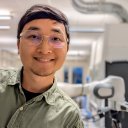
 Shih-Min Yang
· 4 previous affiliations
- Örebro UniversityCurrent
- Current
- PhD student · 2021
- Research Intern · 2024
- VoiceTube2020–2021
- Machine Learning Engineer · 2020–2021
- National Taiwan Normal University2017–2020
- Research Assistant · 2019–2020
- MS student · 2017–2019
Research Overview
Shih-Min Yang focuses on improving learning efficiency in robotic manipulation and developing methods that enable autonomous systems to adapt to diverse tasks with limited supervision. His work integrates hierarchical reinforcement learning, intrinsic reward-based exploration, and neural implicit representations to address the challenges of sparse rewards and complex environment dynamics. Currently a doctoral student at Örebro University and affiliated with the Wallenberg AI, Autonomous Systems and Software Program (WASP), Yang’s research is situated within the broader context of the DARKO EU project, aiming toward the development of general-purpose robotic capabilities.
Research Trajectory
Yang’s academic background began with a focus on computer vision and domain adaptation during his master’s studies at National Taiwan Normal University. This early work established a foundation in high-dimensional data processing and the challenges of transferring learned models across different distributions. Following a period in industry as a machine learning engineer, his research trajectory shifted toward the intersection of perception and action in robotics.
Upon joining Örebro University, Yang began investigating the "curse of dimensionality" in robotic control, where the vast state space of multi-degree-of-freedom robots makes end-to-end learning computationally prohibitive. This led to an emphasis on Hierarchical Decoupling of Strategic Planning and Motor Execution. His early doctoral work addressed the problem of pre-grasp manipulation, where objects are not immediately graspable due to environmental obstructions. By employing hierarchical reinforcement learning (HRL), he developed methods to distill controllers that execute sequences of learned action primitives, allowing robots to exploit environmental constraints to reconfigure objects for successful grasping.
By 2025, Yang’s focus expanded to the fundamental problem of exploration in reinforcement learning (RL). In environments with sparse rewards, standard agents often fail to discover optimal policies because they lack sufficient signal to guide their search. Yang’s work in this period addressed the conflict between exploitation and exploration, specifically investigating how to prevent agents from becoming trapped in "exploration loops" where they repeatedly visit known but non-optimal states. This research aligns with the theme of Decoupling Exploration from Execution in Reinforcement Learning, proposing frameworks that proactively coordinate different exploration strategies to maintain agent momentum in undiscovered territory.
Most recently, Yang has extended his research into the domain of spatio-temporal mapping and navigation in dynamic environments. This shift involves moving away from traditional discrete grid-based representations toward continuous neural implicit models. This work addresses the complexities of Resolving Navigation Paralysis in Dense Human Crowds, where robots must navigate safely and efficiently among moving humans. His recent contributions involve mapping human motion patterns directly into neural fields, which facilitates smoother trajectory prediction and avoids the artifacts associated with discretized maps.
Current Directions
Yang’s current research is increasingly focused on the integration of robotic foundation models and the maintenance of policy diversity. A significant portion of his recent output explores Preventing Entropy Collapse in Reinforcement Learning. This involves balancing the stochastic nature of policy-based agents with novelty-seeking rewards to ensure that agents do not converge prematurely on sub-optimal behaviors.
Furthermore, his involvement in the DARKO project has led to practical applications in multi-agent and human-robot interaction scenarios. This includes exploring how robots can navigate social spaces without causing "freezing" behaviors, a common failure mode in dense crowds. This line of inquiry also touches upon Engineering Altruism in Multi-Agent Reinforcement Learning, where agents must balance individual task completion with the collective flow of a shared environment. Additionally, his work continues to grapple with Integrating Kinematic Constraints into Neural Trajectory Predictors, ensuring that the trajectories generated by neural models remain grounded in the physical realities of robotic hardware and environment geometry.
Representative Work
Data-driven Grasping and Pre-grasp Manipulation Using Hierarchical Reinforcement Learning with Parameterized Action Primitives In this first-author paper, Yang introduces DHPAP, a framework designed for complex grasping tasks where a target object is initially obstructed. The method utilizes hierarchical reinforcement learning to learn a sequence of manipulation actions. By leveraging parameterized feedback-based action primitives, the system can change an object's pose through environmental interaction, eventually reaching a configuration that allows for a successful grasp. This work demonstrates the utility of HRL in breaking down long-horizon manipulation tasks into manageable sub-problems.
KEA: Keeping Exploration Alive by Proactively Coordinating Exploration Strategies in Curiosity-driven Exploration As the lead author, Yang addresses the limitations of Soft Actor-Critic (SAC) and novelty-based exploration in sparse reward environments. The paper identifies a critical challenge: the difficulty of balancing SAC’s inherent stochasticity with external novelty rewards, which often leads to inefficient exploration or premature convergence. The proposed KEA framework proactively switches between novelty-seeking and high-entropy policies, ensuring the agent continues to explore truly novel states rather than oscillating within known areas.
KEA: Keeping Exploration Alive by Proactively Coordinating Exploration Strategies This work further elaborates on the KEA framework, emphasizing its role in preventing "exploration loops." By coordinating exploration strategies, the method achieves significant efficiency gains in complex continuous control tasks. The research highlights the necessity of strategic coordination over simple heuristic-based exploration, providing a more robust mechanism for agents to navigate environments where the reward signal is infrequent or difficult to locate.
NeMo-map: Neural Implicit Flow Fields for Spatio-Temporal Motion Mapping In this second-author contribution, Yang participated in the development of NeMo-map, a continuous neural-implicit representation for mapping human motion patterns. Unlike traditional discrete grids, which suffer from resolution limits and artifacts, NeMo-map maps spatio-temporal coordinates directly to the parameters of a statistical motion model. This approach enables more accurate robot navigation and trajectory prediction in crowded environments by providing a smooth, differentiable representation of how motion patterns evolve over both space and time.
Profile updated
Loading new papers…
Other researchers whose papers cluster into the same research directions — a proxy for overlapping technical interests and shared intellectual neighborhoods.
See something wrong? Report a mistake