

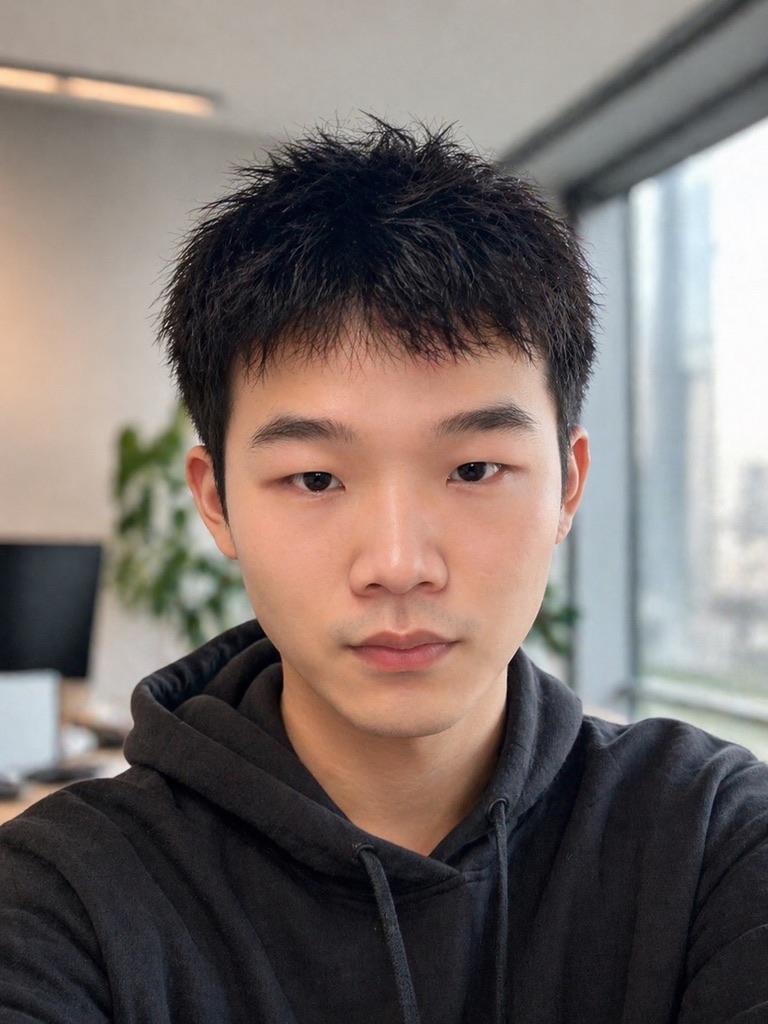
 Shigeng Wang
· 3 previous affiliations
- Intel (Israel)Since 2024
- Intern · Since 2024
- Current
- PhD student · 2021–2026
Research Overview
Shigeng Wang focuses on model quantization, hardware-efficient acceleration, and computer vision. His early work addressed lightweight object detection and applied machine learning for medical diagnostics. More recently, his research has shifted toward efficient deep learning, specifically targeting post-training quantization and compression techniques for large language models to enable high-fidelity, low-bit inference.
Research Trajectory
Wang's early research centered on computer vision applications, particularly in optimizing object detection for specialized domains. In 2021, he introduced PowerDet: Efficient and Lightweight Object Detection for Electric Power Open Scenes, a model designed to overcome the limitations of multi-scale object detection on mobile devices during electrical grid maintenance. This focus on specialized visual recognition extended into medical diagnostics, where he contributed to Deep learning-based classification of infectious keratitis on slit-lamp images (2022) and the subsequent Development and multi-center validation of machine learning model for early detection of fungal keratitis (2023), applying deep learning to improve early detection rates from clinical imagery. During this period, he also participated in broader computer vision research, collaborating on an Episodic Projection Network for Out-of-Distribution Detection in Few-shot Learning (2022) to project feature vectors into task-specific spaces without losing generalization.
Continuing his work on challenging visual environments, Wang investigated the detection of small and densely packed objects. He co-developed a Research on Dense-Tiny Object Detection Method of Transmission Line Based on Dynamic NMS (2023). This trajectory matured into sophisticated architectures for unmanned aerial vehicles (UAVs). In 2025, he published HSFANet: Hierarchical Scale-Sensitive Feature Aggregation Network for Small Object Detection in UAV Aerial Images, which utilized dynamic position aggregation and scale-sensitive loss to identify tiny objects in high-resolution aerial imagery. He further refined these techniques with SSABNet: Spatial-Semantic Aggregation and Balancing Network for Small-Target Detection in UAV Remote Sensing Images (2026), addressing the irreversible loss of fine-grained spatial details during hierarchical feature extraction in severe background clutter.
Concurrently, Wang's research expanded into the domain of efficient deep learning for foundation models, specifically focusing on the area of Mitigating the Computational Overhead of Model Quantization. In 2026, he presented SliderQuant: Accurate Post-Training Quantization for LLMs, a framework that moves away from uniform compression strategies. By employing adaptive sliding windows that account for the heightened sensitivity of a model's initial and final layers, the work advanced the research direction of Sensitivity Aware Mixed Precision for Transformer Quantization and contributed to the broader area of Global Optimization for Low Bit Model Quantization.
Building on the need for extreme compression, he subsequently developed CAT-Q: Cost-efficient and Accurate Ternary Quantization for LLMs (2026). This method compresses large language models to 1.58 bits using only a small set of calibration samples, drastically reducing data requirements and memory usage. The work intersects with several critical research areas, including Multiplication Free Inference with Ternary Neural Networks, Sequential Error Compensation for Neural Network Compression, and the field of Differentiable Soft Quantization for Discrete Latent Models.
In addition, Wang contributed to The Devil Is in the Reconstruction Loss Scale: Rethinking Optimization in LLM Quantization (2026), investigating cross-stage optimization imbalances in sequential post-training quantization and showing that RMSE variants decouple optimization strength from loss scale via implicit gradient normalization. Alongside model compression, Wang also addressed power systems engineering, formulating Decentralized Stability-Constrained Optimal Power Flow for Inverter-Based Power Systems (2026) to manage operational stability in modern decentralized grid networks.
Current Directions
The most recent papers in the evidence indicate research spanning model compression for large language models, fine-grained object detection in remote sensing, and stability optimization in power systems. In the domain of efficient deep learning, Wang is investigating post-training quantization methods that reduce the memory and computational footprints of foundation models. This includes developing adaptive, layer-sensitive quantization frameworks and exploring ternary weight representations to enable multiplication-free inference without the need for extensive retraining. Concurrently, his work in computer vision continues to address the challenges of small-target detection in UAV imagery, focusing on spatial-semantic aggregation architectures that preserve weak target cues in cluttered, high-resolution environments.
Profile updated
Loading new papers…
Other researchers whose papers cluster into the same research directions — a proxy for overlapping technical interests and shared intellectual neighborhoods.
See something wrong? Report a mistake