

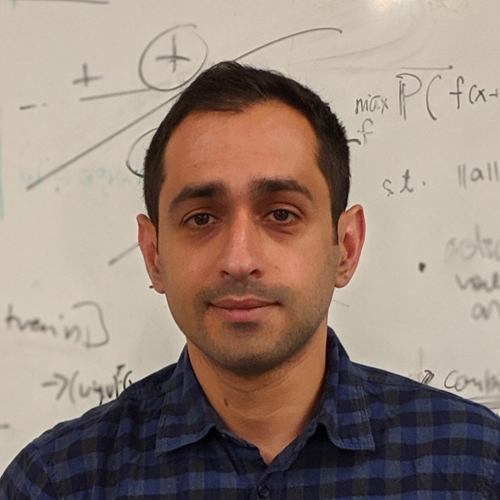
 Shahin Jabbari
· 3 previous affiliations
- Drexel UniversitySince 2021
- Assistant Professor · Since 2021
- Harvard University2019–2021
- Postdoc · 2019–2021
- University of Pennsylvania2013–2019
- PhD student · 2013–2019
Research Overview
Shahin Jabbari focuses on machine learning theory, algorithmic fairness in sequential decision making, and strategic network formation. His early work explored learning under noise and crowdsourced classification, eventually shifting toward the intersection of reinforcement learning and fairness constraints. Most recently, his research addresses multi-objective policy optimization and the reliability of post hoc explanation methods in complex models.
Research Trajectory
Jabbari's early research focused on foundational machine learning theory and crowdsourcing. He introduced a framework for analyzing class noise in PAC learning, studying properties that enable learning with empirical risk minimization in PAC-Learning with General Class Noise Models. Shortly after, he collaborated on adaptive task assignment mechanisms for crowdsourced classification, contributing to the research direction of Modeling Heterogeneous Task Difficulty with the publication Adaptive Task Assignment for Crowdsourced Classification.
Moving into optimization and strategic behavior, Jabbari developed mistake-bound learning algorithms to predict the solutions of linear programs when only partial information about objectives and constraints is available. This work, detailed in Learning from Rational Behavior: Predicting Solutions to Unknown Linear Programs, advanced the broader area of Learning Optimization Models from Observed Decisions. Concurrently, he began investigating strategic network formation games. With collaborators, he modeled scenarios where agents balance the benefits of connectivity against the costs of link formation and vulnerability to adversarial attacks, as presented in Strategic Network Formation with Attack and Immunization.
Between 2016 and 2019, a central theme of algorithmic fairness emerged in his work, particularly in sequential decision-making contexts. He led foundational research extending fairness constraints to reinforcement learning, where an algorithm's actions influence future states and rewards. In Fair Learning in Markovian Environments, he demonstrated that while exact fairness is computationally prohibitive, a relaxed "approximate-action fairness" allows for efficient learning. He further formalized these constraints in Fairness in Reinforcement Learning. Together, these papers significantly shaped the research direction of Long-Term Fairness in Dynamic Decision Systems. Expanding on fairness in resource distribution, he also collaborated on Fair Algorithms for Learning in Allocation Problems, which examined how to allocate scarce resources while maintaining equality of opportunity across different demographic groups. During this period, he also continued his research on network resilience, co-authoring Network Formation under Random Attack and Probabilistic Spread to analyze equilibrium networks under independent cascade failure models.
In recent years, Jabbari's collaborative work has expanded into complex game theory, applied policy optimization, and explainable AI. He participated in the development of novel methods for structured hierarchical games in Solving structured hierarchical games using differential backward induction. Applying reinforcement learning to public health policy, he contributed to Robust Lock-Down Optimization for COVID-19 Policy Guidance, which proposed robust, multi-objective approaches for balancing disease transmission and economic impact. Most recently, he has investigated the practical challenges of machine learning interpretability. His work on The Disagreement Problem in Explainable Machine Learning: A Practitioner’s Perspective formalizes how post hoc explanation methods often contradict one another, contributing to the critical research area of The Reliability Gap in Explaining Complex Neural Networks.
Current Directions
The most recent papers in the evidence indicate a focus on the practical deployment, evaluation, and interpretability of complex machine learning systems. Recent work investigates the reliability of explainable AI, specifically addressing how practitioners resolve disagreements between conflicting post hoc feature attribution methods in high-stakes settings. Additionally, recent collaborative efforts address multi-objective reinforcement learning for policy guidance—such as pandemic lock-down optimization—and the computational challenges of solving structured hierarchical games.
Profile updated
Loading new papers…
Other researchers whose papers cluster into the same research directions — a proxy for overlapping technical interests and shared intellectual neighborhoods.
See something wrong? Report a mistake