

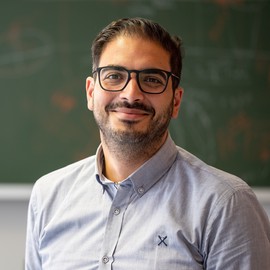
 Shadi Albarqouni
· 7 previous affiliations
- Helmholtz MunichSince 2020
- Helmholtz AI Young Investigator Group Leader · Since 2020
- Technical University of MunichSince 2013
- Senior Research Affiliate · Since 2020
- Postdoc · 2017–2020
- Postdoctoral Research Associate · 2013–2017
- University of BonnSince 2022
- TT W2 Professor of Computational Medical Imaging Research · Since 2022
- Helmholtz AI2020–2025
- AI Young Investigator Group Leader · 2020–2025
- Visiting Scientist · 2020
- ETH Zurich2019–2020
- Visiting Scientist · 2019–2020
- iugaza2005–2010
- M.Sc, Electrical Engineering · 2005–2010
Research Overview
Shadi Albarqouni focuses on computational medical imaging, federated learning, and affordable artificial intelligence for healthcare. His early research explored crowdsourcing and unsupervised anomaly detection to overcome the scarcity of annotated medical data. More recently, his work addresses decentralized learning frameworks, uncertainty quantification, and the development of trustworthy clinical algorithms that remain robust across diverse global environments.
Research Trajectory
Albarqouni's early research addressed the fundamental challenge of data scarcity in medical machine learning. In 2016, he developed AggNet: Deep Learning From Crowds for Mitosis Detection in Breast Cancer Histology Images, a model designed to learn from noisy, non-expert crowdsourced annotations when expert ground-truth data is unavailable.
Recognizing the limitations of supervised learning in pathology, his focus expanded to unsupervised methods that do not require labeled anomaly data. He collaborated on Deep Autoencoding Models for Unsupervised Anomaly Segmentation in Brain MR Images (2018), which introduced a hybrid generative model to detect brain lesions by learning to reconstruct healthy anatomy and identifying anomalies through reconstruction errors. This work contributed to the broader research direction of Pseudo-healthy Reconstruction for Unsupervised Medical Anomaly Detection. During this period, his group also addressed domain shift in digital pathology with StainGAN: Stain Style Transfer for Digital Histological Images, leveraging cycle-consistent generative adversarial networks to normalize stain colors without manual reference slides. This advanced the area of Overcoming Cross-Institutional Domain Shift in Medical AI.
By 2021, his lab was rigorously evaluating and refining unsupervised anomaly detection. He led a comprehensive evaluation in Autoencoders for unsupervised anomaly segmentation in brain MR images: A comparative study, which identified restoration-based variational autoencoders as highly effective while highlighting remaining hurdles like domain shift. Concurrently, his group investigated the vulnerabilities of these generative approaches in The OOD Blind Spot of Unsupervised Anomaly Detection, demonstrating that models trained exclusively on healthy data can be susceptible to non-lesion out-of-distribution artifacts. Continuing to innovate in this space, he introduced SPA: Shape-Prior Variational Autoencoders for Unsupervised Brain Pathology Segmentation (2022), which disentangles healthy brain tissue components using learned shape priors to better isolate anomalies. He also extended unsupervised anomaly detection to volumetric computed tomography in CTFSH: Full Head CT Anomaly Detection with Unsupervised Learning, addressing the need for rapid triage in emergency clinical settings.
To further reduce reliance on large annotated datasets, Albarqouni's research explored self-supervised and semi-supervised paradigms. His lab developed Virtual embeddings and self-consistency for self-supervised learning, a framework that creates virtual embeddings via latent space interpolation to improve performance in low-data regimes, contributing to the area of Label Efficient Semi-Supervised Medical Image Segmentation.
A major parallel theme in Albarqouni's trajectory is the development of decentralized and privacy-preserving machine learning frameworks for healthcare. In 2021, his group introduced FedDis: Disentangled Federated Learning for Unsupervised Brain Pathology Segmentation, a novel approach that disentangles brain images into shape and appearance components. This allows hospitals to share anatomical knowledge globally while keeping scanner-specific noise local, advancing the area of Disentangling Data Ambiguity from Model Ignorance. He expanded this federated learning paradigm to handle multi-modal data in FedNorm: Modality-Based Normalization in Federated Learning for Multi-Modal Liver Segmentation (2022), which uses modality-based normalization to train global models effectively across heterogeneous CT and MRI scans from distributed institutions.
As his work matured, Albarqouni increasingly focused on the reliability and real-world deployment of clinical AI. In 2023, his lab developed Uncertainty for Proximal Femur Fractures Classification, a method that quantifies model uncertainty using Monte Carlo Dropout to provide a crucial quality control mechanism for clinical deployment. This focus on trustworthy AI culminated in his leadership of the FUTURE-AI consortium, where he spearheaded the FUTURE-AI: International consensus guideline for trustworthy and deployable artificial intelligence in healthcare, establishing an international framework to guide the ethical, legal, and clinical deployment of medical AI tools.
Current Directions
The most recent papers in the evidence, spanning 2023 to 2025, address the practical integration of deep learning into specialized clinical workflows and the challenge of learning from limited data in rare medical domains. Recent work investigates patient-specific segmentation frameworks for abdominal magnetic resonance imaging-guided radiation therapy, as seen in Enhancing patient-specific deep learning based segmentation for abdominal magnetic resonance imaging-guided radiation therapy: A framework conditioned on prior segmentation. This approach generates accurate segmentations without requiring a separate model for each patient, facilitating seamless clinical integration.
Additionally, his lab is developing multi-task learning architectures for grading rare precursors to eye lesions. In INTERACT-CMIL: Multi-Task Shared Learning and Inter-Task Consistency for Conjunctival Melanocytic Intraepithelial Lesion Grading, his group introduced a framework that simultaneously predicts multiple diagnostic criteria by enforcing inter-task consistency, improving reliability and interpretability for ocular pathologists. This ongoing research continues to advance the broader areas of Medical Image Segmentation with Limited Labels and Learning to Translate Images Without Paired Data.
Profile updated
Loading new papers…
Other researchers whose papers cluster into the same research directions — a proxy for overlapping technical interests and shared intellectual neighborhoods.
See something wrong? Report a mistake