

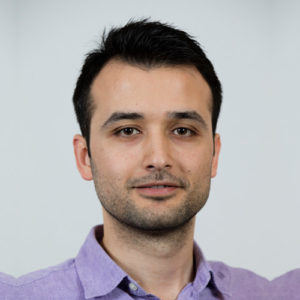
 Sezer Karaoglu
· 5 previous affiliations
- 3DUniversumSince 2014
- Co-Founder · Since 2014
- University of AmsterdamSince 2015
- Postdoc · Since 2015
- PhD student · 2017–2015
- Master Thesis · 2010–2011
- weScan.ioSince 2021
- Co-Founder · Since 2021
- FairfakeSince 2021
- Co-Founder · Since 2021
- ScanM (Acquired by 3DUniversum)2017–2019
- Co-Founder · 2017–2019
Research Overview
Sezer Karaoglu focuses on 3D computer vision, scene understanding, and generative artificial intelligence. His trajectory spans early work in object detection and intrinsic image decomposition to advanced methods for monocular 3D reconstruction and neural rendering. Currently, his research addresses the geometric consistency of AI-generated media, deepfake detection, and the physical fidelity of generative relighting models.
Research Trajectory
Karaoglu’s early research explored the intersection of text recognition and visual scene understanding. He introduced Object Reading: Text Recognition for Object Recognition (2012), which utilized text detection based on saliency cues to aid in visual object class recognition. He expanded on this integration of text and vision in Con-Text: Text Detection for Fine-Grained Object Classification and Words Matter: Scene Text for Image Classification and Retrieval (both 2017). During this period, he also investigated robust visual representations and ensemble methods, evaluating Age estimation under changes in image quality: An experimental study (2015) and developing Detect2Rank: Combining Object Detectors Using Learning to Rank (2016) to combine multiple object detectors for improved accuracy. Additionally, he began addressing illumination and geometry by estimating light sources from RGB-D data in Point Light Source Position Estimation From RGB-D Images by Learning Surface Attributes (2017).
Around 2018, Karaoglu’s focus shifted heavily toward 3D reconstruction and physical scene decomposition. Alongside his academic research, he is a co-founder of 3DUniversum, bridging his theoretical work with applied computer vision. He introduced a pipeline for Inferring Point Clouds from Single Monocular Images by Depth Intermediation (2018), which predicted depth maps to generate partial views before completing the 3D object using a 3D-CNN. Concurrently, he contributed to the research direction of Disentangling Reflectance and Shading in Natural Images. This is evident in his collaborative work on Joint Learning of Intrinsic Images and Semantic Segmentation (2018), which demonstrated that albedo invariance can improve the semantic segmentation of outdoor scenes. He continued advancing this area with PIE-Net: Photometric Invariant Edge Guided Network for Intrinsic Image Decomposition (2022), an edge-driven hybrid CNN designed to handle hard negative illumination transitions, contributing to the broader area of Physics Informed Photometric Invariance for Robust Vision.
Karaoglu has also tackled the geometric modeling of complex indoor environments. In Joint 3D Layout and Depth Prediction from a Single Indoor Panorama Image (2020), he developed a deep learning pipeline that uses an intermediate "layout depth map" to mutually reinforce 3D room layout and pixel-wise depth predictions. This work aligns with the area of Surface Normal Regularization for Geometric Consistency. He further integrated geometric priors into 3D reconstruction in Geometry-guided Feature Learning and Fusion for Indoor Scene Reconstruction (2023), embedding surface normals and viewing directions into feature learning to produce smoother meshes. This research advanced directions such as 3D Reconstruction of Textureless Surfaces and Visibility Aware Feature Aggregation for 3D Neural Representations. In 2024, he co-authored Ray-Distance Volume Rendering for Neural Scene Reconstruction, which replaced the standard Signed Distance Function with a Signed Ray Distance Function to eliminate interference from neighboring objects in complex indoor spaces.
Most recently, his trajectory has expanded into generative AI, neural rendering, and media forensics. He participated in developing GaussianBlender: Instant Stylization of 3D Gaussians with Disentangled Latent Spaces (2025), a feed-forward framework for the text-driven stylization of 3D Gaussian Splats. Addressing the rise of synthetic media, he introduced Grab-3D: Detecting AI-Generated Videos from 3D Geometric Temporal Consistency (2025), a framework that identifies AI-generated videos by tracking the trajectories of vanishing points to find geometric inconsistencies. His work on illumination evolved into generative relighting with LumiNet: Latent Intrinsics Meets Diffusion Models for Indoor Scene Relighting (2025), which transfers complex lighting between indoor images while preserving geometry. This culminated in Relighting as a Probe of Visual Priors via Augmented Latent Intrinsics (2026), which fused dense features from vision models with latent intrinsic representations to achieve high physical fidelity on challenging materials like glass and metal.
Current Directions
Karaoglu's most recent work investigates the intersection of generative artificial intelligence, 3D scene representations, and physical fidelity. A major current direction involves generative relighting and intrinsic image decomposition, where he explores how to transfer complex lighting conditions while preserving underlying geometry and materials. This includes probing the semantic-photometric trade-offs in foundational vision models to improve relighting on challenging, non-Lambertian surfaces.
Additionally, he is actively developing methods for the instant stylization and editing of 3D Gaussian Splats using disentangled latent spaces, moving away from slow per-asset optimization toward rapid, feed-forward generation. Another critical focus is media forensics; he is addressing the detection of AI-generated videos by analyzing 3D geometric temporal consistency, using physical constraints like vanishing point trajectories to identify synthetic content that otherwise appears photorealistic to standard 2D detectors.
Profile updated
Loading new papers…
Other researchers whose papers cluster into the same research directions — a proxy for overlapping technical interests and shared intellectual neighborhoods.
See something wrong? Report a mistake