

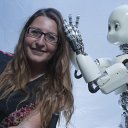
 Serena Ivaldi
· 4 previous affiliations
- Principal Researcher · Since 2023
- Researcher · 2014–2022
- Postdoc · 2014
- Sorbonne Université2011–2014
- Postdoc · 2011–2014
- Italian Institute of Technology2007–2011
- PhD student · 2007–2011
Research Overview
Serena Ivaldi focuses on humanoid robotics, whole-body control, and physical human-robot interaction. Her early work explored developmental approaches to object learning and multi-sensor dynamics on humanoid platforms like the iCub. More recently, her research addresses shared autonomy, co-manipulation tasks, and the optimization of whole-body controllers for complex interactive environments.
Research Trajectory
Ivaldi’s research trajectory begins with foundational work in humanoid robot dynamics and sensory integration. In 2012, as a second author, she contributed to Force feedback exploiting tactile and proximal force/torque sensing - Theory and implementation on the humanoid robot iCub. This work addressed the challenge of measuring whole-body dynamics for a multiple-branch kinematic chain subjected to unknown external forces. By aligning a system dynamics model with measurements from embedded force/torque sensors, inertial sensors, and distributed artificial skin, the research provided a robust methodology for adapting to continuously changing contact locations on the iCub platform.
Following this, her focus expanded to include developmental robotics, specifically how humanoid robots can learn about their environments through social interaction and physical manipulation. Serving as second author, she helped develop the framework presented in From passive to interactive object learning and recognition through self-identification on a humanoid robot (2016). Taking inspiration from infant development, this research proposed an incremental, unsupervised learning approach where a robot first learns object appearances passively by observing a human partner, and subsequently refines its models through active manipulation.
By 2018, Ivaldi’s work increasingly emphasized physical human-robot interaction (pHRI) and collaborative tasks. As senior author on Generating Assistive Humanoid Motions for Co-Manipulation Tasks with a Multi-Robot Quadratic Program Controller, she led research into real-time humanoid control for co-manipulation. The paper formulated a multi-robot quadratic program controller that simultaneously solved for human dynamics reconstruction and optimal robot controls, allowing the humanoid to maintain its own balance while actively assisting a human partner in shared objectives.
This interest in human-robot collaboration naturally extended into the broader paradigms of shared control and shared autonomy. In 2021, she co-authored Autonomy in Physical Human-Robot Interaction: A Brief Survey, which synthesized the research community's progress in designing robotic systems capable of seamlessly adapting their level of autonomy to reduce human cognitive and physical workload. Returning to the technical challenges of humanoid control, she served as senior author on Automatic Tuning and Selection of Whole-Body Controllers (2022), addressing the algorithmic optimization required to deploy these complex control architectures effectively.
Current Directions
The most recent papers in the evidence indicate a continued focus on human-machine interfaces and the practical deployment of advanced robotic systems in remote or collaborative settings. Ivaldi recently participated as a contributing author to Analysis and Perspectives on the ANA Avatar XPRIZE Competition (2024). This work investigates the use of telerobotics technologies and avatar systems designed to allow human operators to sense, communicate, and act in remote environments as though physically present. Her current trajectory bridges the low-level optimization of whole-body controllers with the high-level challenges of shared autonomy, telerobotics, and seamless physical human-robot interaction.
Profile updated
Loading new papers…
Other researchers whose papers cluster into the same research directions — a proxy for overlapping technical interests and shared intellectual neighborhoods.
See something wrong? Report a mistake