

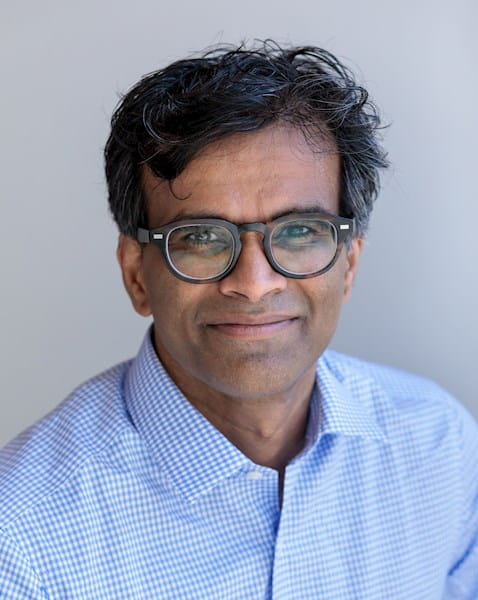
 Sendhil Mullainathan
· 1 previous affiliation
- University of ChicagoSince 2018
- Assistant Professor · Since 2018
Research Overview
Sendhil Mullainathan focuses on the intersection of machine learning, behavioral economics, and social policy. His research utilizes computational techniques to address complex problems in human behavior and medicine, while integrating insights from causal inference and behavioral science to study issues such as poverty, discrimination, and algorithmic decision-making. His recent work examines the internal logic of large language models (LLMs), the alignment between human expectations and AI performance, and the methodological challenges of evaluating automated systems in high-stakes environments.
Research Trajectory
Mullainathan’s early research was grounded in behavioral economics and the study of social problems through traditional empirical methods. This period involved investigating the psychological impacts of poverty on mental bandwidth, the mechanics of discrimination in labor markets—often using field experiments such as fictitious resumes—and the effects of competition on media bias. These inquiries established a foundation in understanding how human cognitive limitations and social structures influence economic outcomes.
Around 2014, Mullainathan’s focus shifted toward the methodological integration of machine learning into the social sciences. He began to address the skepticism held by social scientists regarding ML techniques, arguing that while criticisms concerning the atheoretical nature and lack of causality in ML were partially valid, they overlooked the potential for these tools to improve empirical practice. This transition marked a move from using ML as a secondary tool to treating the interaction between algorithms and human behavior as a primary object of study.
In the mid-2010s, his work expanded into the evaluation of human error and the comparative performance of algorithms in professional domains. By using large-scale datasets, such as chess move records or judicial bail decisions, he developed frameworks to predict where human experts are likely to fail and how algorithms might mitigate those errors. This period also saw an increased focus on the "selective labels problem," which addresses the inherent bias in data where outcomes are only observed based on prior human decisions.
In recent years, Mullainathan has pivoted toward the study of generative AI and LLMs. This work investigates the "Potemkin understanding" of these models—where they appear to grasp complex concepts through benchmarks but fail in practical application—and the "human generalization function," which describes how users form mental models of AI capabilities. His current research continues to explore the Theoretical Limits of Language Generation in the Limit and the Managing Stochastic Instability in Large Language Model Reasoning, seeking to reconcile the stochastic nature of AI with the deterministic expectations of human users.
Representative Work
In Bugbears or legitimate threats?: (social) scientists' criticisms of machine learning?, Mullainathan provides a foundational argument for the adoption of machine learning in social science. He addresses three primary critiques: that ML is atheoretical, lacks causal depth, and is uninterpretable. He argues that these features, rather than being disqualifying, offer opportunities to improve prediction and discovery in social science, provided that researchers innovate existing methodologies to account for the specific constraints of ML. This work served as a programmatic statement for his subsequent decade of research.
Mullainathan further explored the nature of human fallibility in Assessing Human Error Against a Benchmark of Perfection. By analyzing millions of chess games, he and his collaborators used algorithmic benchmarks to identify predictable patterns in human error. The study demonstrates that human mistakes are not random but are systematically linked to the complexity of the decision-making environment and the time constraints involved. This research provides a template for Calibrating Human Reliance in AI-Assisted Decision Making across various expert domains.
The challenges of evaluating algorithms in real-world settings are detailed in The Selective Labels Problem: Evaluating Algorithmic Predictions in the Presence of Unobservables. Focusing on judicial bail decisions, Mullainathan examines how the lack of outcome data for defendants not released by judges creates a biased training set for predictive models. The paper proposes a methodological approach to evaluate whether machines can improve upon human performance even when the available data is a non-random sample of the population. This work is critical for understanding the Asymmetric Dynamics of Human Trust in Automated Systems, particularly when those systems are deployed in the justice system.
In Measuring the Completeness of Theories, Mullainathan introduces a machine learning-based metric to evaluate the ceiling of scientific theories. He argues that predictive accuracy is an insufficient measure of a theory's value because some phenomena are inherently noisy. By comparing a model's performance against the "best achievable" prediction for a given set of features, the "completeness" metric allows researchers to determine whether a theory is nearly optimal or if significant variables remain undiscovered. This approach offers a rigorous way to assess the limits of knowledge in behavioral and social sciences.
His 2024 research in Do Large Language Models Perform the Way People Expect? Measuring the Human Generalization Function addresses the psychological gap between AI performance and user perception. The study identifies a "human generalization function"—the mental model users employ to predict an LLM's future performance based on its current answers. Mullainathan finds that high-performing models like GPT-4 often fail to align with these human expectations, leading to over-reliance in scenarios where the model is likely to fail. This misalignment highlights the risks of deploying AI in high-stakes environments without a clear understanding of how humans interpret machine output.
Most recently, in Potemkin Understanding in Large Language Models, Mullainathan investigates the phenomenon where LLMs pass complex benchmarks while failing simple, practical applications of the same concepts. He characterizes this as "Potemkin understanding," suggesting that LLM "knowledge" is often an incoherent facade rather than a robust conceptual framework. This research contributes to the broader understanding of The Knowledge-Practice Gap in Large Language Models, demonstrating that model performance on human-centric tests does not necessarily imply human-like reasoning or generalizability.
Current Directions
Mullainathan’s current work continues to probe the cognitive and structural foundations of artificial intelligence. He is involved in efforts to develop more robust methods for Iterative Self Improvement for Large Language Models, aiming to reduce the reliance on human-labeled data while maintaining model alignment. This includes participation in collaborative projects such as the "Data Station" concept, which proposes a new architecture for privacy-preserving data analysis and market-driven human curation.
A significant portion of his recent inquiry focuses on whether generative models possess internal "world models" or if they are merely sophisticated statistical predictors. In recent collaborative work, he has explored procedures to assess a learner’s world model by measuring inductive bias when transferring to new tasks. This line of research seeks to determine if LLMs can extrapolate to new data by building functions of state, a hallmark of true understanding.
Beyond the technical aspects of AI, Mullainathan remains engaged with the behavioral implications of technology. He has investigated how online platforms may fail to optimize for user happiness due to a reliance on "revealed preference" assumptions—the idea that what users do is what they want. This work suggests that the regret users feel after spending time on digital platforms stems from a foundational misunderstanding of human preference in algorithmic design. His ongoing research aims to bridge these gaps, ensuring that as AI systems become more integrated into society, they are built on a more accurate understanding of both human psychology and the limits of machine reasoning.
Profile updated
Loading new papers…
Other researchers whose papers cluster into the same research directions — a proxy for overlapping technical interests and shared intellectual neighborhoods.
See something wrong? Report a mistake