

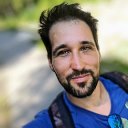
 Sebastian Sanokowski
· 3 previous affiliations
- Current
- Post-Doc · 2025
- Johannes Kepler University of Linz2021–2025
- PhD student · 2021–2025
- MS student · 2019–2021
- Undergrad student · 2016–2019
Research Overview
Sebastian Sanokowski focuses on unsupervised learning for combinatorial optimization, diffusion models, and implicit neural architectures. His early work explored equilibrium states in recurrent networks before shifting toward probabilistic and generative approaches for solving complex graph problems. Most recently, his research investigates scalable discrete diffusion samplers and the theoretical foundations of diffusion bridge models.
Research Trajectory
Sanokowski’s early research investigated alternative architectures for sequence and image processing, contributing to the area of Deep Equilibrium Models and Implicit Differentiation. In 2020, he introduced Implicit recurrent networks: A novel approach to stationary input processing with recurrent neural networks in deep learning. This work proposed applying the mechanics of recurrence to static data by defining neural activation as an equilibrium state rather than a sequence of discrete steps. This formulation allowed for the training of recurrent connections using a more efficient backpropagation method that circumvents the vanishing gradient problems typical of traditional iterative models.
By 2023, his focus shifted significantly toward solving hard combinatorial optimization (CO) problems using unsupervised learning and variational inference. He developed a framework known as VAG-CO, detailing the methodology across an initial preprint and a subsequent conference publication, Variational Annealing on Graphs for Combinatorial Optimization. Advancing the research direction of Non-Autoregressive Modeling for Parallel Sequence Generation, this work addressed the limitations of assuming statistical independence among solution variables. By combining an autoregressive approach with a "subgraph tokenization" technique and annealed entropy regularization, the framework successfully captured complex dependencies between variables, demonstrating highly competitive performance on difficult problem instances.
Continuing in this domain, Sanokowski sought to improve the efficiency of neural solvers. In One Network to Approximate Them All: Amortized Variational Inference of Ising Ground States, he addressed a major bottleneck in previous approaches: the need to train a new model for every individual problem instance. He demonstrated that a single autoregressive neural network could be trained to approximate the ground states for an entire family of Ising Hamiltonians, effectively generalizing across a class of problems through amortized inference.
In 2024, Sanokowski began integrating diffusion models into his optimization research, intersecting with the broader area of Scaling Test Time Compute via Iterative Refinement. He introduced A Diffusion Model Framework for Unsupervised Neural Combinatorial Optimization (DiffUCO). This framework derived a Joint Variational Upper Bound on the reverse KL divergence, which bypassed the need for exact sample likelihoods. This theoretical adjustment allowed highly expressive latent variable models to solve complex graph problems entirely without labeled training data. That same year, he collaborated on Geometry-informed Neural Networks, a framework for generating 3D shapes. Using neural fields and diversity constraints, the method produced multiple feasible structural solutions based solely on design requirements and objectives, enabling data-free generative design.
Most recently, Sanokowski has focused on the theoretical stability and scalability of diffusion samplers. In 2025, he published Rethinking Losses for Diffusion Bridge Samplers, contributing to work in Overcoming Local Mode Entrapment in Multimodal Sampling. This research identified a conceptual flaw in the widely used Log Variance loss for training diffusion bridge samplers, showing that it violates the Data Processing Inequality. By proposing a shift to the reverse KL loss combined with the log-derivative trick (rKL-LD), the work achieved more stable training dynamics, improved performance on high-dimensional benchmarks, and enabled the learning of optimal diffusion coefficients during training. Concurrently, he developed Scalable Discrete Diffusion Samplers: Combinatorial Optimization and Statistical Physics, touching upon the area of Robust Optimization and Stability in Deep Reinforcement Learning. This work introduced more efficient training methodologies for diffusion models applied specifically to discrete problem spaces.
Current Directions
Sanokowski’s most recent papers indicate a sustained focus on the intersection of generative AI and discrete mathematics. His current work investigates the theoretical foundations of diffusion models, particularly how loss functions and sampling strategies can be optimized for stability and scale. A major theme is the adaptation of continuous generative frameworks—such as diffusion bridge samplers—to discrete domains like combinatorial optimization and statistical physics. By refining the underlying variational bounds and loss formulations, his research aims to make unsupervised neural solvers more robust, scalable, and capable of operating effectively without reliance on labeled datasets.
Profile updated
Loading new papers…
Other researchers whose papers cluster into the same research directions — a proxy for overlapping technical interests and shared intellectual neighborhoods.
See something wrong? Report a mistake