

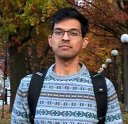
 Sattwik Basu
· 4 previous affiliations
- University of Illinois Urbana-ChampaignSince 2022
- Doctor of Philosophy - PhD, Electrical and Computer Engineering · 2022–2027
- Graduate Research Assistant · Since 2022
- Current
- Graduate Teaching Assistant · 2023–2024
- Dolby (United States)Since 2026
- PhD Research Intern · Since 2026
- Harman (United States)2017–2022
- Senior Audio DSP Engineer · 2022
- Audio DSP Engineer · 2018–2022
- Summer Intern, Auditory Augmented Reality Systems · 2017
- University of Rochester2016–2018
- Master of Science - MS, Electrical and Computer Engineering · 2016–2018
- Graduate Teaching Assistant · 2016–2017
Research Overview
Sattwik Basu focuses on deep generative models, posterior sampling techniques, and signal processing. His research develops diffusion and flow-based approaches to solve complex inverse problems, particularly in scenarios involving non-differentiable constraints and discrete latent spaces. His current work emphasizes leveraging generative priors for robust spatial mapping and image reconstruction.
Research Trajectory
Basu’s recent work spans signal processing, novel spatial representations, and the application of generative models to complex optimization landscapes. In 2025, he contributed to research on neural radiance fields in Can NeRFs "See" without Cameras?, exploring how NeRF architectures might operate and render scenes without relying on traditional camera inputs.
Concurrently, he advanced signal processing techniques for parameter estimation. In Estimating Multi-chirp Parameters using Curvature-guided Langevin Monte Carlo, he addressed the challenge of extracting higher-order polynomial chirp parameters from noisy signal mixtures. By formulating the task as a non-convex optimization problem, he introduced a modified Langevin Monte Carlo sampler that leverages the objective function's average curvature. This curvature-guided approach enables robust estimation and reliably finds the minimizer even in low signal-to-noise ratio environments.
Moving into 2026, Basu’s focus shifted toward deep generative models and their application to inverse problems. He developed ALPS, a discrete posterior sampler, in Discrete Langevin-Inspired Posterior Sampling. This work utilizes discrete diffusion models as priors and uses gradient information to guide sampling within discrete latent spaces. The approach facilitates parallel updates and improves performance on image restoration and spatial mapping tasks, contributing to the broader research direction of The Token Independence Flaw in Parallel Generation.
Building on the intersection of generative priors and spatial reasoning, he introduced the CoGuide framework in Contrastive Diffusion Guidance for Spatial Inverse Problems. This research tackles "spatial inverse problems," such as reconstructing a building's floorplan based solely on a person's walking trajectory. Because the relationship between the measured signal and the underlying geometry is non-differentiable and non-smooth, he utilized contrastive learning to map both modalities into a shared, smooth embedding space. This creates a stable surrogate likelihood that allows diffusion models to navigate complex optimization landscapes. This work advances several areas, including the research direction of Restoring Images with Unknown Complex Degradations, the area of Integrating Static Environmental Constraints for Trajectory Prediction, and the broader field of Steering Generative Diffusion with Physical Laws.
Current Directions
The most recent papers in the evidence indicate a strong focus on utilizing diffusion models to solve complex, non-smooth inverse problems. Current work investigates how to bridge discrete and continuous optimization landscapes, particularly for spatial mapping tasks where direct measurements are unavailable or non-differentiable. By developing novel posterior sampling techniques and surrogate likelihoods through contrastive learning, this research aims to make deep generative priors more applicable to physical and geometric reasoning tasks.
Profile updated
Loading new papers…
Other researchers whose papers cluster into the same research directions — a proxy for overlapping technical interests and shared intellectual neighborhoods.
See something wrong? Report a mistake