

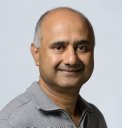
 Sanjeev Khudanpur
· 3 previous affiliations
- Johns Hopkins UniversitySince 1996
- Associate Professor · Since 2008
- Assistant Professor · 2001–2008
- Researcher · 1996–2001
- University of Maryland, College Park1989–1997
- PhD student · 1989–1997
- Undergrad student · 1984–1988
Research Overview
Sanjeev Khudanpur focuses on speech recognition, statistical machine translation, and the integration of syntactic structures into language models. His trajectory spans early work in translingual speech retrieval and unsupervised acoustic modeling to advanced decoding and discriminative training techniques for translation systems. Most recently, his research addresses code-switching in multilingual speech and the evaluation of creativity in large language models.
Research Trajectory
Sanjeev Khudanpur's research trajectory began with foundational contributions to speech and language processing, particularly focusing on cross-lingual applications and statistical machine translation (SMT). In 2001, he contributed to work on Mandarin-English Information: Investigating Translingual Speech Retrieval, which explored the research direction of Machine Transliteration for Out of Vocabulary Entities alongside robust language understanding for noisy speech transcripts. He subsequently participated in efforts to expand the feature space for translation models, helping to develop methodologies for optimizing log-linear models directly against BLEU evaluation metrics in A Smorgasbord of Features for Statistical Machine Translation (2004).
Moving into the mid-2000s, his focus expanded to include unsupervised learning techniques across different modalities. He contributed to the area of Target Risk Estimation for Unsupervised Domain Adaptation through his involvement in Cross-Instance Tuning of Unsupervised Document Clustering Algorithms (2007). In the speech domain, he co-developed algorithms for the Unsupervised Learning of Acoustic Sub-word Units (2008), demonstrating how hidden Markov model topologies and parameters could be jointly learned directly from speech to discover phoneme-like units without prior linguistic knowledge. Concurrently, he advanced SMT architectures by contributing to the broader area of Ensemble Decoding and System Combination in Machine Translation in Machine Translation System Combination using ITG-based Alignments (2008). Building on this theme of consensus and structured prediction, his lab introduced Variational Decoding for Statistical Machine Translation (2009), addressing the computational gap between derivations and structures through minimum Bayes risk decoding.
In the early 2010s, Khudanpur investigated novel training paradigms and the integration of linguistic structure into statistical models. He participated in the development of unsupervised discriminative training frameworks that leveraged target-language monolingual data, as detailed in Minimum Imputed-Risk: Unsupervised Discriminative Training for Machine Translation (2011). This approach minimized imputed empirical risk by ensuring that probabilistic round-trip translations maintained low expected loss. His research also critically examined the resilience of n-gram models against syntactically motivated alternatives. In Revisiting the Case for Explicit Syntactic Information in Language Models (2012), he and his collaborators explored work in Language Modeling with Explicit Syntactic Dependencies, analyzing where n-grams succeed as word-predictors and where explicit syntax is necessary. To make these long-span syntactic features computationally feasible for large hypothesis sets, he directed research on Fast Syntactic Analysis for Statistical Language Modeling via Substructure Sharing and Uptraining (2012), which contributed to the area of Synthetic Data Distillation for Specialized Model Training by accelerating dependency parsers and part-of-speech taggers.
By the mid-2010s, Khudanpur sought to bridge the gap between speech recognition and translation systems, which were traditionally cascaded with suboptimal interfaces. He directed the development of A Coarse-Grained Model for Optimal Coupling of ASR and SMT Systems for Speech Translation (2015), designing a coarse-to-fine model that utilized features from both systems to optimize directly for translation quality rather than intermediate word error rates.
In recent years, his research has expanded to address complex multilingual environments and the evaluation of modern generative models. He oversaw work on Enhancing Code-Switching Speech Recognition With Interactive Language Biases (2024), which improved hybrid CTC/attention models by incorporating multi-level language posteriors to handle intra-utterance language shifts. Most recently, he participated in Benchmarking Language Model Creativity: A Case Study on Code Generation (2025), exploring the cognitive dimensions of artificial intelligence by quantifying convergent and divergent thinking in large language models through iterative constraint prompting.
Current Directions
Recent work investigates the challenges of multilingual speech processing and the evaluation of modern large language models. A primary focus is code-switching in automatic speech recognition, where models must dynamically adapt to intra-utterance language shifts. This involves developing interactive language biases that integrate frame- and token-level information to improve recognition accuracy in bilingual contexts. Additionally, Khudanpur is involved in exploring the cognitive dimensions of artificial intelligence, specifically the search for novelty in automated scientific discovery. This includes designing frameworks to quantify creativity in large language models by measuring their adaptability and purposefulness when faced with incrementally imposed constraints, pushing models to develop novel solutions beyond their standard training distributions.
Profile updated
Loading new papers…
Other researchers whose papers cluster into the same research directions — a proxy for overlapping technical interests and shared intellectual neighborhoods.
See something wrong? Report a mistake