

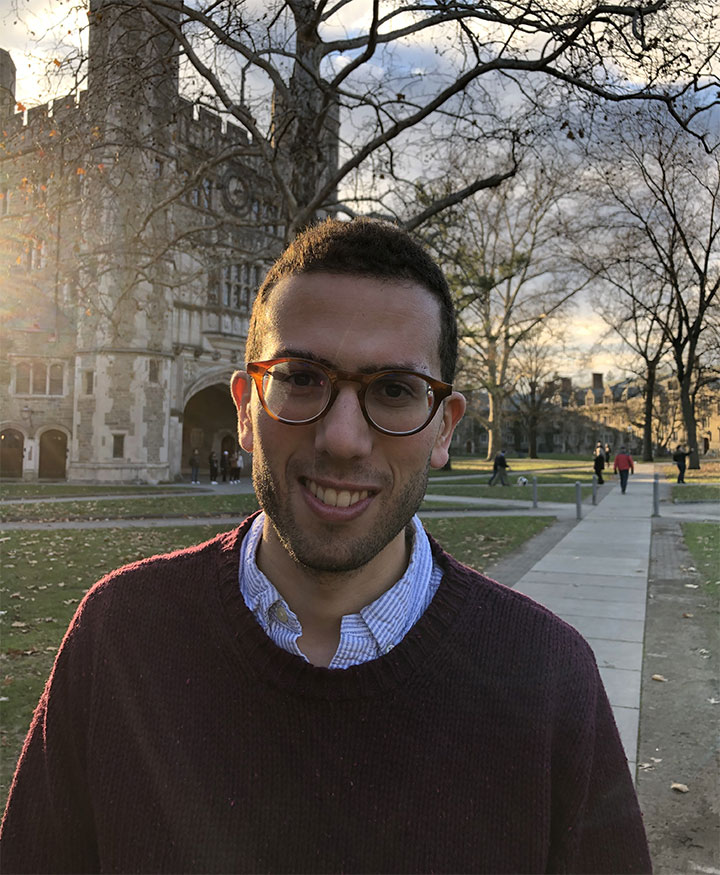
 Samy Jelassi
· 3 previous affiliations
- Microsoft (United States)Since 2026
- Researcher · Since 2026
- Harvard University2023–2026
- Postdoc · 2023–2026
- Princeton University2017–2023
- PhD student · 2017–2023
Research Overview
Samy Jelassi focuses on large language model architecture design, optimization, and long-context capabilities. His early work addressed non-convex optimization and multi-agent learning dynamics, establishing theoretical foundations for deep learning convergence. More recently, his research investigates the mechanistic bottlenecks of sequence models, post-training reinforcement learning, and inference-time scaling for complex reasoning tasks.
Research Trajectory
In 2018, his early research addressed non-convex formulations for large-scale optimization, specifically exploring Smoothed analysis of the low-rank approach for smooth semidefinite programs. This work demonstrated that when constraints on a factorized variable define a smooth manifold, second-order stationary points are typically optimal, offering a scalable approach to semidefinite programming. Following this, he investigated the area of Global Convergence of Overparameterized Multi Layer Networks, co-authoring Neuron birth-death dynamics accelerates gradient descent and converges asymptotically (2019). This paper provided a mean-field description to explain the favorable training properties of models with large parameter counts. In 2020, he introduced an extra-gradient method with player sampling in Extra-gradient with player sampling for faster convergence in n-player games. This research advanced the broader direction of Reducing Gradient Variance for Stable Stochastic Optimization by improving convergence rates in massive multiplayer settings, such as GAN training, through random subset extrapolations and variance reduction mechanisms.
Transitioning to mechanism design, he explored the research direction of Revenue Maximization in Multi-Item Auctions. In Auction Learning as a Two-Player Game (2021), he and his collaborators framed optimal auction design using a time-independent Lagrangian. This conceptual shift circumvented the need for expensive hyper-parameter searches common in prior neural network approaches and provided a unified metric for evaluating auction performance.
By 2024, his focus shifted toward the fundamental properties and limitations of foundation models. Investigating how scale affects learned representations, he authored How Does Overparameterization Affect Features?, demonstrating that wide networks capture unique feature residuals that ensembles of smaller, independently trained networks cannot replicate. He also examined the challenges of combining specialized models in Collective Model Intelligence Requires Compatible Specialization, showing that as models become highly expert in specific domains, their internal representations diverge, creating a barrier to effective model merging.
Addressing architectural bottlenecks, he analyzed the comparative advantages of different sequence models. In Repeat After Me: Transformers are Better than State Space Models at Copying (2024), he proved that the fixed-size latent state of State Space Models creates a memory bottleneck, making them fundamentally less capable of copying and retrieving information than Transformers, which utilize an n-gram hashing mechanism. Concurrently, he contributed to efficient model adaptation with Q-Probe: A Lightweight Approach to Reward Maximization for Language Models, developing a method to train a simple linear layer on frozen embeddings for rapid preference alignment and coding task adaptation.
In 2025, his research deepened into the mechanics of reasoning and length generalization. He led the study Mixture of Parrots: Experts improve memorization more than reasoning, which revealed that while Mixture-of-Experts (MoE) architectures excel at memorizing facts, they struggle to scale reasoning capabilities due to a required "active width" that additional experts cannot provide. Exploring the theoretical principles of context extension, he authored The Role of Sparsity for Length Generalization in Transformers, proposing a framework based on k-sparse planted correlation distributions to explain how decoder-only transformers can successfully predict beyond their training context.
He also contributed to the research area of Inference Time Scaling Laws for LLM Reasoning through his participation in Let Me Think! A Long Chain of Thought Can Be Worth Exponentially Many Short Ones (2025). This work demonstrated that sequential scaling via a single long chain-of-thought is essential for complex state-tracking tasks, outperforming parallel sampling approaches. Additionally, he explored the direction of Granular Weight Merging for Multi-Task Foundation Models by co-authoring LoRA Soups: Merging LoRAs for Practical Skill Composition Tasks, which investigated combining Low-Rank Adaptation modules to achieve zero-shot skill composition.
Most recently, his work has addressed the practical deployment of long-context models and reinforcement learning. He directed research on Let's (not) just put things in Context: Test-time Training for Long-context LLMs (2026), identifying the mathematical phenomenon of "score dilution" where relevant signals are drowned out by distractors in long contexts. To counter this, the team introduced query-only test-time-training (qTTT) to reallocate inference compute and update query projections. In parallel, he oversaw the development of Parameter-Efficient Reinforcement Learning using Prefix Optimization (2026), introducing Prefix-RL. This method optimizes only the initial tokens of a response, revealing that much of the gain in reinforcement learning for reasoning stems from steering the model toward known solution strategies rather than teaching entirely new logic.
Current Directions
The most recent papers in the evidence address the optimization of large language models during inference and post-training. Recent work investigates methods to overcome "score dilution" in long-context scenarios by dynamically reallocating inference compute through test-time training. Additionally, current research explores parameter-efficient approaches to reinforcement learning, focusing on how minimal interventions—such as optimizing response prefixes—can effectively steer models toward successful reasoning strategies without requiring full-parameter updates.
Profile updated
Loading new papers…
Other researchers whose papers cluster into the same research directions — a proxy for overlapping technical interests and shared intellectual neighborhoods.
See something wrong? Report a mistake