

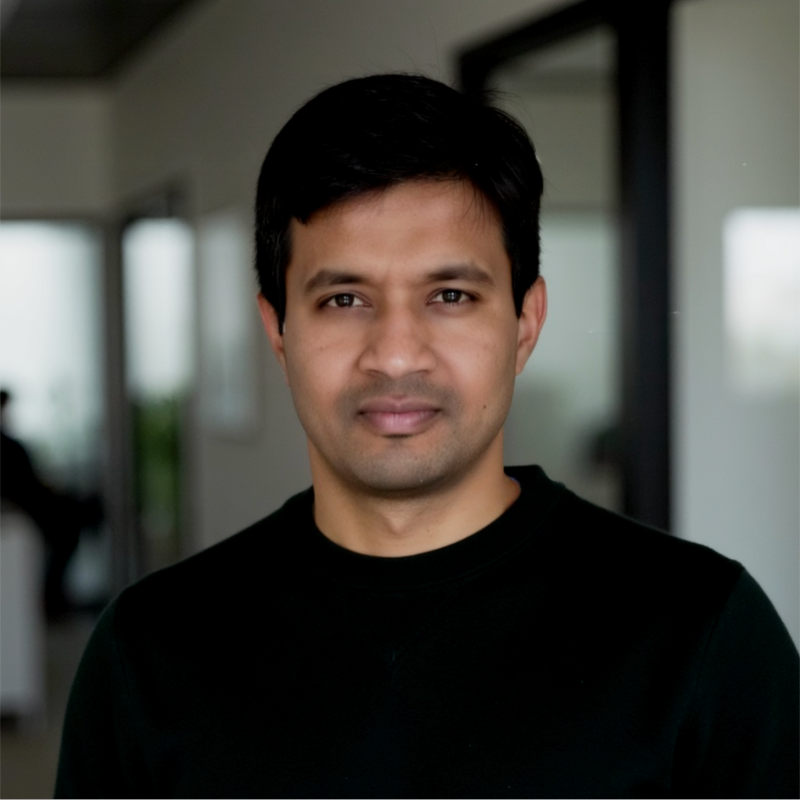
 Sai Rajeswar
· 8 previous affiliations
- Core Industry Member · Since 2024
- Université de MontréalSince 2025
- Adjunct Professor · Since 2025
- Doctor of Philosophy (Ph.D), Computer Science · 2016–2021
- ServiceNow (United States)Since 2022
- Staff Research Lead · Since 2026
- Staff Research Scientist · 2025–2026
- Senior Research Scientist · 2022–2025
- ServiceNow Inc2022–2025
- Research Scientist · 2022–2025
- Research Scientist Intern · 2021
- Element AI2019–2021
- Visiting Researcher · 2019–2021
- Xerox (France)2015–2016
- research engineer · 2015–2016
- Indian Institute of Technology Delhi2013–2015
- Master of Technology - MTech, Computer Science · 2013–2015
Research Overview
Sai Rajeswar focuses on reinforcement learning, multimodal foundation models, and autonomous computer-use agents. His early research explored unsupervised skill discovery and sample-efficient visual control for embodied systems. More recently, his work centers on developing robust graphical interface agents and enterprise automation systems capable of complex spatial reasoning and long-horizon planning.
Research Trajectory
Rajeswar’s early research investigated deep generative models for natural language. In Towards Text Generation with Adversarially Learned Neural Outlines (2018), he collaborated on a hybrid approach combining adversarial and autoregressive paradigms. This method generated high-level sentence outlines in a latent space to provide structured conditioning for sequential word generation, bridging the gap between global planning and local coherence in text.
Transitioning toward embodied AI and robotics, he explored how tactile feedback could guide exploration in sparse-reward environments. His work on Haptics-based Curiosity for Sparse-reward Tasks (2021) introduced a curiosity-driven reinforcement learning approach that rewarded agents when their expected haptic feedback mismatched their actual physical experience. This facilitated the learning of complex manipulation tasks, such as pushing objects and opening doors, where visual information alone is insufficient.
By 2023, his focus shifted heavily toward visual control and unsupervised reinforcement learning, particularly advancing the area of Sample Efficient Reinforcement Learning from Pixels. He developed state-of-the-art methods for the Unsupervised Reinforcement Learning Benchmark (URLB) in Mastering the Unsupervised Reinforcement Learning Benchmark from Pixels. This research combined world-model-based pre-training with a hybrid planner called Dyna-MPC to drastically reduce the environment interactions required for agents to adapt to new visual control tasks. He further expanded on these themes in Unsupervised Model-based Pre-training for Data-efficient Control from Pixels, demonstrating that self-supervised interaction could effectively pre-train world models to facilitate rapid downstream adaptation. Concurrently, he guided research in the direction of Adaptive Scaffolding for Reinforcement Learning Exploration with Choreographer: Learning and Adapting Skills in Imagination. This model-based agent decoupled exploration from skill learning, allowing agents to discover and adapt a repertoire of behaviors entirely within a learned world model.
Building on his expertise in world models, Rajeswar began integrating large-scale vision-language models (VLMs) with reinforcement learning. He led the development of GenRL: Multimodal-foundation world models for generalization in embodied agents (2024), a framework enabling embodied agents to learn diverse tasks from language or video prompts. By grounding abstract instructions into physical actions within an "imagined" environment, the system bypassed the need for manual reward engineering or language-labeled training data.
In 2025, his research expanded into broader multimodal AI and the foundational datasets required to train capable agents. He oversaw the creation of BigDocs: An Open Dataset for Training Multimodal Models on Document and Code Tasks, addressing the scarcity of license-permissive data for complex visual parsing. To improve the underlying architectures of these models, he contributed to AlignVLM: Bridging Vision and Language Latent Spaces for Multimodal Understanding, proposing a novel alignment method that maps visual features to a weighted average of text embeddings to preserve semantic similarity and reduce noise.
This improved multimodal understanding naturally extended into the domain of autonomous web and desktop agents. He directed the development of WebMMU: A Benchmark for Multimodal Multilingual Website Understanding and Code Generation, providing a comprehensive evaluation suite for AI agents interacting with real-world websites. Recognizing that desktop environments present even greater challenges, he subsequently led work on UI-Vision: A Desktop-centric GUI Benchmark for Visual Perception and Interaction. This benchmark highlighted the limitations of state-of-the-art models in the research direction of Spatial Reasoning in Vision Language Models, particularly their struggles with complex interactions like drag-and-drop.
Most recently, Rajeswar has focused on enterprise automation and the rigorous grounding of computer-use agents. In Terminal Agents Suffice for Enterprise Automation (2026), his team demonstrated that simple command-line agents interacting directly with APIs could match or outperform complex GUI-driven architectures in enterprise settings. To rigorously evaluate such systems, he introduced EnterpriseOps-Gym: Environments and Evaluations for Stateful Agentic Planning and Tool Use in Enterprise Settings, revealing that current LLM agents still struggle with long-horizon planning and policy adherence.
To overcome the bottlenecks in training capable desktop agents, his research has heavily emphasized the broader area of Precise Pixel Grounding for Autonomous Graphical Interface Agents. He led the compilation of CUA-Suite: Massive Human-annotated Video Demonstrations for Computer-Use Agents, providing a rich, multi-modal resource of continuous video data for complex desktop applications. Building on this data-centric approach, he developed Grounding Computer Use Agents on Human Demonstrations, introducing the GroundCUA dataset and GroundNext models. This work demonstrated that high-quality human demonstrations and expert annotation yield highly performant computer-use agents with significantly less training data than automated scraping methods.
Current Directions
The most recent papers in the evidence address the development and evaluation of autonomous computer-use agents for both desktop and enterprise environments. Recent work investigates how to ground large language and vision-language models in complex graphical user interfaces using high-quality human demonstrations rather than noisy automated scrapes. This includes building massive, license-permissive datasets and benchmarks to evaluate spatial reasoning, visual perception, and multi-step tool use across diverse software applications. Additionally, ongoing research explores the architectural trade-offs in enterprise automation, contrasting the capabilities of complex GUI-driven agents with streamlined, API-interacting terminal agents to improve long-horizon planning, stateful execution, and policy adherence in realistic deployment scenarios.
Profile updated
Loading new papers…
Other researchers whose papers cluster into the same research directions — a proxy for overlapping technical interests and shared intellectual neighborhoods.
See something wrong? Report a mistake