

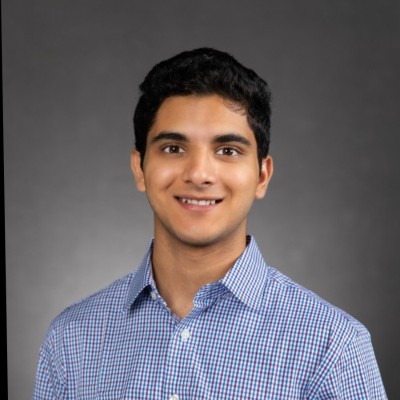
 Sahil Joshi
· 5 previous affiliations
- Rice UniversitySince 2025
- PhD student · 2025–2029
- Artificial Intelligence Researcher · Since 2025
- WorkatoSince 2026
- AI Engineering Intern · Since 2026
- DELL (United States)2023–2025
- Software Engineer 1 · 2023–2025
- University of Massachusetts Amherst2019–2023
- Bachelor's degree, Computer Science · 2019–2023
- Lutron Electronics (United States)2022
- Software Engineer Co-Op · 2022
Research Overview
Sahil Joshi focuses on the efficient training and inference of large language models, specifically designing algorithms to overcome the computational bottlenecks of long-sequence modeling. His research addresses the quadratic scaling limitations of standard attention mechanisms by developing strictly linear-time alternatives and hardware-aware sparse attention techniques. His current work emphasizes scaling transformer architectures to handle contexts of unprecedented length.
Research Trajectory
Sahil Joshi's research trajectory centers on mitigating the computational and memory constraints that limit the context windows of large language models. His early work targets the fundamental quadratic scaling bottleneck inherent to standard transformer architectures. In 2025, he introduced a novel approach to this problem in Replacing Softmax Similarity with a Sharpened Angular Similarity: Theory and Practice of Scaling To Billion-Context Attention. This work proposed replacing the traditional softmax kernel with a sharpened angular similarity metric, utilizing a differentiable hashing technique to achieve strictly linear time and memory complexity. This contribution advanced the area of Linear Attention Mechanisms for Subquadratic Sequence Modeling and the broader direction of The Expressivity Gap in Linear Attention, demonstrating the theoretical and practical ability to scale training to tens of millions of tokens on standard hardware.
Building on these foundational concepts, his research expanded to address both inference efficiency and formal training optimizations in 2026. To improve the speed of model deployment, he collaborated on Scout Before You Attend: Sketch-and-Walk Sparse Attention for Efficient LLM Inference. This research developed a training-free sparse attention algorithm that utilizes lightweight "sketches" to estimate attention and a "walk" mechanism to track information flow across multiple layers. By maintaining near-lossless performance at significantly reduced attention densities, this work contributed to the research direction of Sparse Attention via Dynamic Selection and Clustering and the area of Hardware-Aware Sparse Attention for Long-Context Transformers.
Concurrently, he formalized his linear-time attention mechanism for long-sequence training in RACE Attention: A Strictly Linear-Time Attention for Long-Sequence Training. By refining the differentiable "soft" hashing scheme, this architecture allows contemporary hardware to process sequences of up to 12 million tokens on a single GPU and up to 75 million tokens on a CPU. This advancement intersects with the area of Differentiable Optimization for Discrete Binary Representations and the research direction of Hardware Aware Kernels for Efficient Sequence Modeling, pushing sequence modeling capabilities beyond the limits of existing hardware-aware optimizations.
Current Directions
The most recent papers in the evidence address the practical deployment of large language models for extreme long-context tasks. Current work investigates hardware-aware algorithmic designs that bypass the memory and computational bottlenecks of traditional attention. This includes developing training-free sparse attention methods for rapid inference and refining strictly linear-time attention kernels that leverage differentiable hashing. By focusing on both the training and inference phases, these efforts aim to make sequence modeling over millions of tokens computationally feasible on standard hardware architectures without sacrificing model accuracy.
Profile updated
Loading new papers…
Other researchers whose papers cluster into the same research directions — a proxy for overlapping technical interests and shared intellectual neighborhoods.
See something wrong? Report a mistake