

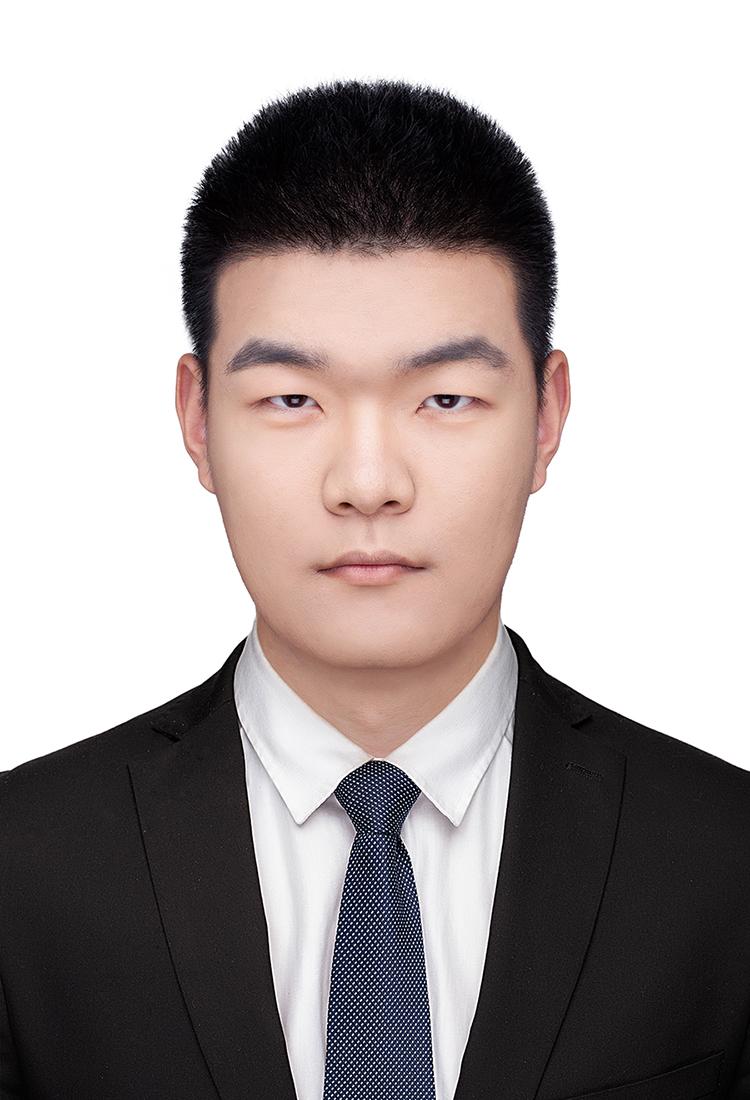
 Ruoyu Chen
· 4 previous affiliations
- Michigan State UniversitySince 2026
- Postdoc · 2026–2027
- Current
- PhD student · 2021–2026
- Chinese Academy of Sciences2021–2026
- Doctor of Philosophy - PhD, Computer Applied Technology · 2021–2026
- Northeastern University2017–2021
- Bachelor's degree, Measurement and Control Technology and Instrumentation · 2017–2021
2 other authors named Ruoyu Chen: Ruoyu Chen (1 paper), Ruoyu Chen (1 paper)
Research Overview
Ruoyu Chen focuses on interpretable artificial intelligence, multimodal foundation models, and explainable attribution methods. His work spans the development of faithful attribution mechanisms for deep neural networks to the application of explanation-guided learning for improving model reliability. Recently, he investigates the internal decision-making processes of large language models and autonomous agents to ensure transparent and safe deployment.
Research Trajectory
Chen’s early research explored applied sensing and computer vision for human-computer interaction and privacy. In 2020, he developed Towards a Virtual Keyboard Scheme Based on Wearing One Motion Sensor Ring on Each Hand, which utilized inertial measurement units and magnetometers to recognize keystrokes from an arc-structured virtual keyboard layout. Following this work in applied systems, he contributed to privacy-preserving vision techniques, participating in the development of Identity-Preserving Face Anonymization via Adaptively Facial Attributes Obfuscation (2021), a framework designed to obfuscate visual appearance while maintaining identity discriminability for monitoring systems.
By 2023, his focus shifted centrally toward explainable artificial intelligence (XAI). He introduced Sim2Word: Explaining Similarity with Representative Attribute Words via Counterfactual Explanations, a method that interprets image similarity models by generating both visual salience maps and textual counterfactual explanations. This foundational interest in interpretability led to a deeper investigation of image attribution. In Less is More: Fewer Interpretable Region via Submodular Subset Selection (2024), he reformulated attribution as an optimization problem. By balancing confidence and semantic consistency, this approach identifies smaller, more accurate interpretable regions, advancing research in the area of Managing the Spatial Discretization Trade-off and contributing to the broader direction of Greedy Maximization for Submodular Subset Selection.
In 2025, Chen expanded these attribution techniques across multiple paradigms. He extended his submodular optimization framework to model-agnostic contexts with Less is More: Efficient Black-box Attribution via Minimal Interpretable Subset Selection, addressing the combinatorial explosion inherent in analyzing discrete input data like images. Moving beyond post-hoc explanations, he utilized interpretability to actively improve model training. With Did Models Sufficient Learn? Attribution-Guided Training via Subset-Selected Counterfactual Augmentation, he introduced a framework that masks regions models over-rely on, forcing them to learn robust features. This work directly addresses challenges in the research direction of Breaking Shortcut Learning in Deep Neural Networks. Concurrently, he applied interpretability to complex architectures, developing a visual precision search method to generate accurate attribution maps for object-level foundation models in Interpreting Object-level Foundation Models via Visual Precision Search. He also addressed feature representation in limited-data regimes, proposing a generalized semantic contrastive learning approach for few-shot object detection in Generalized Semantic Contrastive Learning via Embedding Side Information for Few-Shot Object Detection.
A major theme of Chen's 2025 research involves the internal mechanisms of Multimodal Large Language Models (MLLMs). He developed the EAGLE framework in Where MLLMs Attend and What They Rely On: Explaining Autoregressive Token Generation to quantify the relative influence of language priors versus perceptual evidence during token generation, contributing to the area of Real Time Hallucination Prevention During Token Generation. He further investigated these models in Explaining multimodal LLMs via intra-modal token interactions, highlighting how isolated image patches and preceding text tokens create fragmented explanations, and proposing methods to capture intra-modal dependencies. His work with MLLMs also includes collaborative participation in FaceInsight: A Multimodal Large Language Model for Face Perception and leading a project on video camouflaged object detection. In the latter, Phantom-Insight: Adaptive Multi-cue Fusion for Video Camouflaged Object Detection with Multimodal LLM, he guided the development of a system that fuses temporal and spatial cues via an LLM to separate object edge details in dynamic environments. Alongside his applied XAI work, Chen explored the theoretical foundations of deep learning, providing mathematical proofs on the role of weight decay in delayed generalization in Beyond Progress Measures: Theoretical Insights into the Mechanism of Grokking.
The most recent phase of his trajectory extends into fundamental transformer mechanics and multi-modal integration. In 2026, he participated in Deconstructing Positional Information: From Attention Logits to Training Biases, which analyzed the divide between additive and multiplicative positional encodings and identified training biases in early attention layers. Additionally, he investigated multi-modal image fusion in Disentangle to Fuse: Toward Content Preservation and Cross-Modality Consistency for Multi-Modality Image Fusion, introducing a content-preserving style normalization mechanism to explicitly disentangle style and content across heterogeneous sensor modalities.
Current Directions
The most recent papers in the evidence indicate a strong focus on the interpretability and internal mechanics of foundation models, particularly Multimodal Large Language Models (MLLMs). Recent work investigates how these models balance language priors with visual evidence during autoregressive generation, seeking to map intra-modal dependencies and prevent hallucinations. Additionally, ongoing research addresses the fundamental architecture of Transformers, analyzing positional encoding biases and exploring theoretical phenomena such as grokking and delayed generalization. Another active area involves multi-modal image fusion, where recent methods emphasize disentangling style and content to maintain semantic consistency across heterogeneous sensors.
Profile updated
Loading new papers…
Other researchers whose papers cluster into the same research directions — a proxy for overlapping technical interests and shared intellectual neighborhoods.
See something wrong? Report a mistake