

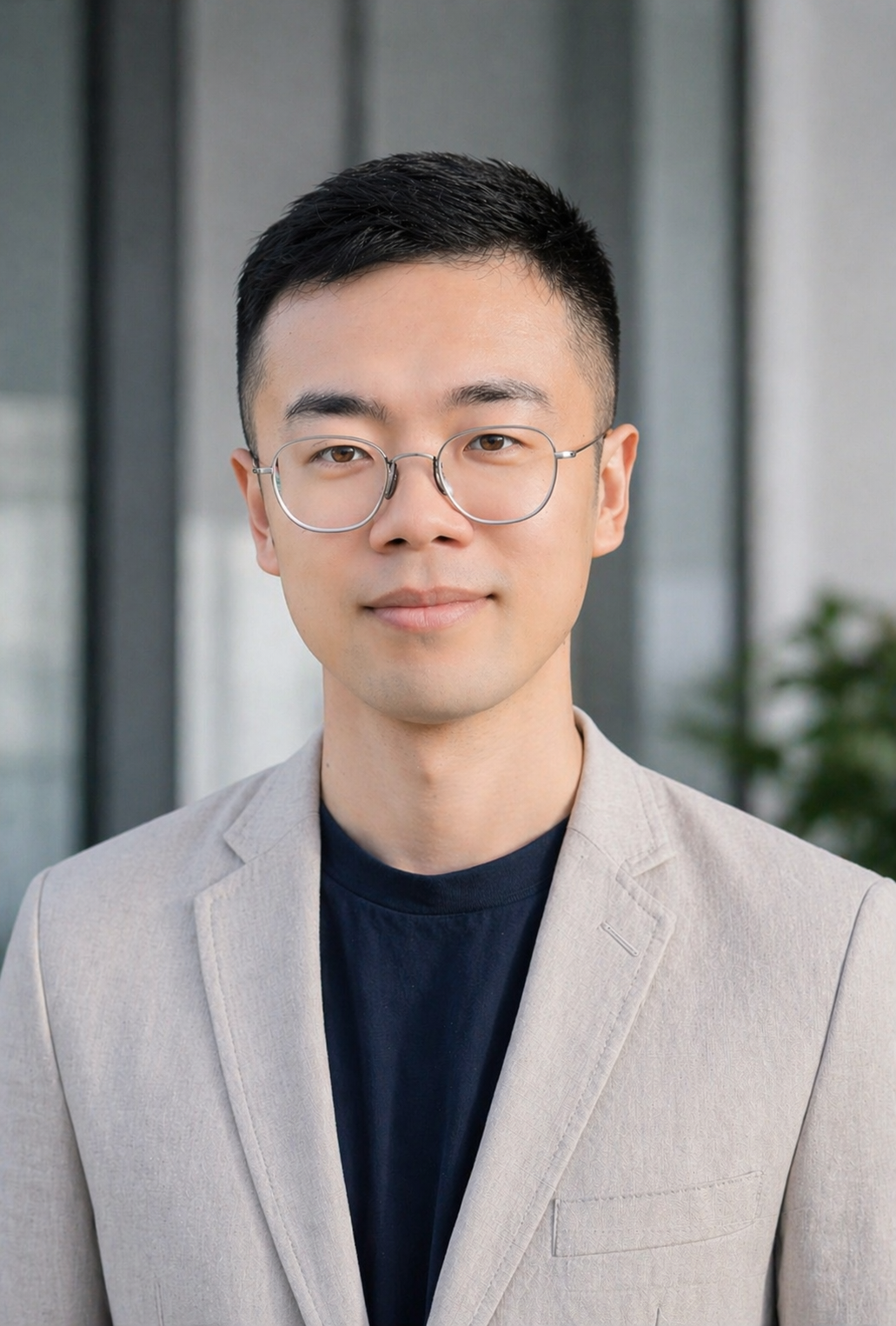
 Ruizhe Li
· 5 previous affiliations
- University of AberdeenSince 2022
- Assistant Professor · 2022–2026
- Outreach Officer of SCNU JI · Since 2024
- Demonstrator · 2017–2019
- University of BirminghamSince 2026
- Assistant Professor · Since 2026
- University College London2021–2022
- Postdoctoral Research Fellow · 2021–2022
- University of Sheffield2020–2021
- Teaching Assistant · 2020–2021
- Home Office2018
- Invited Talk · 2018
2 other authors named Ruizhe Li: Ruizhe Li (Southern University of Science and Technology · SDS · 2 papers), Ruizhe Li (Fudan University · 1 paper)
Research Overview
Ruizhe Li focuses on the interpretability of large language models, multimodal reasoning, and the reliability of artificial intelligence in clinical and conversational settings. His trajectory spans from early work on dialogue systems and audio-visual speech recognition to mechanistic interpretability, where he investigates how neural networks encode logic, bias, and context. Currently, his research emphasizes uncovering the internal computational mechanisms of language models to ensure safe and grounded generation.
Research Trajectory
Ruizhe Li’s early research centered on dialogue systems and the latent representations of text. In 2019, he introduced A Dual-Attention Hierarchical Recurrent Neural Network for Dialogue Act Classification, a model designed to capture the dependency between dialogue acts and conversational topics using a novel dual task-specific attention mechanism. He subsequently explored the properties of latent spaces in generative models, detailing his findings in On the Low-density Latent Regions of VAE-based Language Models, and further expanded on text modeling approaches in Deep latent variable models for text modelling. Expanding into conversational agents, he participated in developing affective decoding methods in Affective Decoding for Empathetic Response Generation, which directly incorporated emotion signals into dialogue systems, contributing to the broader research direction of Bridging the Empathy Gap in Conversational AI.
By 2023, his work expanded into robust multimodal processing and clinical applications. To address challenges in audio-visual speech recognition (AVSR), he co-developed an adversarial network in MIR-GAN: Refining Frame-Level Modality-Invariant Representations with Adversarial Network for Audio-Visual Speech Recognition, aligning with the area of Adversarial Modality Alignment for Invariant Representation Learning. He also led the development of the UniVPM framework in Hearing Lips in Noise: Universal Viseme-Phoneme Mapping and Transfer for Robust Audio-Visual Speech Recognition, which leverages lip movements to reconstruct clean audio features, allowing models to generalize to unseen noise environments. Concurrently, he investigated the intersection of structured knowledge and language models for healthcare. In Leveraging A Medical Knowledge Graph into Large Language Models for Diagnosis Prediction, he introduced DR.KNOWS, a system that anchors LLMs to reasoning paths extracted from the Unified Medical Language System, advancing work in the domain of Grounding Large Language Models for Clinical Reliability.
Moving into 2024, he guided research applying LLMs to educational accessibility and speech transcription correction. He oversaw work on personalizing educational content in LLM-Generated Personalized Analogies to Foster AI Literacy in Adult Novices, addressing the barrier of complex AI concepts for general audiences. He also directed a novel generative error correction paradigm in Listen Again and Choose the Right Answer: A New Paradigm for Automatic Speech Recognition with Large Language Models, which tackled the limitations of LLMs that lack awareness of source speech content during transcription refinement.
His most recent trajectory heavily emphasizes mechanistic interpretability—understanding the internal workings and failure modes of large language models. In Anchored Answers: Unravelling Positional Bias in GPT-2's Multiple-Choice Questions, he utilized interpretability techniques to identify the internal modules responsible for skewed decision-making, contributing to the study of Positional Bias in Multiple Choice Selection and the broader area of Projecting Intermediate Transformer States to the Vocabulary Space. He extended this internal analysis to demographic representations in Race, Ethnicity and Their Implication on Bias in Large Language Models, investigating how models internally encode race rather than solely measuring biased outputs.
Continuing this focus on internal mechanisms and reliability, he supervised research on agentic systems in Uncertainty-Aware Self-Correction for Coding Agents, addressing uncertainty accumulation in multi-step reasoning environments. He also led investigations into foundational logic in DECODING LOGICAL NEGATION IN LARGE LANGUAGE MODELS: FROM STATISTICAL HEURISTICS TO CAUSAL SEMANTIC CIRCUITS, using sparse autoencoders to isolate true logical abstraction from shallow pattern matching. Finally, he introduced ARC-JSD in Attributing Response to Context: A Jensen–Shannon Divergence Driven Mechanistic Study of Context Attribution in Retrieval-Augmented Generation, an efficient method for identifying source sentence usage in RAG models without requiring extra fine-tuning, advancing the broader area of Decoding the Logic of Individual Neurons.
Current Directions
The most recent papers in the evidence address the internal computational mechanisms of large language models and their reliability in complex tasks. Recent work investigates mechanistic interpretability, utilizing tools like sparse autoencoders and divergence metrics to understand how models process logical negation, attribute context in retrieval-augmented generation, and encode demographic concepts. Additionally, current research explores uncertainty estimation and self-correction in autonomous coding agents, aiming to mitigate error propagation and improve the robustness of LLMs during multi-step reasoning and software engineering tasks.
Profile updated
Loading new papers…
Other researchers whose papers cluster into the same research directions — a proxy for overlapping technical interests and shared intellectual neighborhoods.
See something wrong? Report a mistake