

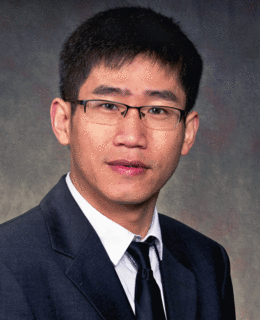
 Ruisheng Wang
· 5 previous affiliations
- Shenzhen UniversitySince 2023
- Full Professor · Since 2023
- Current
- University of Calgary2012–2024
- Professor · 2021–2024
- Associate Professor · 2017–2021
- Full Professor · 2012–2017
- Ping An Technology, US Research Lab2018
- Chief Scientist in Remote Sensing · 2018
- Nokia (Finland)2008–2012
- Researcher, Location & Commerce · 2008–2012
- Ph.D., Electrical & Computer Engineering
Research Overview
Ruisheng Wang focuses on computer vision, remote sensing image analysis, and 3D spatial perception. Early research addressed graph matching and scene parsing for street-view data, which subsequently evolved into extracting complex geometric features from LiDAR point clouds and aerial imagery. Recent work investigates advanced deep learning architectures, including transformer-based models, for semantic segmentation and occupancy prediction in autonomous driving scenarios.
Research Trajectory
Ruisheng Wang’s research trajectory demonstrates a clear evolution from foundational computer vision algorithms to applied remote sensing and, most recently, complex spatial perception for intelligent transportation. Following early participation in hardware architecture research concerning network-on-chip power-gating in 2014, Wang’s focus shifted toward computer vision and structural pattern recognition.
In 2016, Wang co-authored foundational work on graph matching, specifically addressing the NP-hard nature of the problem through low-rank regularization. This algorithmic work was directly applied to urban visual understanding in Enhancing scene parsing by transferring structures via efficient low-rank graph matching. In this second-author publication, Wang helped develop a scene parsing algorithm designed to find dense correspondences and transfer labels across scenes by matching maximally similar structures, improving the consistency of pixel-level labeling in street-view data.
By 2020, Wang’s research expanded into remote sensing and the processing of 3D point clouds. Wang participated in a comprehensive synthesis of the field in Geometric Primitives in LiDAR Point Clouds: A Review. This collaborative work proposed a universal perspective on light detection and ranging (LiDAR) data, categorizing discrete points into geometric primitives to better abstract and represent physical objects at the entity level, moving beyond platform-specific data processing techniques.
A significant indicator of research leadership in this domain occurred in 2022, when Wang served as the senior investigator on A Lightweight Network for Building Extraction From Remote Sensing Images. Addressing the high computational overhead of standard convolutional neural networks, Wang directed the development of RSR-Net, a lightweight architecture utilizing squeeze-and-excitation modules and feature fusion to achieve high-accuracy building extraction with significantly fewer parameters. During this same period, Wang also contributed to Building Instance Mapping From ALS Point Clouds Aided by Polygonal Maps, which tackled the challenge of instance-level building mapping by merging roof segments from aerial laser scanning (ALS) data and matching them against widely accessible polygonal footprints.
In recent years, Wang’s collaborative efforts have increasingly focused on integrating advanced deep learning architectures, such as vision transformers, into large-scale spatial analysis and autonomous driving applications. In 2023, Wang participated in Toward Accurate and Efficient Road Extraction by Leveraging the Characteristics of Road Shapes. This work introduced a road shape-aware network (RSANet) that utilized an efficient strip transformer module to capture the long-distance dependencies required for mapping geometrically deformed and thin road structures in very high-resolution imagery.
This trajectory toward complex scene understanding culminated in recent contributions to intelligent transportation systems. In 2025, Wang collaborated on HSPFormer: Hierarchical Spatial Perception Transformer for Semantic Segmentation. This research addressed the issue of attention drift in transformer-based semantic segmentation by integrating monocular depth estimation and semantic segmentation into a unified framework, thereby improving the dynamic spatial reasoning required for driving scenarios.
Current Directions
The most recent papers in the evidence indicate a strong focus on 3D perception and semantic understanding for autonomous driving and intelligent transportation systems. Current collaborative work investigates camera-based 3D occupancy prediction, aiming to infer complete scene geometry and semantics from 2D images. This includes developing two-stage frameworks that rely on multi-level representation fusion to better utilize the diverse segmentation, graphics, and depth features present in visual inputs.
Additionally, recent research explores weakly supervised learning paradigms to reduce the reliance on dense annotations in computer vision tasks. This includes developing methods for weakly supervised object localization that leverage the intrinsic discrimination and consistency within standard image classification pipelines, allowing models to predict object foreground regions using only image-level category labels. Across these domains, the overarching theme of Wang’s current participation is the design of efficient, spatially aware neural architectures capable of robust perception in complex, real-world environments.
Profile updated
Loading new papers…
Other researchers whose papers cluster into the same research directions — a proxy for overlapping technical interests and shared intellectual neighborhoods.
See something wrong? Report a mistake