

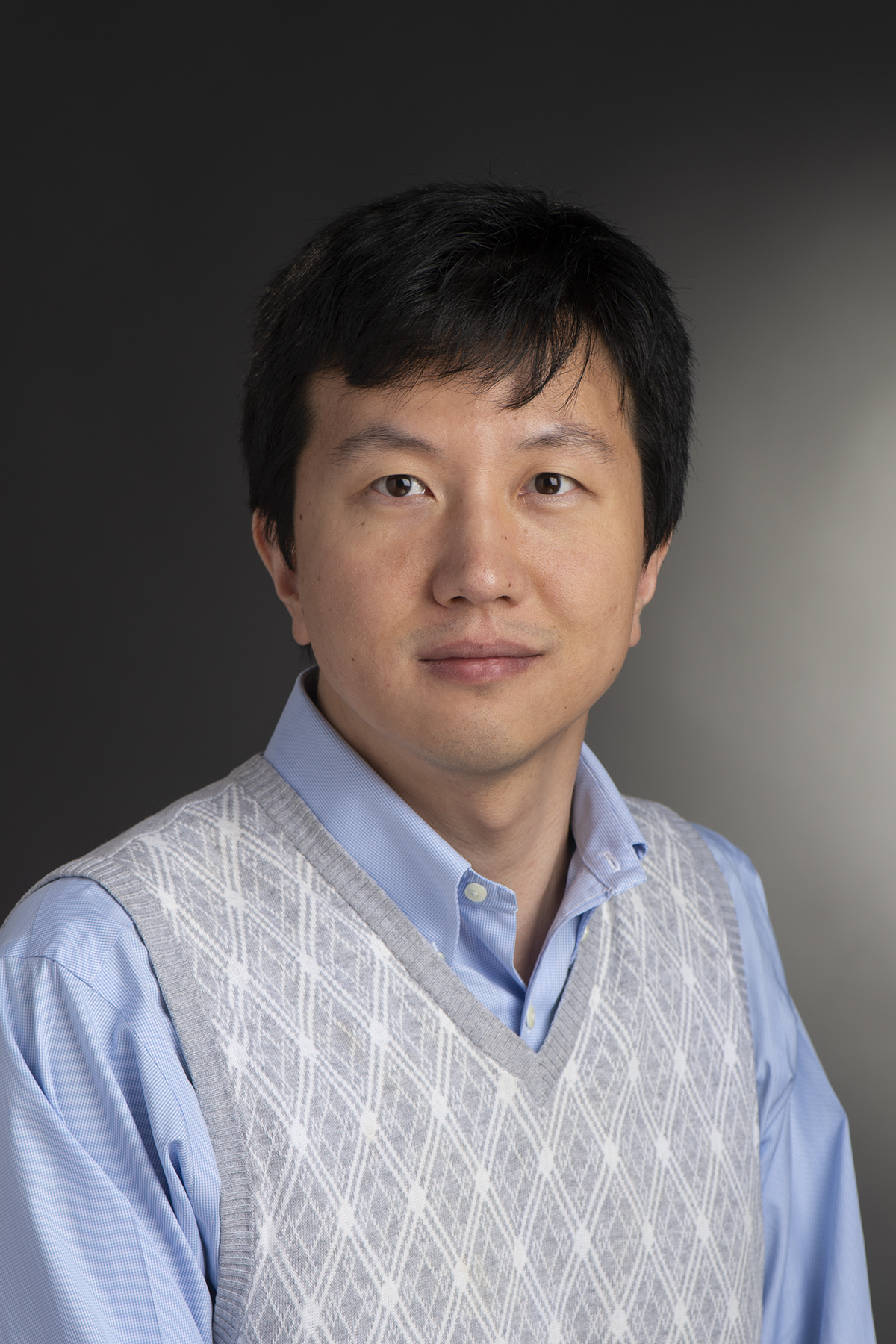
 Rui Li
· 4 previous affiliations
- Rochester Institute of TechnologySince 2018
- Associate Professor · Since 2024
- Assistant Professor · Since 2018
- PhD student · 2007–2013
- University of Rochester2015–2016
- Postdoc · 2015–2016
- Tianjin University of Technology2003–2006
- MS student · 2003–2006
- Harbin Institute of Technology1999–2003
- Undergrad student · 1999–2003
19 other authors named Rui Li: Rui Li (57 papers), Rui Li (Samsung (South Korea) · 20 papers), Rui Li (Renmin University of China · 17 papers), Rui Li (University of Science and Technology of China · 14 papers), Rui Li (King Abdullah University of Science and Technology · 10 papers), and 14 more
Research Overview
Rui Li focuses on statistical machine learning, medical image understanding, and computational biology. His trajectory spans from early work in modeling human visual attention for diagnostic reasoning to developing robust multimodal architectures for incomplete clinical data. Recently, his research emphasizes Bayesian inference and continual learning to improve the adaptability and reliability of deep neural networks.
Research Trajectory
His early trajectory includes participation in Image Understanding from Experts' Eyes by Modeling Perceptual Skill of Diagnostic Reasoning Processes (2013), where researchers utilized eye-tracking to capture the visual scanpaths of dermatologists, translating tacit clinical expertise into formal models for medical image analysis.
Transitioning toward computational biology and structured learning, he developed deep learning frameworks for predicting protein-protein interactions directly from amino acid sequences in Interpretable Structured Learning with Sparse Gated Sequence Encoder for Protein-Protein Interaction Prediction. This work introduced a sparse gating mechanism to highlight crucial amino acids, improving both computational efficiency and interpretability. Expanding on biological network analysis, he contributed to the area of Multi-Hop Aggregation for Graph Neural Networks through Predicting Biomedical Interactions With Higher-Order Graph Convolutional Networks. By capturing complex relationships beyond immediate neighbors, this higher-order approach achieved more accurate predictions of biological interactions.
A major theme in his research is the advancement of multi-modality medical image processing, particularly addressing the practical challenges of missing data, unaligned images, and localized target areas. He led work on generative models for medical imaging, introducing TarGAN: Target-Aware Generative Adversarial Networks for Multi-modality Medical Image Translation to ensure high-quality translation of critical regions of interest, such as organs, rather than just the global image. He further extended this to oncology with Semi-Supervised Segmentation-Guided Tumor-Aware Generative Adversarial Network for Multi-Modality Brain Tumor Translation, which mitigates tumor distortion in modality-missing datasets.
To tackle the fundamental problem of missing modalities in clinical settings, he designed TFusion: Transformer based N-to-One Multimodal Fusion Block, an architecture that automatically learns to fuse available modalities without relying on zero-padding or synthesizing missing inputs. This aligns with his broader contributions to the research direction of Robust Multimodal Learning for Incomplete Clinical Data, which was further advanced in Learning multi-modal brain tumor segmentation from privileged semi-paired MRI images with curriculum disentanglement learning. This framework leverages a small set of paired images during training to disentangle modality-specific styles from invariant content, yielding robust segmentation on unpaired data. Alongside these generative and fusion approaches, he developed unsupervised deformable registration techniques in Unsupervised Multi-Modal Medical Image Registration via Discriminator-Free Image-to-Image Translation and addressed the challenges of anisotropic data by developing interpolation techniques for multiple intermediate slices in Slice imputation: Multiple intermediate slices interpolation for anisotropic 3D medical image segmentation.
Parallel to his work in medical imaging, he has extensively investigated continual learning and Bayesian adaptation in neural networks. With collaborators, he explored interactive image segmentation as a continual learning problem in A Continual Learning Framework for Uncertainty-Aware Interactive Image Segmentation, utilizing Bayesian nonparametric modeling to manage neural network kernels and prevent catastrophic forgetting. This evolved into a more comprehensive structural approach in Bayesian Adaptation of Network Depth and Width for Continual Learning, which allows a network to automatically expand its capacity in both dimensions as it encounters new tasks.
His recent work applies these advanced statistical frameworks to distributed systems and graph structures. He contributed to Harnessing Heterogeneous Statistical Strength for Personalized Federated Learning via Hierarchical Bayesian Inference, introducing a hyper-prior to model client parameter distributions, thereby sharing statistical strength across a network while preserving local specialization. In the broader area of Node-Adaptive Neighborhood Aggregation Depth, he participated in developing Bayesian Neighborhood Adaptation for Graph Neural Networks, which models message-passing as a stochastic process to dynamically determine the optimal neighborhood scope for node aggregation. Most recently, he has applied optimal control theory to generative modeling, introducing Shortcut Diffusion Training with Cumulative Consistency Loss: An Optimal Control View to enable high-quality image generation in minimal steps by optimizing the entire generation trajectory.
Current Directions
The most recent papers in the evidence address the scalability, efficiency, and adaptability of complex machine learning systems through Bayesian inference and optimal control. Recent work investigates hierarchical Bayesian frameworks for personalized federated learning, allowing individual client models to remain highly specialized while effectively sharing statistical strength across diverse data distributions. Additionally, he is exploring adaptive architectures for graph neural networks, modeling message-passing behaviors as stochastic processes to dynamically determine neighborhood scopes without exhaustive search. In the domain of generative modeling, his current research reframes diffusion model training as an optimal control problem, utilizing cumulative consistency loss to drastically reduce artifacts and achieve high-quality image generation in just one or two steps.
Profile updated
Loading new papers…
Other researchers whose papers cluster into the same research directions — a proxy for overlapping technical interests and shared intellectual neighborhoods.
See something wrong? Report a mistake