

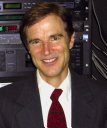
 Roger Dannenberg
· 1 previous affiliation
- Carnegie Mellon UniversitySince 2020
- Emeritus · Since 2020
Research Overview
Roger Dannenberg focuses on computer music, real-time interactive systems, and music information retrieval. His early work pioneered functional languages for sound synthesis and automated accompaniment, establishing foundational techniques for human-computer musical performance. Recently, his research has expanded to address large-scale foundation models for audio understanding, structural coherence in generative music, and the mitigation of cultural biases in music AI.
Research Trajectory
Dannenberg's early research established core paradigms for real-time musical computation and automated accompaniment. In 1984, he introduced Arctic: A Functional Language for Real-Time Control, a system designed to simplify the development of complex interactive systems by treating values as functions of time, inherently managing concurrency. That same year, he presented An On-Line Algorithm for Real-Time Accompaniment, laying the groundwork for systems that can listen and respond to live musicians.
Throughout the 1990s, his work expanded on these interactive and generative capabilities. He developed The Implementation of Nyquist, A Sound Synthesis Language in 1993, providing a flexible environment for sound design and composition. Building on his earlier accompaniment algorithms, he co-authored Automated Accompaniment of Musical Ensembles (1994). This system tracked multiple performers to synthesize missing parts in real time, advancing the research direction of Elastic Temporal Alignment for Non-Linear Sequences.
In the 2000s, Dannenberg's focus broadened to include higher-level music understanding and analysis. His 2005 paper, Toward Automated Holistic Beat Tracking, Music Analysis and Understanding, demonstrated how leveraging the repetitive structural nature of music could significantly improve low-level rhythmic analysis, contributing to the area of Bridging the Performance Gap in Causal Signal Processing. He later articulated a broader framework for this intersection of analysis and performance in A Vision of Creative Computation in Music Performance (2011), proposing a challenge for computers to act as reactive bandmates capable of improvisational synchronization rather than merely following rigid scores.
As deep learning transformed music information retrieval (MIR), Dannenberg's research integrated modern representation learning techniques. He led the development of Motif-Centric Representation Learning for Symbolic Music (2023), which combined regularization-based pretraining with contrastive learning to help models recognize musical motifs across rhythmic and transposing alterations. He also participated in large-scale community efforts to standardize evaluation, such as the MARBLE: Music Audio Representation Benchmark for Universal Evaluation (2023), which established comprehensive taxonomies for MIR tasks and supported the broader area of Open Access Strategies for Music Information Retrieval.
His recent collaborative work has increasingly focused on self-supervised frameworks and foundation models for audio. In 2024, he contributed to MERT: Acoustic Music Understanding Model with Large-Scale Self-supervised Training, a framework combining acoustic and musical teachers to learn generalized representations, advancing work in the direction of Bridging the Acoustic Domain Gap Between Speech and Singing. He also explored parameter-efficient digital emulations of analog hardware in Modeling Analog Dynamic Range Compressors using Deep Learning and State-space Models (2024). Recognizing the rapid evolution of the field, he co-authored Foundation Models for Music: A Survey (2024), which mapped the technical landscape of neural audio tokenizers while highlighting the need for research in The Cross-Cultural Generalization Gap in Music Models.
Most recently, Dannenberg has participated in projects addressing cultural diversity and long-form generation in music AI. He contributed to the Multi-Accent Mandarin Dry-Vocal Singing Dataset: Benchmark for Singing Accent Recognition (2025), providing a large-scale resource for training models to recognize regional accents in musical contexts. He also collaborated on YuE: Scaling Open Foundation Models for Long-Form Music Generation (2026), an open-source autoregressive framework capable of generating full-length songs from lyrics, which pushes forward the research direction of Long Form Structural Coherence in Musical Audio Generation.
Current Directions
The most recent papers in the evidence indicate a focus on scaling foundation models for comprehensive music understanding and generation. Recent work investigates the challenges of generating high-fidelity, full-length musical compositions directly from text, emphasizing structural coherence over extended durations. Additionally, there is a strong emphasis on addressing cultural and linguistic diversity within music AI. This includes developing large-scale datasets to capture regional vocal accents and surveying the ethical implications of Western-centric training data, ensuring that emerging generative models are both robust and culturally inclusive.
Profile updated
| Paper | Venue | Year |
|---|---|---|
| Multi-Accent Mandarin Dry-Vocal Singing Dataset: Benchmark for Singing Accent RecognitionGitHubCarlWangChina/ | ACM Multimedia | 2025 |
Loading new papers…
Other researchers whose papers cluster into the same research directions — a proxy for overlapping technical interests and shared intellectual neighborhoods.
See something wrong? Report a mistake