

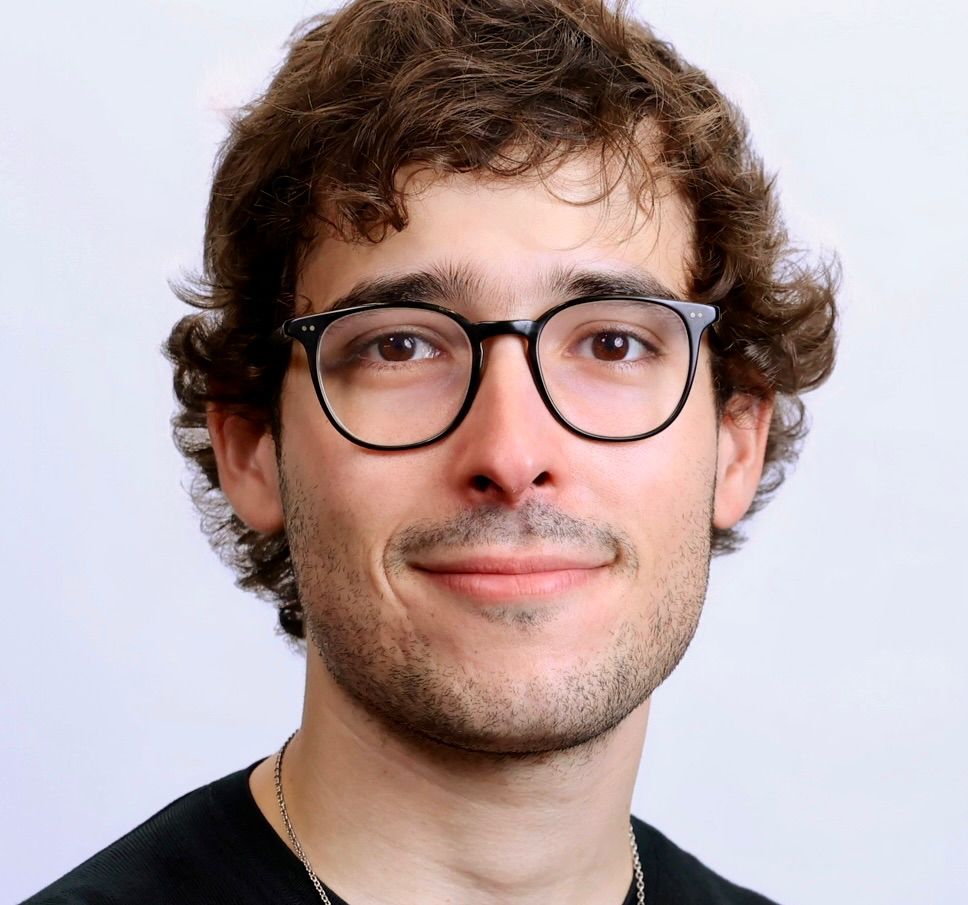
 Rodrigo Mira
· 7 previous affiliations
- Google (United States)Since 2025
- Researcher · Since 2025
- Google DeepMind (United Kingdom)Since 2025
- Senior Research Scientist · Since 2025
- Meta (United States)2022–2025
- Postdoctoral Researcher (via Magnit) · 2023–2025
- Research Intern · 2022
- Sony (Japan)2023
- Research Intern · 2023
- Imperial College London2017–2023
- PhD student · 2019–2023
- MS student · 2017–2018
- PRO Unlimited @ Meta2022
- Contingent Worker · 2022
- Instituto Superior Técnico2014–2017
- Undergrad student · 2014–2017
Research Overview
Rodrigo Mira focuses on audio-visual speech processing, self-supervised learning, and generative modeling for human animation. His trajectory spans foundational work in lip-reading and deepfake detection to advanced diffusion models for speech-driven facial synthesis. His most recent work investigates temporal consistency in long-form video generation and unified architectures for multimodal speech recognition.
Research Trajectory
Early in his research career, Mira focused on extracting robust representations from silent video. In 2021, he introduced LiRA: Learning Visual Speech Representations from Audio Through Self-Supervision, a framework that leverages the natural correlation between audio and video to train lip-reading models without relying on massive labeled datasets. By predicting acoustic features from silent video, the model achieved strong performance on major benchmarks using significantly less supervised data than traditional methods.
This understanding of natural audio-visual alignment subsequently informed approaches to media forensics. In Leveraging Real Talking Faces via Self-Supervision for Robust Forgery Detection, he developed RealForensics, a two-stage framework that forces a detector to predict natural facial dynamics as an auxiliary task. This approach improved generalization to unseen forgery methods and demonstrated robustness to heavy video compression, contributing to the area of Deepfake Detection via Identity and Structural Consistency.
Parallel to representation learning, his research explored generative methods for synthesizing speech directly from visual cues. He proposed SVTS: Scalable Video-to-Speech Synthesis, which decoupled the synthesis problem into a video-to-spectrogram predictor and a pre-trained neural vocoder, enabling efficient training on unconstrained datasets. This line of inquiry culminated in End-to-End Video-to-Speech Synthesis Using Generative Adversarial Networks, where he and his collaborators bypassed intermediate representations entirely to translate silent video directly into raw audio waveforms. Utilizing a dual-critic adversarial training approach, the model advanced work in Adversarial Optimization for High Fidelity Audio Synthesis.
Beyond speech reconstruction, his research addressed audio enhancement in highly degraded environments. He developed LA-VocE: Low-SNR Audio-visual Speech Enhancement using Neural Vocoders to improve speech clarity using visual streams. He later adapted these techniques for low-latency applications in RT-LA-VocE: Real-Time Low-SNR Audio-Visual Speech Enhancement. By redesigning non-causal models to operate without future data context, the framework achieved high-quality reconstruction with minimal processing latency, advancing the research direction of Causal Audio Synthesis for Real Time Streaming.
Expanding the scope of facial animation beyond articulated speech, he investigated the generation of non-verbal expressions. In Laughing Matters: Introducing Laughing-Face Generation using Diffusion Models, he leveraged a factorized space-time U-Net and a specialized audio encoder to generate realistic laughing animations from a single still portrait and an audio clip. This work captured complex nuances often missed by traditional speech-driven methods, intersecting with the broader area of Universal Acoustic Foundation Models for Cross-Domain Audio Understanding. During this period, he also contributed to a specialized project in algorithmic music composition, applying deep Q-learning to tune RNN-based models for specific regional styles in Automated composition of Galician Xota - tuning RNN-based composers for specific musical styles using deep Q-learning.
Returning to core speech processing, he collaborated on architectures designed to handle multiple input modalities simultaneously. In Unified Speech Recognition: A Single Model for Auditory, Visual, and Audiovisual Inputs, the research team demonstrated that automatic speech recognition, visual speech recognition, and audiovisual speech recognition could be effectively consolidated into a single deployable model. This consolidated approach built upon foundational concepts in areas such as Cross Modal Distillation for Visual Speech Recognition and Cross-Modal Face-Voice Identity Synthesis.
Current Directions
The most recent papers in the evidence address the challenges of maintaining temporal consistency and identity in long-form audio-driven animation, alongside continued improvements in unified speech recognition architectures.
A major focus of this recent work is mitigating identity drift and error accumulation during temporal autoregressive generation. In KeyFace: Expressive Audio-Driven Facial Animation for Long Sequences via KeyFrame Interpolation, he and his collaborators introduced a two-stage diffusion-based framework that generates sparse anchor keyframes and interpolates between them, supporting continuous emotions and non-speech sounds over extended durations. He further refined this anchoring concept in Lookahead Anchoring: Preserving Character Identity in Audio-Driven Human Animation. Rather than relying on fixed boundaries within the current generation window, this approach utilizes keyframes from future timesteps as directional beacons, allowing the model to continuously pursue future anchors while responding to immediate audio cues without restricting natural motion dynamics.
Alongside facial animation, recent work continues to optimize multimodal speech recognition systems. The 2026 paper Pay Attention to CTC: Fast and Robust Pseudo-Labelling for Unified Speech Recognition investigates fast and robust pseudo-labelling techniques to improve the training efficiency and accuracy of joint auditory and visual speech recognition models.
Profile updated
Loading new papers…
Other researchers whose papers cluster into the same research directions — a proxy for overlapping technical interests and shared intellectual neighborhoods.
See something wrong? Report a mistake