

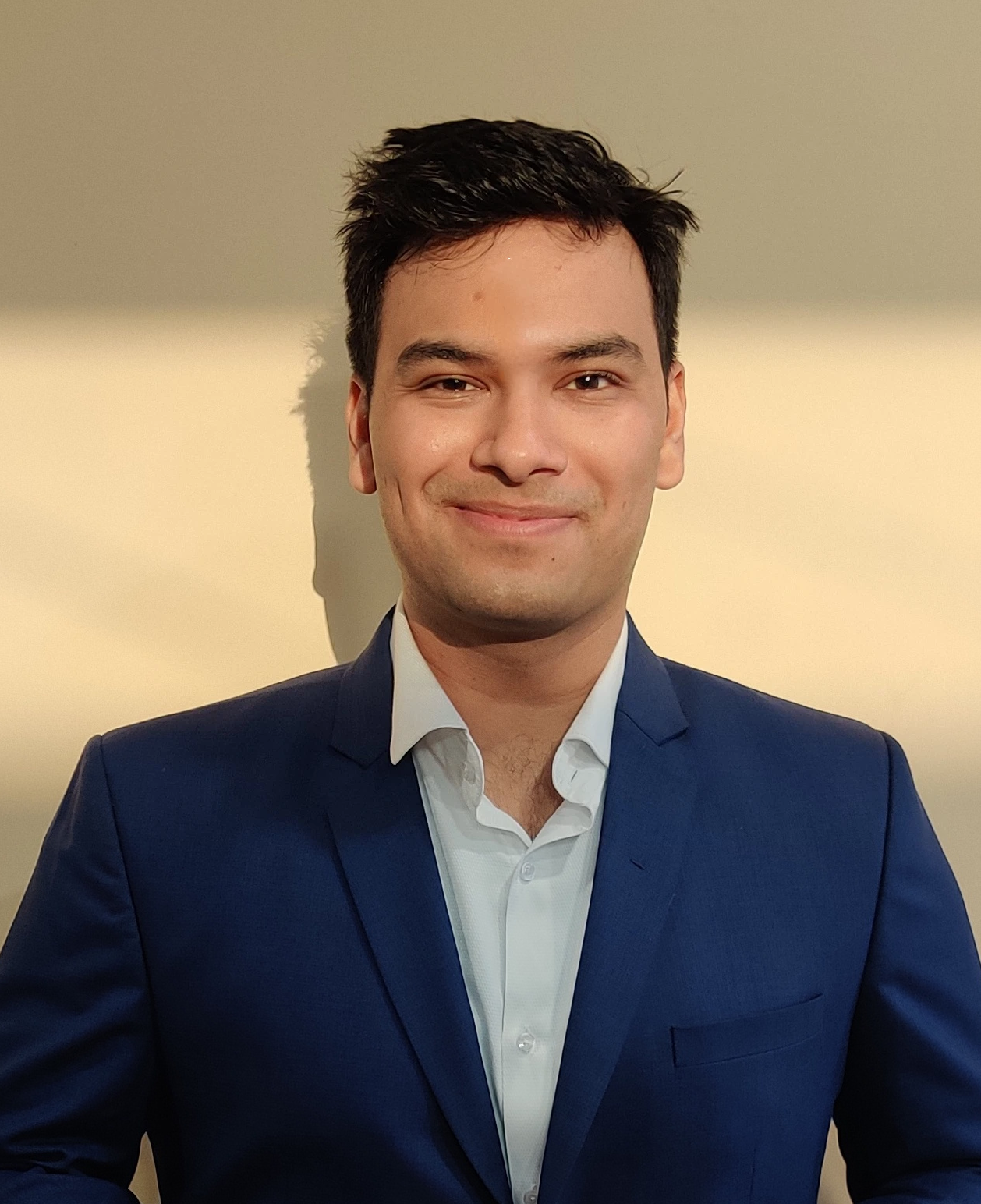
 Rishabh Dabral
· 4 previous affiliations
- Max Planck Institute for InformaticsSince 2022
- Researcher · Since 2024
- Current
- Postdoctoral Researcher · 2022–2024
- Doctoral Researcher · 2016–2022
- Summer Intern · 2014
- Indian Institute of Information Technology Design and Manufacturing Jabalpur2012–2016
- Bachelor of Technology (B.Tech.), Computer Science and Engineering · 2012–2016
- Canon (Japan)2015
- Intern · 2015
Research Overview
Rishabh Dabral focuses on 3D computer vision, human performance capture, and the synthesis of digital humans. His trajectory spans from foundational diffusion-based motion synthesis to real-time neural rendering and complex multi-person interactions. Currently, his work addresses egocentric motion capture and the generation of physically plausible human-object interactions for embodied agents.
Research Trajectory
The foundation of Dabral’s recent work lies in generative human motion synthesis. He introduced MoFusion: A Framework for Denoising-Diffusion-based Motion Synthesis, which established a denoising-diffusion approach for generating high-quality, conditional human motion. This framework addressed the traditional trade-off between motion diversity and quality by incorporating scheduled weighting strategies for kinematic losses, ensuring that the synthesized motions remain temporally and physically plausible.
This interest in generative motion naturally extended to complex, multi-person scenarios. He developed the ReMoS framework, detailed in initial preprints like ReMoS: Reactive 3D Motion Synthesis for Two-Person Interactions and formally presented in REMOS: 3D Motion-Conditioned Reaction Synthesis for Two-Person Interactions. This work advances the research direction of Multi-Person Coordination in Generative Human Motion. By employing a two-stage cascaded architecture and specialized spatio-temporal attention, ReMoS synthesizes synchronized body and fine-grained finger movements for a "reactor" conditioned solely on an "actor's" motion. This framework successfully models high-stakes interactions like martial arts and dancing, contributing to broader areas such as Surface-Aware 3D Human Motion Modeling, Hierarchical Cascades for Expressive Human Motion Synthesis, and Proximity Weighted Loss for Realistic Interaction Synthesis.
Parallel to motion synthesis, Dabral has significantly advanced sparse-view human performance capture and rendering. He developed MetaCap: Meta-learning Priors from Multi-view Imagery for Sparse-View Human Performance Capture and Rendering, which leverages meta-learning in a pose-canonicalized space to create powerful weight initializations for neural radiance fields. This enables high-fidelity 3D human reconstruction from as few as one to four camera views in a fraction of the traditional processing time. He further optimized real-time rendering pipelines with the Double Unprojected Textures (DUT) framework, presented across Real-time Free-view Human Rendering from Sparse-view RGB Videos using Double Unprojected Textures and its subsequent publication Real-time Free-view Human Rendering from Sparse-view RGB Videos using Double Unprojected Textures. By disentangling coarse geometry estimation from fine-grained appearance synthesis through a two-stage unprojection process, DUT achieves 4K photorealistic rendering at high inference speeds.
Moving from human-only capture to interactions with the physical world, his research expanded into human-object interaction. He developed BimArt, a generative framework for synthesizing 3D bimanual interactions with articulated objects, detailed in BimArt: A Unified Approach for the Synthesis of 3D Bimanual Interaction with Articulated Objects and BimArt: A Unified Approach for the Synthesis of 3D Bimanual Interaction with Articulated Objects. BimArt predicts dense contact maps to generate physically plausible hand motions directly from object trajectories, bypassing the need for manual reference grasps. In collaborative work, he also contributed to VHOI: Controllable Video Generation of Human-Object Interactions from Sparse Trajectories via Motion Densification, a two-stage framework that generates realistic videos of people interacting with objects by densifying sparse 2D trajectories into part-level mask sequences to guide video diffusion models.
Most recently, his focus has broadened to include egocentric capture and in-the-wild reconstruction for embodied agents. He introduced Ego4o: Egocentric Human Motion Capture and Understanding from Multi-Modal Input, a versatile framework that fuses data from sparse IMUs, egocentric images, and natural language to perform simultaneous human motion capture and semantic understanding. He also participated in the development of EmbodMocap: In-the-Wild 4D Human-Scene Reconstruction for Embodied Agents, a portable system for capturing 4D human motion and scene geometry simultaneously using mobile devices, addressing the need for large-scale datasets in embodied AI. Additionally, he collaborated on Follow My Hold: Hand-Object Interaction Reconstruction through Geometric Guidance, a diffusion-based framework that reconstructs the 3D geometry of hand-held objects from monocular RGB images by leveraging hand-object interaction as geometric guidance during the diffusion process.
Current Directions
The most recent papers in the evidence address the challenges of capturing and understanding human motion in unconstrained, real-world environments. Recent work investigates egocentric motion capture by fusing multi-modal inputs—such as sparse wearable sensors, egocentric imagery, and natural language—to simultaneously track physical movement and generate semantic action descriptions. Additionally, ongoing research explores in-the-wild 4D human-scene reconstruction using portable mobile devices to build datasets for embodied AI agents. Another key focus is the reconstruction of hand-held objects from monocular images, utilizing hand-object interaction as geometric guidance to optimize object geometry and ensure physically plausible interactions during the generative process.
Profile updated
Loading new papers…
Other researchers whose papers cluster into the same research directions — a proxy for overlapping technical interests and shared intellectual neighborhoods.
See something wrong? Report a mistake