

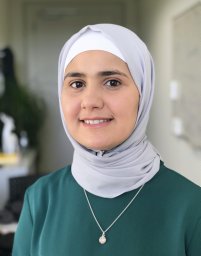
 Rima Alaifari
· 4 previous affiliations
- RWTH Aachen UniversitySince 2025
- Full Professor · Since 2025
- ETH Zurich2014–2025
- Assistant Professor for Applied Mathematics (non-TT) · 2016–2025
- Postdoctoral Fellow · 2014–2016
- Vrije Universiteit Brussel2010–2014
- PhD student · 2010–2014
- Johannes Kepler University of Linz2005–2010
- Master of Science - MS, Computational and Applied Mathematics · 2005–2010
Research Overview
Rima Alaifari focuses on the mathematical foundations of signal processing, inverse problems, and machine learning, with a particular emphasis on the stability and uniqueness of signal reconstruction. Her work integrates tools from harmonic analysis, frame theory, and functional analysis to address challenges in Stability Collapse in High Dimensional Phase Retrieval, adversarial robustness, and the discretization of neural operators. Her research trajectory has evolved from establishing fundamental limits of stability in infinite-dimensional Hilbert and Banach spaces to developing robust computational frameworks for medical imaging and physics-informed machine learning.
Research Trajectory
The early stages of Alaifari’s research were primarily concerned with the Mathematical Conditions for Unique Phase Retrieval. Phase retrieval, the problem of recovering a signal from the magnitude of its measurements, is a central challenge in physical sensing applications where phase information is lost. Alaifari’s work in this period addressed the "stability gap" that exists between finite-dimensional and infinite-dimensional settings. While phase retrieval is generally stable in finite dimensions, her research demonstrated that this stability does not naturally extend to infinite-dimensional spaces. This theoretical groundwork was essential for understanding why certain reconstruction algorithms fail or become highly sensitive to noise when applied to continuous signals.
By 2017 and 2018, Alaifari began applying these insights into stability and signal deformation to the emerging field of adversarial machine learning. This shift was characterized by an interest in Overcoming the Digital to Physical Domain Gap. Rather than focusing solely on additive pixel-wise noise, she investigated how geometric transformations and Smoothness Regularization for Physically Plausible Deformations could be used to probe the vulnerabilities of deep neural networks. This work sought to Perceptual Misalignment of Mathematical Distance Metrics by moving beyond standard $L_p$ norms to more perceptually relevant measures of distortion.
In the early 2020s, her focus expanded to include the reliability of deep learning in medical imaging, specifically compressed sensing MRI. This research challenged the prevailing view that classical mathematical methods are inherently more stable than deep learning approaches. Alaifari demonstrated that traditional regularization techniques, such as Total Variation (TV) minimization, are susceptible to localized adversarial artifacts that can be more damaging than the global noise typically studied in adversarial ML. This period also marked a significant move toward "operator learning," where she began applying frame theory to ensure that neural networks mapping between function spaces remain mathematically consistent across different digital resolutions.
Current Directions
Alaifari’s current research is concentrated on the intersection of operator theory and physics-based machine learning. A primary focus is the development of "alias-free" neural architectures that maintain Graph Connectivity and Stability in Phase Retrieval and other inverse problems. This involves creating Representation Equivalent Neural Operators (ReNOs) and Convolutional Neural Operators (CNOs) that are resolution-invariant, ensuring that a model trained on one grid size performs consistently when deployed on another.
Furthermore, she continues to investigate $L^\infty$ stability in the context of wave propagation and linear inverse problems. This work addresses the limitations of standard $L^2$ energy-based stability estimates, which often fail to capture localized phenomena or "spikes" that are critical in safety-sensitive applications like medical diagnostics or seismic imaging. Her recent work also explores the "fragility" of Gabor phase retrieval, proving that even stable signals can become difficult to reconstruct when moved from continuous to discrete lattice samples.
Representative Work
Phase Retrieval In The General Setting Of Continuous Frames For Banach Spaces (2017) In this first-author paper, Alaifari develops a unifying framework for phase retrieval in Banach spaces using continuous frames. The work establishes a significant theoretical result: phase retrieval is never uniformly stable in infinite dimensions, even when uniqueness is guaranteed. This finding complemented existing work in Hilbert spaces and provided a rigorous mathematical basis for the instabilities observed in high-dimensional signal reconstruction.
ADef: an Iterative Algorithm to Construct Adversarial Deformations (2018) As the lead author, Alaifari introduced the ADef algorithm, which shifts the focus of adversarial attacks from additive noise to small, iterative deformations. By applying gradient descent to find infinitesimal flows that cause misclassification, the paper demonstrated that convolutional neural networks (CNNs) are vulnerable to geometric distortions that are often imperceptible to humans. This work highlighted the need for robustness measures that account for the underlying geometry of the image manifold.
Stable Phase Retrieval in Infinite Dimensions (2019) This paper provides a deeper analysis of the stability-uniqueness trade-off in Hilbert spaces. Alaifari and her co-authors prove that while injectivity (uniqueness) is possible in infinite dimensions, the inverse mapping is never continuous. This result is fundamental to the field of computational harmonic analysis, as it defines the boundary between what is mathematically possible and what is numerically stable in phaseless measurement systems.
Uniqueness of STFT phase retrieval for bandlimited functions (2020) Focusing on Short-Time Fourier Transform (STFT) measurements, this first-author work addresses the practical problem of recovering bandlimited signals, such as audio or radio waves. The paper proves that phase retrieval is possible even with "imperfect" measurement windows, leveraging the properties of Paley–Wiener spaces to establish the first uniqueness results for discrete, magnitude-only samples in this context.
Localized adversarial artifacts for compressed sensing MRI (2022) In this study, Alaifari examines the robustness of image reconstruction in MRI. The research argues that $L^\infty$ errors, which manifest as localized artifacts or "spikes," are a more critical metric for medical safety than the standard $L^2$ error. The paper demonstrates that classical Total Variation minimization is surprisingly vulnerable to these localized attacks, whereas deep neural networks can sometimes exhibit superior robustness to such specific perturbations.
Are Neural Operators Really Neural Operators? Frame Theory Meets Operator Learning (2023) As the senior author, Alaifari introduces the Representation Equivalent Neural Operator (ReNO) framework. This work addresses the "discretization gap" in neural operators, which are intended to operate on infinite-dimensional function spaces but are implemented on finite grids. By applying Frame Theory, the paper provides a method to ensure that discrete implementations are mathematically consistent with their continuous counterparts, effectively eliminating aliasing errors across different resolutions.
Profile updated
Loading new papers…
Other researchers whose papers cluster into the same research directions — a proxy for overlapping technical interests and shared intellectual neighborhoods.
See something wrong? Report a mistake