

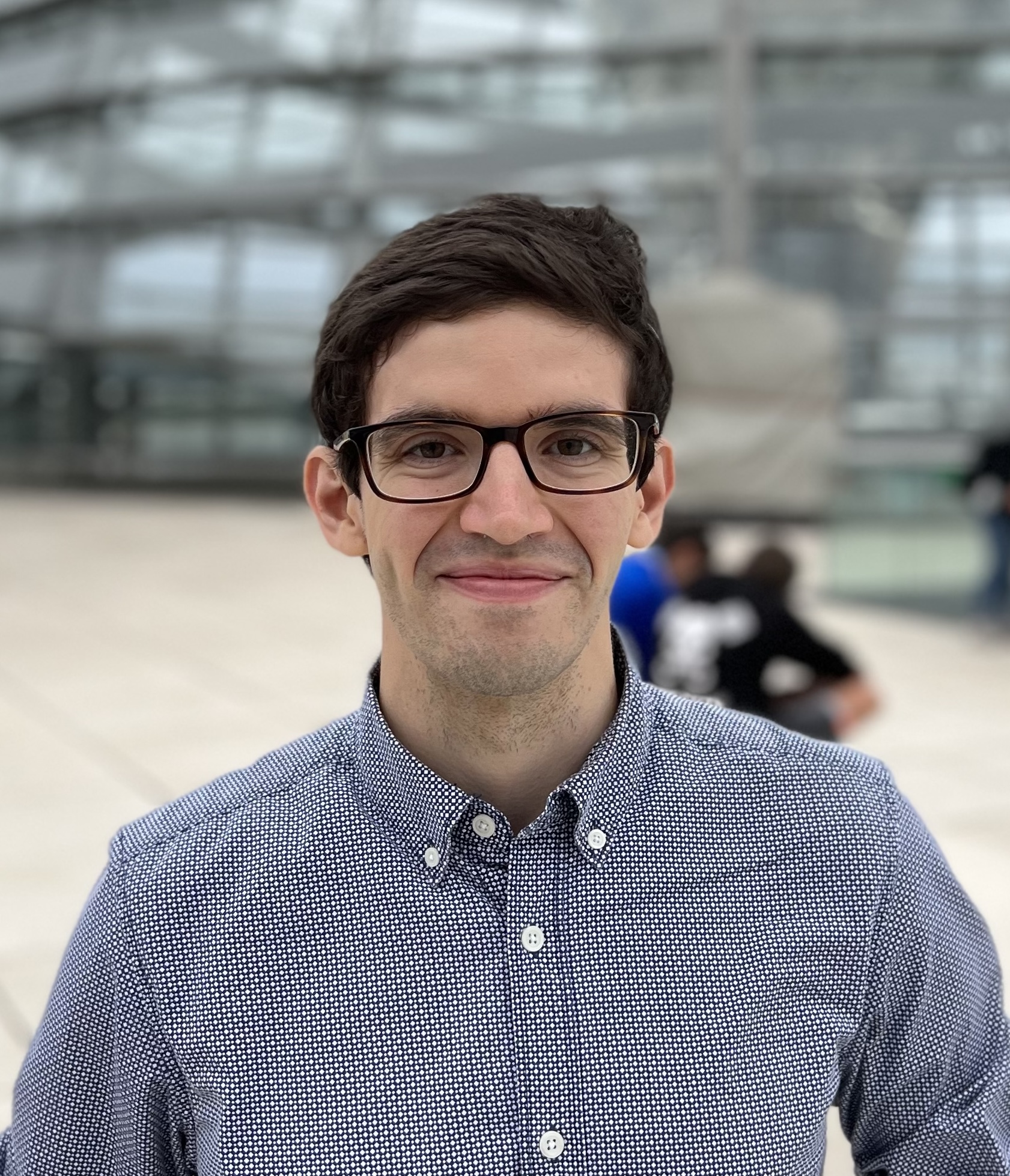
 Ricardo Baptista
· 3 previous affiliations
- University of TorontoSince 2025
- Assistant Professor · Since 2025
- Current
- California Institute of Technology2022–2024
- Instructor · 2022–2024
- Postdoc · 2022
Research Overview
Ricardo Baptista focuses on the foundations of probabilistic modeling, inference, and computational measure transport for science and engineering applications. His trajectory spans the development of scalable algorithms for high-dimensional density estimation and the rigorous mathematical analysis of generative models. Recently, his work emphasizes understanding memorization in diffusion models and advancing conditional simulation techniques.
Research Trajectory
The core of Baptista’s research investigates how to efficiently model complex probability distributions and perform inference in high-dimensional spaces. In 2025, he advanced the research direction of Density Estimation with Invertible Neural Networks by developing scalable methods for mapping conditional independence relationships. He introduced L-SING (Localized Sparsity Identification for Non-Gaussian Distributions) in Learning local neighborhoods of non-Gaussian graphical models: A measure transport approach. By parameterizing conditional distributions using neural transport maps and leveraging the local Markov property, this approach allows each variable's neighborhood to be learned independently. This methodology was further detailed in Learning Local Neighborhoods of Non-Gaussian Graphical Models, demonstrating its ability to capture complex, nonlinear dependencies in high-dimensional datasets such as gene expression networks.
A significant portion of his recent work provides rigorous theoretical foundations for modern generative AI. Investigating the area of Understanding Training Data Memorization in Generative Models, he analyzed how diffusion models can inadvertently reproduce their training samples. In Memorization and Regularization in Generative Diffusion Models, he established a theoretical framework to understand this phenomenon, showing that without proper regularization, the reverse-time dynamics naturally collapse onto empirical data points. A companion analysis, also titled Memorization and Regularization in Generative Diffusion Models, modeled the system's dynamics to demonstrate how techniques like Tikhonov penalties and early stopping can prevent this collapse and encourage true generalization.
Baptista has also made substantial contributions to conditional simulation and optimal transport. In Conditional simulation via entropic optimal transport: Toward non-parametric estimation of conditional Brenier maps, he proposed a non-parametric estimator based on the computational scalability of entropic optimal transport, providing statistical and algorithmic guarantees for generating samples from conditional distributions. Expanding his probabilistic perspective to multimodal learning, he authored A Mathematical Perspective On Contrastive Learning. This work reframed contrastive learning as the optimization of a joint probability distribution, revealing why standard approaches struggle with generative tasks and introducing novel loss functions to address these limitations.
His research frequently intersects with physical sciences and dynamical systems. To tackle high-dimensional Bayesian inference when simulator gradients are unavailable, he developed a gradient-free framework in Dimension reduction via score ratio matching. For physical modeling, he addressed the challenge of solving nonlinear partial differential equations with unpredictable noise in Solving Roughly Forced Nonlinear PDEs via Misspecified Kernel Methods and Neural Networks, utilizing a Negative Sobolev Norm to recover solutions even when underlying models are misspecified.
Moving into state estimation for complex dynamical systems, Baptista developed novel neural operators that act on probability measures. In Learning Enhanced Ensemble Filters, he introduced the Measure Neural Mapping Enhanced Ensemble Filter (MNMEF) to overcome the accuracy limits of the traditional Gaussian ansatz in ensemble Kalman filters. This framework was subsequently published in the Journal of Computational Physics as Learning enhanced ensemble filters, demonstrating state-of-the-art performance in data assimilation tasks.
In 2026, Baptista participated in collaborative efforts to accelerate generative modeling and analyze population dynamics. He contributed to Variational Flow Maps: Make Some Noise for One-Step Conditional Generation, which shifts the focus of conditional image generation from guiding a sampling path to learning optimal starting noise, achieving high-quality results in a single step. Additionally, he collaborated on Wasserstein Residuals: Learning Gradient Flows from Population Dynamics, introducing a method called "Stitching" that bypasses computationally expensive optimal transport steps by minimizing a residual loss, making it highly robust to gaps in observational data. In another 2026 collaboration addressing scientific computing challenges, Baptista co-developed WaSP: Wasserstein Data Synthesis Pipeline for Solver-Free Operator Learning, a solver-free training framework for neural operators that bridges the distribution shift between manufactured input-solution pairs and target distributions along intermediate Wasserstein paths.
Current Directions
Based on his most recent publications, Baptista's current research focuses on accelerating generative models and refining state estimation for complex dynamical systems. A major theme is the development of single-step conditional generation techniques, moving away from iterative diffusion processes toward more efficient variational flow maps. Concurrently, he is investigating population dynamics through the lens of Wasserstein gradient flows, seeking computationally tractable methods to infer trajectories from sparse observational data. His ongoing work also emphasizes the integration of measure neural mappings into ensemble filtering and the development of solver-free neural operator learning using synthetic data pipelines for partial differential equations.
Profile updated
Loading new papers…
Other researchers whose papers cluster into the same research directions — a proxy for overlapping technical interests and shared intellectual neighborhoods.
See something wrong? Report a mistake