

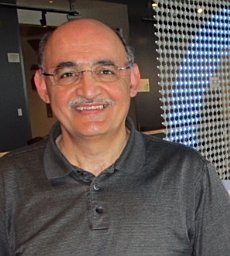
 Reza Ghanadan
· 12 previous affiliations
- University of Maryland, College ParkSince 2024
- Full Professor · Since 2024
- PhD student · 1990–1993
- MS student · 1988–1990
- Undergrad student · 1986–1988
- Interactive AI2024–2025
- Founder/President · 2024–2025
- Amazon (United States)2021–2023
- Principal Researcher · 2021–2023
- Google (United States)2017–2021
- Principal Researcher · 2017–2021
- Algorithm Technolgies LLC2017
- Founder/CEO · 2017
- Principal Researcher · 2013–2017
- Boeing2010–2013
- Principal Researcher · 2010–2013
- BAE Systems (United Kingdom)2002–2010
- Principal Researcher · 2002–2010
- New York University2006–2008
- MS student · 2006–2008
- Flarion Technolgoies2000–2002
- Researcher · 2000–2002
- Bell Labs1995–2000
- Researcher · 1995–2000
- Postdoc · 1993–1994
Research Overview
Reza Ghanadan focuses on the intersection of control theory, distributed systems, and embodied artificial intelligence. His work has evolved from the fundamental mathematics of nonlinear adaptive control to the development of secure, collaborative machine learning frameworks and the deployment of large-scale interactive platforms for human-robot interaction. Currently, his research emphasizes Situational Safety for Embodied and Agentic AI, the integration of multimodal prompts for robotic manipulation, and the advancement of privacy-preserving learning protocols.
Research Trajectory
The early stages of Ghanadan’s research were grounded in classical control theory and the stability of complex physical systems. In the mid-1990s, his work addressed the challenges of controlling nonlinear systems that lacked standard structural properties, such as well-defined relative degrees or minimum phase characteristics. This period was defined by an analytical focus on adaptive tracking and parameter estimation, establishing a foundation in mathematical rigor that would later inform his approach to autonomous systems.
By the late 2000s, Ghanadan’s focus shifted toward the challenges of distributed networked systems, particularly mobile ad-hoc networks (MANETs) and sensor networks. During this phase, he investigated the efficiency of routing control messages and the dissemination of information in dynamic environments. This work expanded to include security and trust management in decentralized architectures, where he participated in research exploring how compromised or faulty sensors impact decision fusion and the overall quality of information. This transition marked a move from isolated physical control to the broader problems of coordination and reliability in multi-agent environments.
In the late 2010s, Ghanadan began integrating game-theoretic frameworks into the study of human-machine systems. This research addressed the inherent asymmetries in information and risk sensitivity between human operators and autonomous agents. By modeling these interactions as risk-sensitive dynamic games, his work sought to enable machines to adaptively learn human preferences while providing optimal assistance. This period bridged the gap between traditional control systems and modern artificial intelligence, emphasizing the need for agents that can operate effectively alongside humans in complex, uncertain environments.
Since 2020, Ghanadan has focused heavily on the security, privacy, and scalability of machine learning. He has led research into "Assisted Learning" and "Imitation Privacy," addressing the "privacy deadlock" that occurs when organizations wish to collaborate without exposing proprietary data or models. This work is central to Defending Machine Learning Models Against Extraction Attacks and ensuring Dual Sided Privacy for Machine Learning Inference. Most recently, his work has moved into the domain of Embodied AI, where he oversees the development of large-scale simulation platforms and challenges designed to advance conversational agents in multimodal, physical contexts.
Current Directions
Ghanadan’s current research program is centered on the deployment of general-purpose embodied agents. A primary focus is the SimBot Challenge, an initiative that tasks researchers with building robot assistants capable of completing complex missions in simulated environments. This work explores the affordances of combining computer vision, physical embodiment, and natural language processing to create agents that can follow nuanced instructions and interact with humans in real-time.
Within this domain, Ghanadan is investigating Relational Scene Graphs for Visual Reasoning. This involves moving beyond raw sensory data to create hierarchical representations of environments that allow robots to reason about physical relationships and object states. He also participates in research regarding Conditioning Anomaly Detection on Scene Context, which is critical for ensuring that embodied agents can identify and respond to unusual situations that may compromise safety or task performance.
Another significant area of current interest is the safety and alignment of Large Language Models (LLMs) used in agentic contexts. Ghanadan has contributed to the development of "preventative detoxification" methods, such as Model with Inhibition Control (MICo), which aim to reduce toxic outputs in LLMs without degrading their utility. Furthermore, he is involved in efforts to improve data efficiency through Maximizing Data Diversity through Semantic Filtering, ensuring that the datasets used to train these complex models are both high-quality and representative of the long-tail scenarios encountered in the real world.
Representative Work
Adaptive control of nonlinear systems via approximate linearization In this early work, Ghanadan developed an adaptive control scheme for nonlinear systems that do not satisfy traditional regularity conditions. The approach utilizes an approximate model for controller design while deriving parameter update laws from the exact model's observation error. This research demonstrated that stable closed-loop tracking is achievable even when the system violates common assumptions like involutivity, providing a constructive procedure for handling a broader class of nonlinear dynamics.
Efficient dissemination techniques for MANET routing control messages As a senior researcher in this study, Ghanadan addressed the problem of optimal flooding in mobile ad-hoc networks. The paper investigates proactive and hybrid routing protocols, focusing on how to distribute control information to all nodes with minimal communication latency and overhead. This work contributed to the understanding of how to maintain network-wide state in highly dynamic and resource-constrained wireless environments.
Risk-Sensitive Cooperative Games for Human-Machine Systems This research proposes a framework for human-machine collaboration based on risk-sensitive dynamic games. Ghanadan and his collaborators addressed the challenge of asymmetric information, where a machine must learn a human's hidden preferences and risk tolerances to optimize a joint objective. The framework allows for adaptive learning and assistance, ensuring that the autonomous system aligns its actions with the human's specific sensitivities to uncertainty and risk.
Meta Clustering for Collaborative Learning In the context of distributed machine learning, Ghanadan led the development of "meta clustering," a method for categorizing learners rather than data points. By using a Select-Exchange-Cluster (SEC) method, the framework allows individual learners to identify and filter out unqualified or incompatible collaborators based on their underlying supervised functions. This approach ensures that collaborative learning sets are accurate, enhancing the performance of all participating agents.
Assisted Learning and Imitation Privacy Ghanadan introduced the Assisted Learning framework to enable cross-organizational collaboration on supervised learning tasks without the exchange of sensitive data or proprietary algorithms. This work formalizes the concept of "Imitation Privacy," which quantifies the degree to which a model's functional behavior is protected from being stolen through API queries. The framework allows an organization to seek assistance by broadcasting task-specific but non-sensitive information, facilitating a secure form of collaborative intelligence.
Alexa, play with robot: Introducing the First Alexa Prize SimBot Challenge on Embodied AI As the senior lead for the SimBot Challenge, Ghanadan describes the creation of a simulated physical environment designed to push the boundaries of conversational and embodied AI. The challenge requires agents to integrate computer vision and natural language understanding to perform tasks in a multi-room layout. This work represents a major effort to move AI research from static datasets to interactive, user-centric environments where agents must navigate the complexities of physical embodiment and human dialogue.
Profile updated
Loading new papers…
Other researchers whose papers cluster into the same research directions — a proxy for overlapping technical interests and shared intellectual neighborhoods.
See something wrong? Report a mistake