

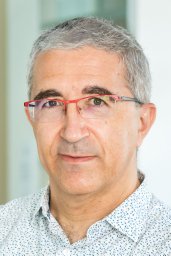
 Renaud Marlet
· 6 previous affiliations
- École nationale des ponts et chausséesSince 2009
- Senior Researcher · Since 2009
- Current
- Valeo (France)Since 2019
- Principal Scientist at Valeo.ai · Since 2019
- valeo.aiSince 2019
- Principal Scientist · Since 2019
- Researcher · Since 2022
- Associate Research Scientist · 2004–2009
- Trusted Logic SA (France)2000–2004
- Assistant CTO · 2000–2004
- École Polytechnique1985–1988
- Engineer, Science · 1985–1988
Research Overview
Renaud Marlet focuses on computer vision, 3D geometry processing, and scene understanding for autonomous systems. His early work addressed software engineering and global registration techniques for structure from motion before shifting toward semantic segmentation and surface reconstruction from point clouds. His current research investigates self-supervised learning and open-vocabulary perception for LiDAR and camera data in autonomous driving environments.
Research Trajectory
Marlet’s early research addressed system software optimization. In 2001, he contributed to Specialization tools and techniques for systematic optimization of system software, developing toolkits to automate operating system specialization and improve performance.
He subsequently transitioned to computer vision and geometry processing, focusing heavily on structure from motion (SfM) and 3D reconstruction. He developed methods for global calibration, such as Global Fusion of Relative Motions for Robust, Accurate and Scalable Structure from Motion, which mitigated drift in multi-view reconstructions by fusing relative motions and extracting stable translation directions. This line of work culminated in the release of OpenMVG: Open Multiple View Geometry, a widely adopted, modular C++ library providing algorithms for 3D reconstruction from images.
As deep learning transformed computer vision, his focus expanded to neural surface reconstruction and object detection. He introduced Few-Shot Object Detection and Viewpoint Estimation for Objects in the Wild, a meta-learning framework incorporating 3D shape information, which contributed to the research direction of Resolving Geometric Symmetry Ambiguity in 3D Pose Estimation. He also advanced neural surface reconstruction with POCO: Point Convolution for Surface Reconstruction, shifting away from rigid 3D grids by attaching latent features directly to input points via an attention-based interpolation scheme.
In recent years, his trajectory has heavily emphasized perception for autonomous driving, particularly leveraging self-supervised learning to reduce annotation costs. He explored the area of Label-Efficient 3D Perception for Point Clouds through methods like ALSO: Automotive Lidar Self-Supervision by Occupancy Estimation, which pre-trains LiDAR networks by predicting spatial occupancy from sparse sensor data. To further minimize manual labeling, he investigated active learning strategies in MILAN: Milli-Annotations for Lidar Semantic Segmentation, using self-supervised representations to select highly informative LiDAR scans for annotation.
A major theme in his recent work is the research direction of Open-Vocabulary 3D Perception via 2D Foundation Models. He developed techniques to transfer knowledge from pre-trained 2D image models to 3D LiDAR networks. This began with Image-to-Lidar Self-Supervised Distillation for Autonomous Driving Data, which aligned visual regions with 3D point clusters using superpixels. He refined this approach in Revisiting the Distillation of Image Representations into Point Clouds for Autonomous Driving and subsequently formalized it in Three Pillars Improving Vision Foundation Model Distillation for Lidar. This work demonstrated that scaling the 3D backbone, utilizing massive 2D vision foundation models, and training on diverse datasets significantly closes the gap between self-supervised and fully supervised LiDAR networks.
Concurrently, he explored alternative architectures and representations for outdoor scenes. He investigated the adaptation of vision transformers for 3D semantic segmentation in RangeViT: Towards Vision Transformers for 3D Semantic Segmentation in Autonomous Driving. He also contributed to the broader area of Bird's Eye View Representations for LiDAR Point Clouds. With collaborators, he participated in the development of BEVContrast: Self-Supervision in BEV Space for Automotive Lidar Point Clouds, contrasting features within 2D cells to improve semantic segmentation. He further advanced camera-only BEV segmentation with OccFeat: Self-supervised Occupancy Feature Prediction for Pretraining BEV Segmentation Networks, combining 3D occupancy prediction with semantic feature distillation. Most recently, he has addressed open-vocabulary segmentation in driving environments with LOSC: LiDAR Open-voc Segmentation Consolidator, a method that consolidates noisy, back-projected image semantics to enforce spatio-temporal consistency and train robust 3D networks.
Current Directions
The most recent papers in the evidence address open-vocabulary 3D perception and label-efficient learning for autonomous driving. Current work investigates how to effectively leverage large-scale 2D vision-language models to understand 3D LiDAR scans without relying on exhaustive manual annotations. This involves consolidating noisy semantic labels projected from images to enforce spatio-temporal consistency in 3D space. Additionally, ongoing research explores advanced self-supervised pre-training paradigms—such as occupancy prediction and feature distillation—to build robust representations for both LiDAR and Bird's-Eye-View (BEV) segmentation in low-data regimes.
Profile updated
Loading new papers…
Other researchers whose papers cluster into the same research directions — a proxy for overlapping technical interests and shared intellectual neighborhoods.
See something wrong? Report a mistake