

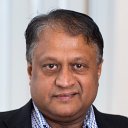
 Ramani Duraiswami
· 6 previous affiliations
- University of Maryland, College ParkSince 1998
- Full Professor · Since 2014
- Professor · Since 1998
- Associate Professor · 2007–2014
- Assistant Professor · 2004–2007
- Researcher · 1998–2004
- FujiFilm VisualSonics (Canada)Since 2011
- Co-Founder · Since 2011
- Affiliate Professor · Since 2024
- Fantalgo2006–2013
- CEO · 2006–2013
- Johns Hopkins University1985–1991
- Ph.D., Mechanical Engineering and Applied Math. · 1985–1991
- B. Tech., Mechanical Engineering · 1981–1985
Research Overview
Ramani Duraiswami focuses on computational acoustics, fast numerical algorithms, and scalable machine learning. His trajectory spans the development of fast multipole methods for wave equations and kernel density estimation to recent advances in linear-time attention mechanisms and differentiable spatial audio. Currently, his work addresses efficient 3D scene representation, audio-visual reasoning, and optimized neural architectures.
Research Trajectory
Duraiswami’s early research addressed inverse problems in acoustics. In 1992, he explored ill-posed Fredholm integral equations in New theory/algorithms for bubble density measurement using inverse acoustic scattering techniques, developing numerical methods to account for thermal losses and off-resonance scattering in noisy experimental data.
By the early 2000s, his focus expanded to computer vision and statistical modeling. With collaborators, he utilized nonparametric techniques for visual surveillance in Background and foreground modeling using nonparametric kernel density estimation for visual surveillance, constructing robust statistical representations of scene backgrounds. Recognizing the computational bottlenecks of kernel density estimation (KDE), he applied the Fast Gauss Transform (FGT) to vision problems in Efficient Kernel Density Estimation Using the Fast Gauss Transform with Applications to Color Modeling and Tracking. This foundational work on accelerating KDE naturally progressed into the research direction of Overcoming the Cubic Complexity of Kernel Methods. A key contribution to this area was Efficient Kernel Machines Using the Improved Fast Gauss Transform, which introduced numerical approximation techniques to achieve linear-time performance for large-scale kernel-based machine learning algorithms.
In parallel, Duraiswami advanced the Fast Multipole Method (FMM) for wave equations. He developed mathematical formulations for 3D wave propagation in Recursions for the Computation of Multipole Translation and Rotation Coefficients for the 3-D Helmholtz Equation. This theoretical work enabled practical breakthroughs in spatial audio, such as the computation of high-frequency head-related transfer functions (HRTFs) using an FMM-accelerated boundary element method (BEM) in Head-related transfer functions via the fast multipole accelerated boundary element method. Continuing his work on numerical linear algebra, he contributed to the area of Preconditioning Strategies for Ill-Conditioned Linear Systems with Fast Radial Basis Function Interpolation via Preconditioned Krylov Iteration. He also explored hardware acceleration for these algorithms, implementing FMM on graphics processing units in Fast multipole methods on graphics processors.
Duraiswami’s recent trajectory bridges his historical expertise in numerical methods with modern deep learning architectures. Returning to boundary element methods, he derived exact analytical expressions for layer potential kernels in Analytical Galerkin Boundary Integrals of Laplace Kernel Layer Potentials in (\boldsymbol{\mathbb{R}^3}). This work advances the broader area of Numerical Integration of Singular and Weakly Singular Kernels and supports theoretical work in Generalizing Machine Learning Guarantees to Alternative Kernels. Drawing inspiration from FMM, his group addressed the quadratic complexity of Transformer models in FAST: Factorizable Attention for Speeding up Transformers, introducing a factorizable polynomial kernel that achieves linear-time sequence modeling. This was further optimized in Transformer Based Linear Attention with Optimized GPU Kernel Implementation, which provided a highly efficient CUDA implementation that significantly reduced memory usage and increased speed.
In the audio domain, Duraiswami has integrated classical signal processing with differentiable programming. He introduced a lightweight, interpretable model of human hearing in Biomimetic Frontend for Differentiable Audio Processing, outperforming standard convolutional networks in noisy environments. For spatial audio, he developed Room Impulse Response Synthesis via Differentiable Feedback Delay Networks for Efficient Spatial Audio Rendering, optimizing filter parameters to match perceptual metrics for zero-latency, real-time rendering on edge devices.
His recent work also encompasses 3D computer vision and multimodal reasoning. To stabilize the training of neural networks representing 3D shapes, he proposed a regularization technique based on PDE theory in ViscoReg: Neural Signed Distance Functions via Viscosity Solutions. He similarly improved 3D scene representation in 3D Gaussian Splatting with Normal Information for Mesh Extraction and Improved Rendering, using signed distance function gradients to regularize geometry and extract precise surface meshes. In multimodal AI, he contributed to the research directions of Relational Auditory Reasoning Beyond Single Clip Recognition and Audio-Visual Disentanglement in Multi-Source Environments by exposing logical flaws in state-of-the-art models with AURA: A Fine-Grained Benchmark and Decomposed Metric for Audio-Visual Reasoning. Most recently, he explored generative synthesis in Learning Illumination Control in Diffusion Models, enabling text-guided relighting while preserving subject identity.
Current Directions
Recent work investigates the intersection of efficient neural architectures, differentiable rendering, and multimodal reasoning. A major focus is on reducing the computational complexity of sequence modeling through linear-time attention mechanisms and optimized hardware implementations that bypass the traditional quadratic bottlenecks of Transformers. In parallel, research addresses 3D scene representation and spatial audio, utilizing techniques like neural signed distance functions, regularized 3D Gaussian splatting, and differentiable feedback delay networks to achieve high-fidelity, real-time synthesis. Finally, current projects explore multimodal evaluation and control, including fine-grained benchmarks that test the logical consistency of audio-visual reasoning models and novel pipelines for text-guided illumination control in diffusion models.
Profile updated
Loading new papers…
Other researchers whose papers cluster into the same research directions — a proxy for overlapping technical interests and shared intellectual neighborhoods.
See something wrong? Report a mistake