

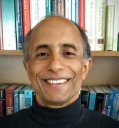
 Rajeev Raman
· 3 previous affiliations
- University of LeicesterSince 2001
- Full Professor · Since 2001
- King's College London1994–2001
- Assistant Professor · 1994–2001
- Postdoc · 1992–1994
Research Overview
Rajeev Raman focuses on the design and analysis of data structures, cache-oblivious algorithms, and sequence prediction models. His trajectory spans foundational lower bounds in computational models to optimized memory-hierarchy data structures and succinct sequence prediction techniques. Recently, his collaborative work has expanded into computer vision, specifically addressing occlusion and temporal coherence in 3D reconstruction.
Research Trajectory
Raman’s early research in the 1990s centered on theoretical computer science and computational complexity. As a co-author, he contributed to foundational work on the arithmetic model of computation in Lower Bounds for Set Intersection Queries (1995). This research established tight lower bounds for processing intermixed sequences of updates and queries, demonstrating the fundamental time constraints of set intersection reporting.
In the early 2000s, Raman’s focus shifted toward optimizing data structures for modern memory hierarchies, frequently leading these efforts as a senior author. In Optimised Predecessor Data Structures for Internal Memory (2001), he guided research on the dynamic predecessor problem, introducing techniques to simultaneously reduce cache and translation-lookaside buffer (TLB) misses by simulating hierarchical memory and cache-oblivious algorithms. He expanded on this paradigm in Exponential Structures for Efficient Cache-Oblivious Algorithms (2002), developing cache-oblivious data structures for searching, partial persistence, and planar point location that maintain high performance without relying on specific hardware parameters like block size.
By the 2010s, Raman’s research incorporated sequence prediction and data compression. He participated as a middle author in CPT+: Decreasing the Time/Space Complexity of the Compact Prediction Tree (2015), which proposed strategies to reduce the size and prediction time of tree-based models while increasing accuracy. He later led related work in Succinct BWT-Based Sequence Prediction (2019), investigating how the Burrows-Wheeler Transform and succinct data structures could further optimize sequence prediction frameworks.
Most recently, Raman has participated in applied computer vision research. As a co-author of IFVONet: Integrating Inter-Frame Variation and Occlusion Awareness for 3D Hand Mesh Reconstruction (2025), he contributed to a framework designed to reconstruct 3D hand meshes from video by capturing inter-frame variations and improving the recovery of globally occluded regions.
Current Directions
The most recent papers in the evidence indicate an ongoing interest in complex sequence modeling and spatial reconstruction. Recent work investigates computer vision challenges, particularly the extraction of 3D meshes from video data. This involves developing methods to handle severe object occlusions and improve temporal coherence across frames by analyzing inter-frame variations. Broadly, these directions reflect a continued focus on optimizing how sequential and spatially complex data is processed, moving from foundational data structures into applied, video-based reconstruction tasks.
Profile updated
Loading new papers…
Loading research neighbors…
See something wrong? Report a mistake