

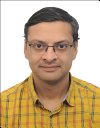
 Raghava Mutharaju
· 7 previous affiliations
- Indian Institute of Technology PalakkadSince 2025
- Associate Professor · Since 2025
- Associate Professor · 2024–2025
- Assistant Professor · 2018–2023
- GE Global Research (United States)2016–2018
- Research Scientist · 2016–2018
- Wright State University2009–2016
- PhD student · 2009–2016
- Research Intern · 2015
- University of Huddersfield2013–2014
- Visiting Research Student · 2013–2014
- Motilal Nehru National Institute of Technology2004–2006
- M.Tech, Computer Science and Engineering · 2004–2006
Research Overview
Raghava Mutharaju focuses on the evaluation and scalability of ontology reasoners, specifically within the Web Ontology Language (OWL 2) ecosystem. As a principal investigator, his work addresses the performance bottlenecks of formal reasoning systems by developing comprehensive, customizable benchmarks. His most recent efforts center on creating robust evaluation frameworks that span diverse levels of expressivity and scale.
Research Trajectory
In the available corpus, Raghava Mutharaju's research trajectory is highly focused on the infrastructure and evaluation of formal reasoning systems, with a concentrated output in 2020. A recurring challenge in the Semantic Web and knowledge representation communities is a structural "chicken and egg" problem: ontology developers hesitate to build large, highly expressive ontologies due to the performance bottlenecks of existing reasoners, while reasoner developers lack diverse, real-world ontologies to test and improve their systems. This bottleneck limits progress in formal semantics and intersects with the research direction Geometric Embeddings for Formal Ontologies and the broader area of Scaling Symbolic Reasoning to Large Knowledge Bases.
To break this cycle, Mutharaju led a series of projects as the principal investigator to develop robust benchmarking tools for OWL 2. His research group initially introduced A Benchmark for OWL 2 DL Reasoners, laying the groundwork for systematic reasoner evaluation. This initiative was substantially expanded in the core publication OWL2Bench: A Benchmark for OWL 2 Reasoners. In this work, Mutharaju and his collaborators designed a high-quality benchmark with extensive coverage of OWL 2 language constructs. The benchmark was specifically engineered to span a wide spectrum of size and expressivity, allowing researchers to pinpoint exact performance bottlenecks across various reasoning engines.
Continuing this line of infrastructure development, Mutharaju served as the senior author on OWL2Bench: Towards a Customizable Benchmark for OWL 2 Reasoners. This iteration emphasized customizability, providing the community with flexible tools to generate synthetic ontologies that mimic real-world complexity, thereby facilitating more targeted stress-testing of ontology reasoners.
Current Directions
Based on the most recent papers in the evidence, which date to 2020, Mutharaju's work centers on the systematic evaluation of formal logic systems. The primary open problem addressed in this recent work is the lack of scalable, highly expressive datasets required to push the boundaries of automated reasoning. By focusing on customizable benchmarking infrastructure, his research provides the necessary foundation for optimizing reasoners. This optimization is critical for supporting more complex applications in knowledge representation, ultimately facilitating advancements in related fields such as the research theme of Hierarchical Embedding via Geometric Containment.
Profile updated
| Title | Venue | Year |
|---|---|---|
| LLM-ORBench: Designing a Benchmark Dataset for Complex Ontology-Based Reasoning Tasks in Large Language Models | Openreview | 2026 |
| A Benchmark for OWL 2 DL Reasoners | Comad/cods | 2020 |
| OWL2Bench: Towards a Customizable Benchmark for OWL 2 Reasoners | Iswc (demos/industry) | 2020 |
| OWL2Bench: A Benchmark for OWL 2 Reasoners | Iswc | 2020 |
Loading new papers…
Other researchers whose papers cluster into the same research directions — a proxy for overlapping technical interests and shared intellectual neighborhoods.
See something wrong? Report a mistake