

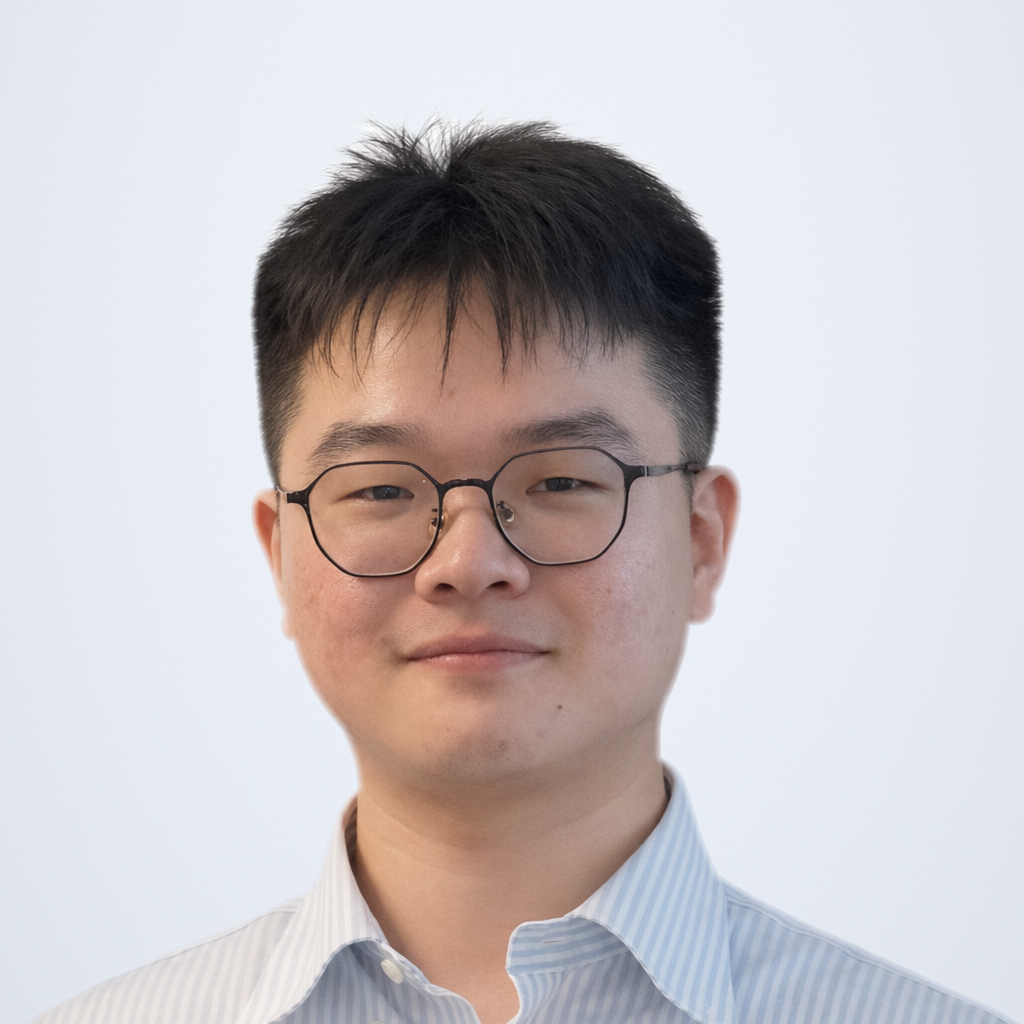
 Qingyong Hu
· 2 previous affiliations
- Postdoc · Since 2025
- Current
- PhD student · 2020–2025
- Undergrad student · 2015–2020
1 other author named Qingyong Hu: Qingyong Hu (University of Oxford · 59 papers)
Research Overview
Qingyong Hu focuses on the development of scalable graph neural network architectures and multimodal perception systems for complex, real-world environments. His work addresses fundamental challenges in graph representation learning, including adaptive sampling for transformers and the preservation of relational data in federated learning environments. Recently, his research has transitioned toward the application of these techniques in intelligent driving systems, specifically focusing on Asymmetric Spatiotemporal Decoupling for Video Models and the creation of large-scale datasets for remote physiological monitoring.
Research Trajectory
Hu’s early contributions centered on the structural optimization of Graph Transformers. In 2022, he participated in research addressing the limitations of existing node sampling strategies, which often failed to account for specific graph characteristics or long-range dependencies. This work sought to move beyond local neighbor-based sampling to better capture the global structure of large-scale graphs. During this period, the research also touched upon the necessity of Temporal Correspondence for Dynamic Point Clouds, exploring how spatial-temporal features could be more effectively integrated into transformer-based architectures.
By 2024, Hu’s focus shifted toward the intersection of graph learning and distributed systems. He contributed to the development of frameworks for federated node classification, addressing the "missing link" problem inherent in subgraph federated learning. This research was particularly concerned with maintaining the performance of message-passing paradigms when graph data is distributed across multiple local systems, ensuring that the global structural integrity of the graph is not lost during the aggregation process.
In 2025, Hu’s research trajectory moved toward applied multimodal perception within the automotive domain. This phase of work emphasizes the integration of diverse data streams—including RGB, Near-Infrared (NIR), and depth video—to monitor driver states and improve cockpit interactions. This work utilizes Temporal Aggregation over Pre-extracted Visual Features to reason about complex human behaviors and physiological signals in real-time driving scenarios.
Current Directions
Hu’s current research is characterized by an emphasis on human-centric AI and robust perception in intelligent cockpits. This involves two primary pillars: the development of comprehensive datasets for physiological sensing and the creation of "generalist" agents capable of understanding a wide array of human and environmental inputs.
A significant portion of his recent work involves remote physiological measurement (RPM). Traditional RPM methods often struggle in the constrained and variable environment of a vehicle cockpit. Hu has contributed to efforts to bridge this gap by developing multimodal datasets that capture a broad range of biometric annotations and environmental conditions. This work is foundational for building non-invasive systems that can monitor driver health and alertness without requiring wearable sensors.
Furthermore, Hu is involved in the development of driving agents that prioritize "super-alignment"—the ability of an AI system to adapt its reactions and decisions based on individual user preferences and biases. These agents are designed to process multimodal inputs, including facial emotions, hand movements, and body gestures, to build a more holistic understanding of the driver’s state and the surrounding driving scenario.
Representative Work
In Hierarchical Graph Transformer with Adaptive Node Sampling, Hu contributed to a study identifying deficiencies in how Graph Transformers handle large-scale data. The research highlighted that standard sampling strategies are often agnostic to the training process and neglect long-range dependencies. The proposed hierarchical approach utilized adaptive node sampling to better capture the nuances of graph-structured data, demonstrating improved performance on large graphs where traditional transformers often struggle.
Hu’s work on FedGT: Federated Node Classification with Scalable Graph Transformer addressed the challenges of training GNNs on subgraphs stored across distributed systems. In federated learning contexts, the links between these local subgraphs are typically missing, which can severely degrade the performance of models relying on message-passing. Hu participated in the development of FedGT to provide a more scalable and robust solution for node classification that maintains structural information across decentralized nodes.
The transition to automotive applications is evidenced by PhysDrive: A Multimodal Remote Physiological Measurement Dataset for In-vehicle Driver Monitoring. Hu was part of the team that developed this large-scale dataset, which was designed to overcome the limitations of existing RPM resources. PhysDrive includes diverse modalities and biometric annotations, specifically tailored to the challenges of real-world driving, such as varying lighting conditions and driver movements. This work provides a benchmark for the development of contactless in-vehicle sensing technologies.
Finally, in A Super-Aligned Driving Generalist Is Your Cockpit, Hu contributed to the design of "Sage Deer," a multimodal agent for intelligent cockpits. The project focused on achieving "super-alignment," ensuring the agent could tailor its behavior to the specific preferences of different users. The agent integrates RGB, NIR, and depth video to perceive a wide range of inputs, from physiological indicators to behavioral decisions, representing a shift toward more integrated and user-aware autonomous systems.
Profile updated
| Paper | Venue | Year |
|---|---|---|
| Hierarchical Graph Transformer with Adaptive Node SamplingGitHubzaixizhang/ | NeurIPS | 2022 |
Loading new papers…
Other researchers whose papers cluster into the same research directions — a proxy for overlapping technical interests and shared intellectual neighborhoods.
See something wrong? Report a mistake