

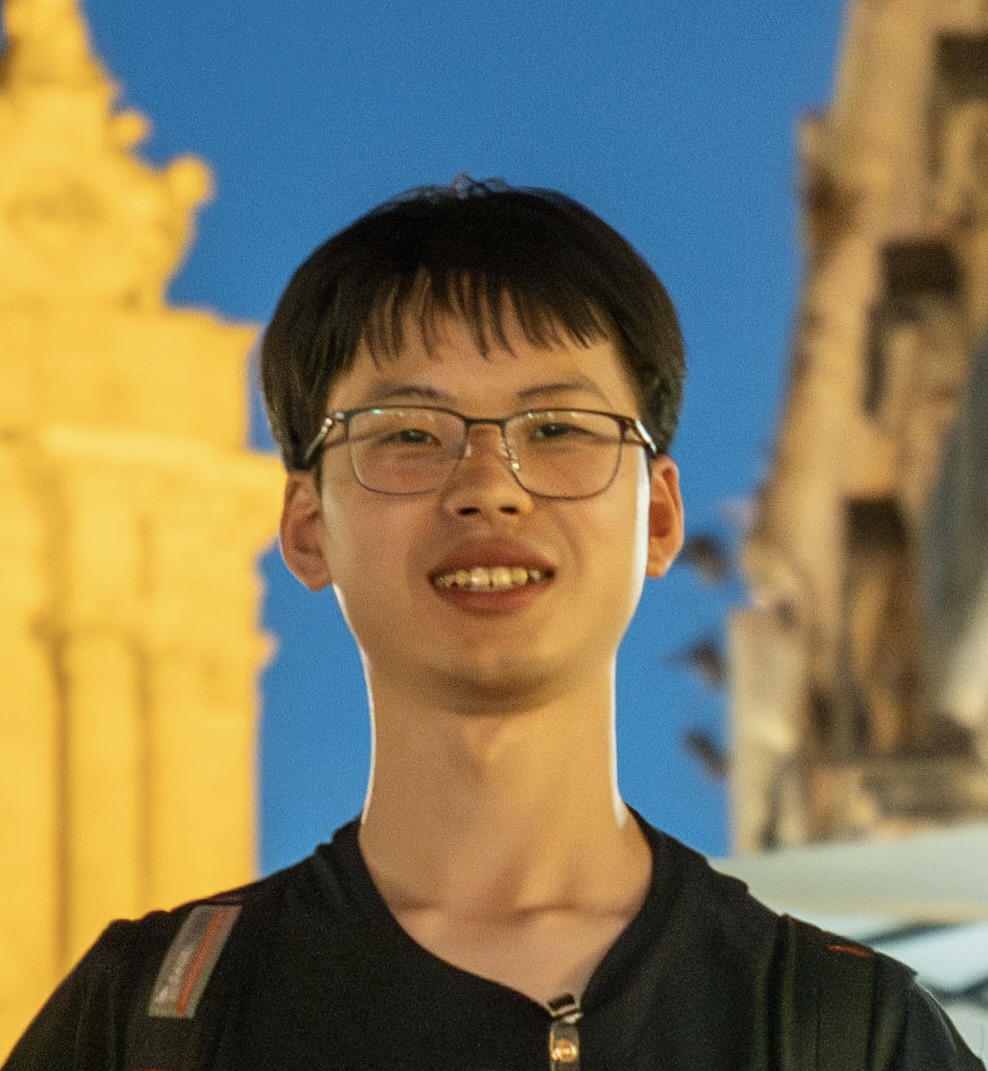
 Qiaole Dong
· 2 previous affiliations
- Tencent (China)Since 2026
- Researcher · Since 2026
- Fudan UniversityCurrent
- Current
- PhD student · 2022–2026
- Undergrad student · 2018–2022
Research Overview
Qiaole Dong focuses on the perception and anticipation of motion in video, optical flow estimation, and structural image generation. His earlier work developed incremental transformer architectures for coherent image inpainting and leveraged geometric matching to improve optical flow models. More recently, his research has expanded into the post-training of multimodal large language models, investigating reinforcement fine-tuning and the impact of data contamination on reasoning capabilities.
Research Trajectory
Dong's early research concentrated on structural image generation, specifically addressing the challenges of recovering holistic structures and vivid textures in corrupted images. In 2022, he introduced Incremental Transformer Structure Enhanced Image Inpainting with Masking Positional Encoding, which utilized an additional structure restorer to incrementally facilitate image inpainting. This approach mitigated the limited receptive fields of convolutional neural networks while managing the computational costs associated with attention-based models. He subsequently expanded on this architecture with collaborators in ZITS++: Image Inpainting by Improving the Incremental Transformer on Structural Priors, studying a zero-initialized residual addition-based incremental transformer. This work further refined the integration of structural priors to restore complex images with both vivid textures and reasonable holistic structures.
Concurrently, Dong developed a strong focus on the perception and anticipation of motion, particularly through optical flow estimation. In 2023, he explored the application of generative models to this domain, reproducing and open-sourcing a diffusion model for optical flow in Open-DDVM: A Reproduction and Extension of Diffusion Model for Optical Flow Estimation. Recognizing that models trained from scratch on standard optical flow data often struggle with robust feature matching, he proposed a novel pre-training paradigm in Rethinking Optical Flow from Geometric Matching Consistent Perspective. By leveraging geometric image matching as a pre-training task, this work improved the underlying feature representations for optical flow estimation. To address the computational overhead and non-causal limitations of multi-frame approaches, he later developed MemFlow: Optical Flow Estimation and Prediction with Memory, a real-time method designed to maintain temporal coherence without relying on unseen future frames.
Building on these foundations in motion and temporal coherence, Dong's work advanced into video-level tracking and editing. He contributed to the area of Memory Augmented Architectures for Persistent Object Tracking with the development of Online Dense Point Tracking with Streaming Memory. This lightweight, fully online framework decomposed long-range tracking into visibility-guided feature propagation and short-range attention retrieval, significantly improving inference speed and parameter efficiency. In parallel, he participated in research on temporally coherent video editing, co-developing the VidPivot framework in Enhancing Video Inpainting with Aligned Frame Interval Guidance. By decoupling multi-frame consistent image inpainting from masked area motion propagation, and utilizing sparsely sampled anchor frames to guide the diffusion process, this work addressed common issues of flickering and content degradation in image-to-video models.
Most recently, Dong's research has expanded into the post-training methodologies of large language models and multimodal systems. In Why Reinforcement Fine-Tuning Enables MLLMs Preserve Prior Knowledge Better: A Data Perspective, he investigated the mechanics of reinforcement fine-tuning, demonstrating that it mitigates catastrophic forgetting by naturally selecting training data that aligns with a model's pre-existing probability landscape. Continuing this critical examination of reinforcement learning in language models, he contributed to Reasoning or Memorization? Unreliable Results of Reinforcement Learning Due to Data Contamination, which revealed how data contamination in pre-training corpora can artificially inflate the apparent reasoning improvements driven by reinforcement learning. By evaluating models on clean datasets, the research demonstrated that genuine reasoning improvements rely heavily on accurate reward signals rather than memorized benchmark solutions.
Current Directions
The most recent papers in the evidence indicate a strategic shift toward the post-training and evaluation of large language models (LLMs) and multimodal large language models (MLLMs). Current work investigates the dynamics of reinforcement fine-tuning (RFT) and its advantages over standard supervised fine-tuning in preserving a model's prior knowledge. A central theme of this recent research is the critical role of data integrity and probability landscapes in model training. This includes analyzing how RFT minimizes interference by focusing on low-perplexity reasoning trajectories, as well as identifying how data contamination in pre-training corpora can lead to unreliable evaluations of a model's true reasoning capabilities.
Profile updated
Loading new papers…
Other researchers whose papers cluster into the same research directions — a proxy for overlapping technical interests and shared intellectual neighborhoods.
See something wrong? Report a mistake