

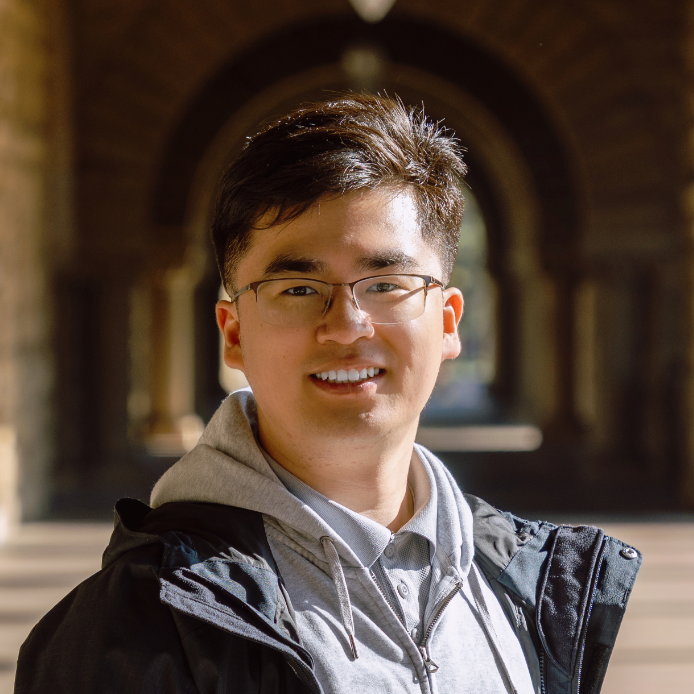
 Qiao Gu
· 4 previous affiliations
- University of TorontoCurrent
- Current
- PhD student · 2021–2026
- Meta (United States)2023–2024
- Intern · 2023–2024
- Carnegie Mellon University2019–2021
- MS student · 2019–2021
- Undergrad student · 2015–2019
Research Overview
Qiao Gu focuses on 3D computer vision, generative models, and robot learning. His work spans from early visual analytics and medical data clustering to the development of structured 3D world models for robotic perception and planning. Currently, he investigates open-vocabulary 3D scene graphs, egocentric video perception, and failure detection for vision-language-action models.
Research Trajectory
Qiao Gu’s early research involved data visualization and applied machine learning for complex datasets. In 2017, he presented PreserVis, a Visual Analytic System for Traffic and Pollution Patterns - Multi-Challenge Award for Compelling Synthesis of Information, which utilized intuitive clustering and novel visualization methods to uncover hidden environmental patterns. He subsequently applied clustering techniques to healthcare data, analyzing patient vital signs and laboratory values in Characterizing Fluid Response and Sepsis Progression in Emergency Department Patients (2019) to better understand the progression of sepsis and the efficacy of fluid bolus therapy in emergency settings.
Transitioning his focus toward 3D computer vision and robotics during his graduate studies, his work began to address the challenges of spatial reasoning and object manipulation. In 2021, he introduced ZePHyR: Zero-shot Pose Hypothesis Rating, a framework for 6D object pose estimation designed to handle entirely new objects without requiring retraining or manual annotation. By learning to score pose hypotheses based on discrepancies between 3D models and sensor data, this work contributed to the research direction of Category-Agnostic Priors for Universal 3D Understanding. Building on the need for real-time perception in robot manipulation, he developed OSSID: Online Self-Supervised Instance Detection by (and for) Pose Estimation (2022). This system leveraged a slower zero-shot pose estimator to self-supervise a fast detection algorithm, significantly improving inference speeds and advancing the area of Low Latency 6D Pose Estimation.
By 2023, his research expanded into semantic 3D mapping and the integration of large vision-language models into spatial representations. He collaborated on ConceptFusion: Open-set Multimodal 3D Mapping, which proposed a scene representation capable of reasoning beyond a pre-defined closed set of concepts. This enabled diverse queries to 3D maps using language, images, or audio. Both ConceptFusion and his earlier work on OSSID align with the broader field of Open Vocabulary 3D Semantic Mapping for Robotics. Alongside his applied robotics research, he also investigated core machine learning challenges, specifically catastrophic forgetting in continual learning. He proposed a novel feature distillation method in Preserving Linear Separability in Continual Learning by Backward Feature Projection (2023), which allows new features to evolve while maintaining linear mappings to their previous versions. This approach preserves the linear separability of old classes and contributes to the research direction of Relational and Structural Knowledge Distillation.
Later in 2023, he addressed the need for semantically rich yet compact world representations for robot planning by presenting ConceptGraphs: Open-Vocabulary 3D Scene Graphs for Perception and Planning. Unlike approaches that rely on dense, per-point feature vectors, ConceptGraphs constructs an open-vocabulary, graph-structured representation of 3D scenes that explicitly encodes semantic spatial relationships between entities, facilitating more scalable downstream planning.
During an internship at Meta Reality Labs, his focus shifted toward egocentric perception in dynamic environments. This led to the development of EgoLifter: Open-World 3D Segmentation for Egocentric Perception (2024). Designed for egocentric data where scenes contain hundreds of objects captured from natural motion, EgoLifter utilizes 3D Gaussians and weak supervision from 2D foundation models to automatically segment scenes into a complete decomposition of individual 3D objects. To handle dynamic elements in the video, the system incorporates transient prediction mechanisms. This work advanced several areas, including Lifting Vision Language Embeddings for 3D Scene Understanding and the domain of Dynamic Object Removal for Static 3D Mapping.
Most recently, his research has targeted the reliability and safety of generalist robot policies. In 2025, he introduced SAFE: Multitask Failure Detection for Vision-Language-Action Models. SAFE operates as a lightweight failure detector that probes the internal latent features of Vision-Language-Action (VLA) models to accurately predict task failures on unseen instructions and environments, providing a scalable safety mechanism for autonomous systems.
Current Directions
Based on his most recent publications, Qiao Gu’s current research investigates the intersection of 3D scene understanding, foundation models, and safe embodied AI. A primary focus is the construction of structured, open-world 3D representations—such as scene graphs and 3D Gaussian splatting—that can parse complex, dynamic environments from egocentric video. By lifting 2D vision-language features into 3D space, this work aims to create spatial memories that are both semantically rich and geometrically precise. Concurrently, he is addressing the critical need for reliability in modern robotic control by developing scalable failure estimation techniques for Vision-Language-Action models, ensuring that generalist policies can safely detect their own operational limits in novel environments.
Profile updated
| Paper | Venue | Year |
|---|---|---|
| SAFE: Multitask Failure Detection for Vision-Language-Action ModelsGitHubvla-safe/ | NeurIPS | 2025 |
Loading new papers…
Other researchers whose papers cluster into the same research directions — a proxy for overlapping technical interests and shared intellectual neighborhoods.
See something wrong? Report a mistake