

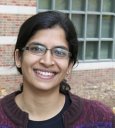
 Preethi Jyothi
· 3 previous affiliations
- Indian Institute of Technology BombaySince 2016
- Associate Professor · Since 2022
- Current
- Assistant Professor · 2016–2022
- Postdoc · 2013–2016
- The Ohio State University2007–2013
- PhD student · 2007–2013
Research Overview
Preethi Jyothi focuses on speech and language technologies for low-resource settings, with an emphasis on linguistic diversity, accents, and code-switching. Her trajectory spans early work in articulatory feature modeling to recent advancements in parameter-efficient training for large language models. Currently, she investigates cross-lingual transfer and robust speech recognition for underrepresented languages.
Research Trajectory
Jyothi’s early research addressed pronunciation variation in conversational speech recognition. She explored context-dependent articulatory feature-based models using dynamic Bayesian networks in Lexical access experiments with context-dependent articulatory feature-based models, building decision trees to better factorize articulatory features. Recognizing the data acquisition bottleneck for statistical speech recognition, she later investigated how to utilize transcribers who are unfamiliar with a target language. In Acquiring Speech Transcriptions Using Mismatched Crowdsourcing, she developed an information-theoretic approach that modeled non-native perception biases as a noisy channel, applying error-correcting codes to extract reliable transcriptions.
Moving into the neural era, her focus expanded to the complexities of multilingualism and mixed-language text. She contributed to the research direction of Modular Parameter Allocation for Multilingual Learning by developing language models specifically tailored for code-switched data. For instance, Code-switched Language Models Using Dual RNNs and Same-Source Pretraining introduced a dual-component recurrent neural network that separately processes each language in a mixed sequence, significantly reducing perplexity. She continued to advance this domain in From Machine Translation to Code-Switching: Generating High-Quality Code-Switched Text.
During this period, she also began probing the limitations of end-to-end models, particularly concerning the area of Linguistic Robustness in Automatic Speech Recognition. With collaborators, she analyzed how accents degrade model performance in How Accents Confound: Probing for Accent Information in End-to-End Speech Recognition Systems. Her work on historically underrepresented languages also took shape with Automatic Speech Recognition in Sanskrit: A New Speech Corpus and Modelling Insights. To further improve resource-scarce tasks across the board, she explored joint learning frameworks in Meta-Learning for Effective Multi-task and Multilingual Modelling, demonstrating that meta-learning combined with intelligent data sampling outperforms traditional multi-task baselines on semantic tasks.
Her subsequent trajectory emphasizes robust speech processing and expanding natural language processing capabilities for extremely low-resource Indian languages. Addressing speech disfluencies, she introduced an adversarial training framework in Adversarial Training for Low-Resource Disfluency Correction, which leverages synthetic and unlabeled data to clean up stuttered speech in languages like Bengali, Hindi, and Marathi. Returning to the challenge of accented speech, she proposed a novel training method in Coupled Training of Sequence-to-Sequence Models for Accented Speech Recognition, adding an L2 loss between intermediate representations of paired utterances to encourage accent invariance.
In 2024, her research tackled the integration of large language models (LLMs) with speech systems. She developed a synchronous aggregation technique in SALSA: Speedy ASR-LLM Synchronous Aggregation, coupling ASR decoder layers directly to an LLM decoder to improve training efficiency without sacrificing decoding speed. She also addressed domain-specific neural machine translation in DictDis: Dictionary Constrained Disambiguation for Improved NMT, focusing on contextually appropriate lexical constraints for polysemous words. Her commitment to regional linguistic diversity is evident in Part-of-speech Tagging for Extremely Low-resource Indian Languages, which built foundational tools for Angika, Magahi, and Bhojpuri. To improve multilingual LLM performance on such languages, she introduced a prompting strategy in In-context Mixing (ICM): Code-mixed Prompts for Multilingual LLMs. Additionally, she expanded into expressive speech synthesis with STORiCo: Storytelling TTS for Hindi with Character Voice Modulation, creating a multi-speaker system capable of switching character voices for children's storytelling.
Most recently, her work investigates parameter-efficient adaptation and end-to-end code-switched translation. In Zero-Shot Cross-Lingual Transfer using Prefix-Based Adaptation, she systematically studied prefix-based methods for decoder-only LLMs, demonstrating their superiority over standard low-rank adaptation across numerous languages. She also developed an end-to-end architecture for translating mixed-language audio in CoSTA: Code-Switched Speech Translation using Aligned Speech-Text Interleaving. Continuing her long-standing interest in classical languages, she contributed to Linguistically informed automatic speech recognition in Sanskrit.
Current Directions
The most recent papers in the evidence point toward two primary research directions: parameter-efficient adaptation of large language models and the development of robust, end-to-end systems for code-switched speech. Recent work investigates how prefix-based adaptation techniques can enable zero-shot cross-lingual transfer in decoder-only LLMs, achieving high performance across dozens of languages with minimal trainable parameters. Concurrently, she is advancing speech translation architectures that interleave speech and text representations to handle code-switched audio, such as Hindi-English mixtures, even when trained on limited synthetic data. Her ongoing research continues to bridge the gap between high-resource NLP paradigms and the complex, multilingual realities of low-resource and regional languages.
Profile updated
Loading new papers…
Other researchers whose papers cluster into the same research directions — a proxy for overlapping technical interests and shared intellectual neighborhoods.
See something wrong? Report a mistake