

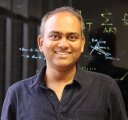
 Pratik Chaudhari
· 7 previous affiliations
- Amazon (United States)Since 2018
- Senior Applied Scientist · Since 2018
- University of PennsylvaniaSince 2019
- Assistant Professor · Since 2019
- California Institute of TechnologySince 2018
- Post-doctoral Researcher · Since 2018
- Postdoc · 2018–2019
- Research Assistant · 2014–2018
- Discover2014–2018
- PhD student · 2014–2018
- nuTonomy2014–2016
- Principal Autonomous Vehicle Engineer · 2014–2016
- Research Assistant · 2010–2014
- Teaching Assistant · 2012
1 other author named Pratik Chaudhari: Pratik Chaudhari (1 paper)
Research Overview
Pratik Chaudhari focuses on the theoretical foundations of deep learning, optimization landscapes, and visual perception in robotics. His trajectory spans early work in continuous-time stochastic control to theoretical insights into how neural networks navigate complex loss landscapes and generalize from high-dimensional data. His most recent research addresses the mechanics of reasoning, context management, and temporal dynamics in large language models.
Research Trajectory
The early phase of Chaudhari’s research focused on continuous-time and continuous-space formulations of stochastic optimal control. He developed Sampling-based algorithms for continuous-time POMDPs (2013), creating a mathematical foundation to approximate continuous-space partially observable Markov decision processes via incremental sampling, ensuring that the optimal cost functions and control policies converged to those of the underlying continuous system.
Moving into the theoretical properties of neural network training, his focus shifted to understanding and manipulating the optimization landscapes of deep learning models. In Trivializing The Energy Landscape Of Deep Networks (2015), he drew on spin glass physics to demonstrate how to transition from a complex, non-convex loss landscape to a simpler one, facilitating faster training. This physical perspective led to the development of Entropy-SGD in Entropy-SGD: Biasing Gradient Descent Into Wide Valleys (2017), an optimization algorithm utilizing Langevin dynamics to steer training toward flat regions of the loss landscape associated with superior generalization. This work directly advanced the broader research direction of Loss Landscape Flatness and the Generalization Gap. Further investigating the implicit properties of optimization, he demonstrated in Stochastic gradient descent performs variational inference, converges to limit cycles for deep networks (2018) that stochastic gradient descent does not merely minimize a loss function but performs implicit variational inference. Because gradient noise in deep networks is highly non-isotropic, he showed that the optimizer orbits critical points in deterministic limit cycles rather than settling at a single minimum.
Expanding into how models adapt to new environments and tasks, Chaudhari and collaborators explored off-policy algorithms for meta-reinforcement learning. In Meta-Q-Learning (2020), they utilized past trajectory context variables and multi-task objectives to recycle data from meta-training replay buffers. He also collaborated on connecting machine learning to thermodynamics to characterize representation quality in A Free-Energy Principle for Representation Learning (2020). In the area of Transfer Learning via Fixed Feature Extraction, his collaborative work helped establish strong baselines by fine-tuning transductively in A Baseline for Few-Shot Image Classification (2020), which also provided insights into the area of The Transductive Batch Dependency in Sequential Inference. Recognizing the practical challenges of adaptation, his group re-examined standard practices in Rethinking the Hyperparameters for Fine-tuning (2020), contributing to the broader field of Hyperparameter Sensitivity in Complex Machine Learning Frameworks by demonstrating how momentum significantly affects fine-tuning outcomes.
Subsequent work investigated the intrinsic geometry of data and its relationship to model capacity. In Does the Data Induce Capacity Control in Deep Learning? (2022), he showed that the "sloppiness" of real-world datasets—where a few dimensions dominate—is mirrored in a network's internal geometry, effectively shrinking its capacity and explaining benign overfitting. This advanced the research direction of Overcoming the Hessian Dimensionality Bottleneck. He further visualized the geometry of learning in A Picture of the Space of Typical Learnable Tasks (2023), revealing that diverse learning methods organize along a low-dimensional manifold reflecting real-world hierarchical structures. Concurrently, he formalized the use of objective Bayesian reference priors to maximize mutual information between tasks and model weights in Deep Reference Priors: What is the best way to pretrain a model? (2022). Outside of deep learning, he also modeled multi-agent interactions in A Model for Perimeter-Defense Problems with Heterogeneous Teams (2022), using biological immune system analogies to optimize resource allocation against diverse attackers.
Most recently, his research has addressed dynamic environments and the mechanics of large language models. Moving beyond static assumptions, he introduced a framework for dynamic environments in Prospective Learning: Learning for a Dynamic Future (2024), enabling models to anticipate future shifts and converge to optimal performance, contributing to the area of Learning in Non-Stationary Data Streams. In the domain of sequence modeling, he introduced specialized tokens and a meta-attention mechanism in Learned Meta-Tokens for Language Modeling (2026) to compress preceding information, allowing Transformers to handle extended context windows. He also analyzed the mathematical scaling laws of reasoning in How does Chain of Thought decompose complex tasks? (2026), demonstrating that there is an optimal depth for task decomposition before excessive generation degrades performance.
Current Directions
Recent work investigates the temporal dynamics of learning and the internal reasoning mechanisms of large language models. A major focus is on moving beyond static, independent and identically distributed (IID) assumptions to develop frameworks that can anticipate and adapt to non-stationary distribution shifts in dynamic environments. Concurrently, ongoing research addresses the architectural and algorithmic challenges of sequence modeling. This includes developing methods to efficiently manage long-range context in Transformers through specialized attention mechanisms and memory compression. Additionally, current efforts seek to mathematically formalize how large reasoning models decompose complex tasks, identifying the theoretical limits and optimal scaling laws of techniques like Chain of Thought prompting to prevent performance degradation from over-generation.
Profile updated
Loading new papers…
Other researchers whose papers cluster into the same research directions — a proxy for overlapping technical interests and shared intellectual neighborhoods.
See something wrong? Report a mistake