

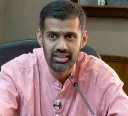
 Prathosh AP
· 2 previous affiliations
- Indian Institute of Science BangaloreSince 2021
- Assistant Professor · Since 2021
- Indian Institute of Technology Delhi2017–2021
- Assistant Professor · 2017–2021
Research Overview
Prathosh AP focuses on deep representational learning, signal processing, and cross-domain generalization, applying these methods to computer vision and physical systems. His trajectory spans early work in temporal data analysis and physiological monitoring to recent advancements in generative models and neural operators. Currently, his research emphasizes machine unlearning, automated symmetry discovery, and physics-informed machine learning.
Research Trajectory
Prathosh's early research concentrated on temporal data analysis and signal processing. In the domain of speech analysis, he introduced Epoch Extraction Based on Integrated Linear Prediction Residual Using Plosion Index, developing a non-linear temporal measure to identify significant excitation instants without requiring dynamic programming or prior pitch information. Moving into healthcare analytics and remote sensing, he developed frameworks for noncontact vital sign estimation. This work included Estimation of Respiratory Pattern From Video Using Selective Ensemble Aggregation, which advanced the research direction of Mitigating Motion and Lighting Artifacts in Remote Photoplethysmography by extracting periodic signals from noisy video channels.
Building on his expertise in video analytics and healthcare, Prathosh co-founded Cogniable.Tech, a startup focused on behavioral healthcare. In this context, his lab developed Guided Weak Supervision for Action Recognition with Scarce Data to Assess Skills of Children with Autism, leveraging large-scale public datasets and directional regularization to automate motor skill assessment even when clinical training data is highly limited. To deploy such video recognition models efficiently on edge devices, he directed research into network compression, utilizing variational information bottlenecks in A Variational Information Bottleneck Based Method to Compress Sequential Networks for Human Action Recognition. He also addressed the challenge of cross-domain robustness with Generalization on Unseen Domains via Inference-Time Label-Preserving Target Projections, proposing a method that actively uses target samples during inference to cluster features irrespective of domain shifts.
Concurrently, Prathosh investigated the latent spaces of deep generative models. He contributed to the area of Automatic Latent Dimension Pruning with MaskAAE: Latent space optimization for Adversarial Auto-Encoders, addressing training instability in generative architectures. Collaborating on FlexAE: flexibly learning latent priors for wasserstein auto-encoders, he advanced the broader direction of Expressive Latent Priors for Generative Models by introducing a learnable prior combined with adversarial smoothing to resolve prior mismatch problems. This interest in generative architectures later extended to mitigating catastrophic forgetting in sequential learning, as demonstrated in Lifelong Learning in StyleGAN through Latent Subspaces, which utilized task-specific dictionaries to learn diverse datasets efficiently.
A major theme in his recent trajectory is the Automated Discovery of Data Symmetries. Rather than assuming symmetries a priori, he co-authored Neural Discovery of Permutation Subgroups to learn underlying group structures directly from data. He expanded this framework in Learning Equivariant Functions via Quadratic Forms, which simultaneously discovers symmetry groups and learns equivariant functions. This line of inquiry culminated in Interpretable Discovery of One-parameter Subgroups: A Modular Framework for Elliptical, Hyperbolic, and Parabolic Symmetries, embedding physical symmetries into neural architectures to extract exact mathematical generators for provable interpretability.
Building on physics-informed machine learning, Prathosh has developed novel neural operators for partial differential equations (PDEs). This includes the Latent Mamba Operator for Partial Differential Equations, which combines the efficiency of state-space models with kernel integral formulations, and CoNO: Complex neural operator for continous dynamical physical systems, which leverages complex-valued networks and the Fractional Fourier Transform for non-stationary systems. He also applied physics-informed constraints to computer vision in MANTA: Physics-Informed Generalized Underwater Object Tracking, integrating Beer-Lambert law-based augmentations to handle color absorption and scattering in marine environments.
Most recently, his lab has heavily focused on model safety, contributing extensively to the area of Preserving Model Utility During Machine Unlearning. He introduced Concept Forgetting via Label Annealing to iteratively remove undesired concepts without degrading overall performance. Addressing the challenge of Machine Unlearning Without Original Training Data, he developed Adapt then Unlearn: Exploring Parameter Space Semantics for Unlearning in Generative Adversarial Networks and Unlearning in Diffusion models under Data Constraints: A Variational Inference Approach, enabling the targeted removal of features from pre-trained image generators. He has also extended these trustworthiness principles to large language models in Enhancing Trustworthiness of Fine-Tuned LLMs via Regularized Subset Selection, proposing a surgical repair method to neutralize the influence of specific training samples responsible for biased or untruthful outputs.
Current Directions
The most recent papers in the evidence indicate a strong focus on trustworthy AI, specifically through machine unlearning and model repair. This includes developing techniques to remove undesired concepts from generative models and large language models without requiring full retraining data or sacrificing overall utility. Concurrently, ongoing work investigates physics-informed machine learning and neural operators, designing architectures like the Latent Mamba Operator and complex-valued networks to efficiently solve partial differential equations. A third major direction involves the automated discovery of mathematical and physical symmetries from data, creating interpretable frameworks that learn equivariant functions directly from underlying group structures.
Profile updated
Loading new papers…
Other researchers whose papers cluster into the same research directions — a proxy for overlapping technical interests and shared intellectual neighborhoods.
See something wrong? Report a mistake