

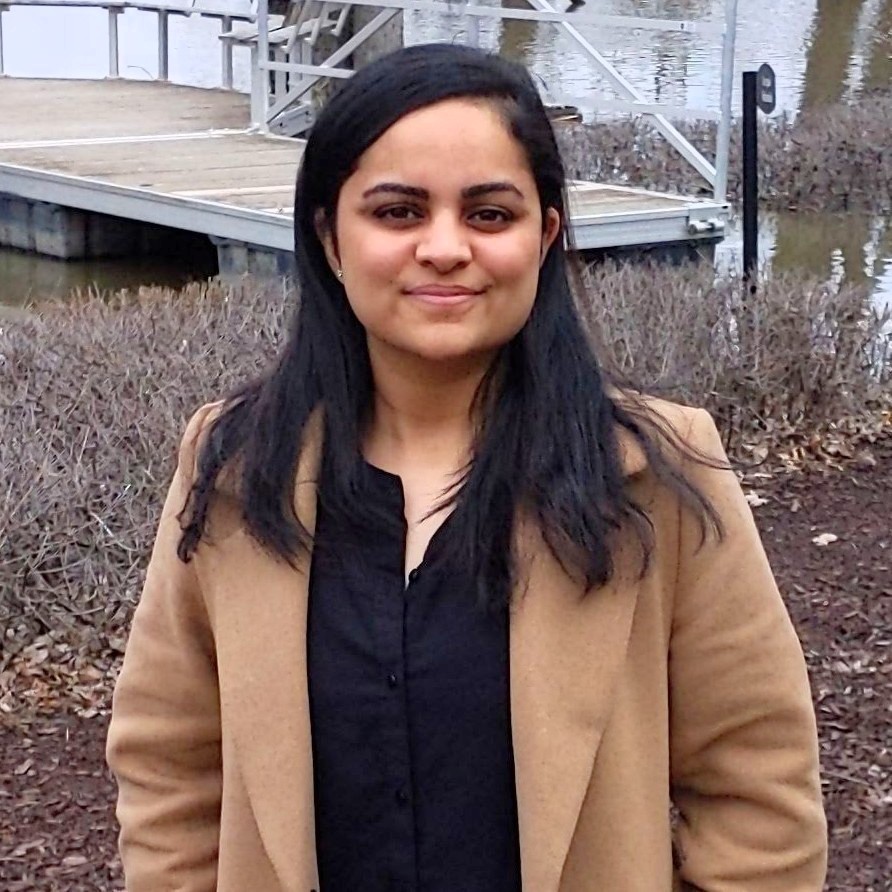
 Pratheeksha Nair
· 6 previous affiliations
- Royal Bank of CanadaSince 2026
- Research Engineer II · Since 2026
- Researcher · 2025–2026
- McGill University2019–2025
- PhD student · 2019–2025
- Student Researcher · 2018–2019
- Master of Technology - MTech, IT · 2014–2019
- Intern · 2016–2018
- IIITB2014–2019
- MS student · 2018–2019
- Undergrad student · 2014–2019
- Summer Intern · 2018
Research Overview
Pratheeksha Nair focuses on visual analytics, applied natural language processing, and the evaluation of large language models. Her early work centers on developing interactive visualization tools and data extraction pipelines to assist domain experts in combating human trafficking. Most recently, her research has expanded to address epistemic calibration and the linguistic assertiveness of generative AI systems.
Research Trajectory
Nair's published research trajectory begins with a focus on applied data science and visual analytics for social good, specifically in the domain of anti-human trafficking efforts. As the first author of VisPaD: Visualization and Pattern Discovery for Fighting Human Trafficking (2022), she led the development of an interactive system designed in close collaboration with domain experts. The tool addresses the complex task of analyzing "micro-clusters" of related online escort advertisements, allowing analysts to visualize geographical spread, cluster sizes, and linked metadata to detect suspicious activities and identify operational patterns.
In 2023, Nair continued to contribute to the anti-trafficking domain through collaborative projects spanning both natural language processing and visual analytics. She was a co-author on SWEET - Weakly Supervised Person Name Extraction for Fighting Human Trafficking, which proposed a weak supervision pipeline to extract person names from noisy escort advertisements. This work addressed the challenge of limited labeled data by combining rule-matching with large language models treated as weak labels. In parallel, she contributed to TrafficVis: Visualizing Organized Activity and Spatio-Temporal Patterns for Detecting and Labeling Human Trafficking, another participatory design project aimed at providing law enforcement with intuitive interfaces for cluster-level detection and evidence analysis.
By 2024, Nair's collaborative research expanded into the domain of artificial intelligence safety and model evaluation. She contributed to Epistemic Integrity in Large Language Models, a study confronting the problem of epistemic miscalibration—instances where a model's linguistic assertiveness does not align with its actual internal certainty. This work introduced a novel human-labeled dataset and a methodology for measuring linguistic assertiveness, highlighting the risks of generative models producing false statements with high confidence.
Current Directions
Based on the most recent papers in the evidence, Nair's current research interests include the safety, reliability, and evaluation of large language models. Recent work investigates the epistemic integrity of generative AI, focusing on how models communicate certainty and the misalignment between their linguistic assertiveness and internal confidence. This direction addresses critical challenges in AI deployment, aiming to mitigate the risks associated with models generating misleading information with unwarranted confidence.
Profile updated
Loading new papers…
Other researchers whose papers cluster into the same research directions — a proxy for overlapping technical interests and shared intellectual neighborhoods.
See something wrong? Report a mistake